US4776111A - Footwear stabilizer - Google Patents
Footwear stabilizer Download PDFInfo
- Publication number
- US4776111A US4776111A US06/900,740 US90074086A US4776111A US 4776111 A US4776111 A US 4776111A US 90074086 A US90074086 A US 90074086A US 4776111 A US4776111 A US 4776111A
- Authority
- US
- United States
- Prior art keywords
- collar
- shoe
- ankle
- opening
- stiff
- Prior art date
- Legal status (The legal status is an assumption and is not a legal conclusion. Google has not performed a legal analysis and makes no representation as to the accuracy of the status listed.)
- Expired - Lifetime
Links
Images

Classifications
-
- A—HUMAN NECESSITIES
- A43—FOOTWEAR
- A43B—CHARACTERISTIC FEATURES OF FOOTWEAR; PARTS OF FOOTWEAR
- A43B7/00—Footwear with health or hygienic arrangements
- A43B7/14—Footwear with health or hygienic arrangements with foot-supporting parts
- A43B7/1405—Footwear with health or hygienic arrangements with foot-supporting parts with pads or holes on one or more locations, or having an anatomical or curved form
- A43B7/1415—Footwear with health or hygienic arrangements with foot-supporting parts with pads or holes on one or more locations, or having an anatomical or curved form characterised by the location under the foot
- A43B7/142—Footwear with health or hygienic arrangements with foot-supporting parts with pads or holes on one or more locations, or having an anatomical or curved form characterised by the location under the foot situated under the medial arch, i.e. under the navicular or cuneiform bones
-
- A—HUMAN NECESSITIES
- A43—FOOTWEAR
- A43B—CHARACTERISTIC FEATURES OF FOOTWEAR; PARTS OF FOOTWEAR
- A43B5/00—Footwear for sporting purposes
-
- A—HUMAN NECESSITIES
- A43—FOOTWEAR
- A43B—CHARACTERISTIC FEATURES OF FOOTWEAR; PARTS OF FOOTWEAR
- A43B7/00—Footwear with health or hygienic arrangements
- A43B7/14—Footwear with health or hygienic arrangements with foot-supporting parts
-
- A—HUMAN NECESSITIES
- A43—FOOTWEAR
- A43B—CHARACTERISTIC FEATURES OF FOOTWEAR; PARTS OF FOOTWEAR
- A43B7/00—Footwear with health or hygienic arrangements
- A43B7/14—Footwear with health or hygienic arrangements with foot-supporting parts
- A43B7/18—Joint supports, e.g. instep supports
- A43B7/20—Ankle-joint supports or holders
-
- A—HUMAN NECESSITIES
- A61—MEDICAL OR VETERINARY SCIENCE; HYGIENE
- A61F—FILTERS IMPLANTABLE INTO BLOOD VESSELS; PROSTHESES; DEVICES PROVIDING PATENCY TO, OR PREVENTING COLLAPSING OF, TUBULAR STRUCTURES OF THE BODY, e.g. STENTS; ORTHOPAEDIC, NURSING OR CONTRACEPTIVE DEVICES; FOMENTATION; TREATMENT OR PROTECTION OF EYES OR EARS; BANDAGES, DRESSINGS OR ABSORBENT PADS; FIRST-AID KITS
- A61F5/00—Orthopaedic methods or devices for non-surgical treatment of bones or joints; Nursing devices; Anti-rape devices
- A61F5/01—Orthopaedic devices, e.g. splints, casts or braces
- A61F5/0102—Orthopaedic devices, e.g. splints, casts or braces specially adapted for correcting deformities of the limbs or for supporting them; Ortheses, e.g. with articulations
- A61F5/0127—Orthopaedic devices, e.g. splints, casts or braces specially adapted for correcting deformities of the limbs or for supporting them; Ortheses, e.g. with articulations for the feet
Definitions
- the invention is related to support structures for shoes, and more particularly to stabilizers for footwear.
- U.S. Pat. No. 2,165,879 to Wilkinson, July 11, 1939 for "Ankle Support” describes a laced canvas and ribbed support which encircles the heel and rear of the foot and is laced in front about the ankle inside the shoe to lend support to the ankle.
- U.S. Pat. No. 2,444,428 to Carrier, July 6, 1948, for "Shoe For Sports And The Like” proposes relatively independent upper and lower parts which are separately laced, the upper part being laced both front and back.
- the Carrier patent also describes a lateral shell of thick and rigid leather on each side to encase the ankle and affixed to an upper part pivotally fixed to a lug below the outside by a rivet.
- Ankle Support Device describes a device worn over the wear ing boot.
- This device includes a tongue attached to an ankle strap, or to the ankle portion of the boot, and at the lower device part to a heel plate. Between these connections and about the ankle is a pair of cooperatting ring portions encircling the ankle (malleoli) allowing rotation of the upper part about the lateral axis of the ankle bone by the cooperating ring ceters, but resisting rotation about a longitudinal axis.
- U.S. Pat. No. 3,613,271 to Geller for "Reshapeable Boot or Shoe and Method of Reshaping” describes an elastic support anchored laterally to the wearer's shoe near the sole below the ankle and connected laterally above the ankle. This elastic support biases the foot against "turning of the ankle” by tending to prevent stretching of the outer ankle tendons, being under tension when such stretching begins.
- U.S. Pat. No. 3,970,083 to Carrigan, et al, July 10, 1976, for "Ankle Support” suggests a pliable single piece jacket fitted and laced inside the shoe about foot and ankle by conventional lacing.
- the jacket encloses on opposite sides elongated stiffening strips in a generally inverted T shape, the inverted base of the T being generally vertically along the leg, the intersection of the T being below the ankle. These strips are aligned generally with the key natural ligaments of the ankle, especially the lateral side of the ankle, whereby the strips reinforce these ligaments.
- U.S. Pat. No. 4,441,265 to Burns, et al, Apr. 10, 1984 is intended to inhibit ankle injuries by a "high cut" athletic boot.
- a band of stretchable material is anchored at the outside of the boot rearwardly over the dorsal surface of the shoe to the inside of the ankle where it is fastened under tension above the ankle.
- This band is intended to place the foot in a slightly valgus position reducing stress on the major ligaments yet permitting normal pronation and supination of the forefoot and plantar flexion and dorsiflexion of the foot.
- a protective device comprising a foot plate from the heel portion over the arch, and ankle sleeve with fastening means and fixed around the ankle portion of the foot, and nonextensible flexible connections arranged to connect the ankle sleeve on both sides of the foot to the foot plate, to prevent sideways overstretching movements.
- an athletic shoe comprises a sole, an upper having an opening, and a tongue to complete the opening.
- the shoe has means for closing the opening about the foot, and exterior stabilizer means comprising a collar compliant about the ankle above the malleoli and stiff in the vertical direction, and a pair of stiff elements attached to and pivoted about pivot points on opposite sides of the foot below the malleoli and each extending upwards from the pivot points to join the collar.
- the collar is tightened and joined at the front by the closing means, preferably a lacing through registering grommets and eyelets in the collar and upper respectively.
- the collar is also stiffened vertically.
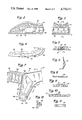
- FIG. 1 is a side view of a shoe embodying the invention with attached exterior stabilizer means;
- FIG. 2 is a side view of a portion of the shoe of FIG. 1;
- FIG. 3 is a rear view of the portion of FIG. 2;
- FIG. 4 is a half of a top view of the shoe of FIG. 3 with the exterior stabilizer means partially removed;
- FIG. 5 is a sectional view along the lines 5--5 of FIG. 2;
- FIG. 6 is a sectional view along the lines 6--6 of FIG. 3;
- FIG. 7 is a half-view of an element of the shoe of FIG. 1 expanded
- FIGS. 8, 9, 10, and 11 are, respectively, views along the section lines 8--8, 9--9, 10--10, and 11--11 of FIG. 7;
- FIG. 12 is a sectional view of a screw fastening of FIG. 1 along the lines 12--12 of FIG. 1.
- an athletic shoe 13 comprises a sole 14, an upper 15 attached to the sole 14 to enclose the foot, and a front opening 16 from low in front to the top of the upper to permit entry of the foot.
- a tongue 18 fills the opening 16 from below the opening 16 to above the top 17.
- the shoe may be lined in whole, or in part, (not shown) and may have a toe cap 31.
- the athletic shoe 13 serves as a tennis shoe and has in the bottom 19 of the sole 14, a suitable pattern of indentations 20 to afford additional traction for the wearer.
- the sole 14 may be made of a resin based material.
- the upper 15 may be made of a real, synthetic or imitation leather, or all or part of canvas.
- An overlay 21 of leather which may also be real or imitation leather provides an attractive pattern and additional wear protection, as, for example, the pattern 22 at the edge of the opening 14 for the lacings 23 for closing the opening 16 over the tongue 18.
- the lacings 23 may be laced in customary fashion through lower openings or eyelets 25, thence through grommets 24, and thence through the two upper openings or eyelets 26 in the lower part of the upper 15, and thence through the openings or eyelets 27 in the top part of the upper 15 in a manner to be explained.
- an exterior stabilizer means 28 comprising a band or collar 29, compliant about the ankle but stiff vertically which encircles the ankle well above the malleoli.
- the collar 29 terminates at a front opening 30 and carries at the opening 30 grommets 32 for receiving the lacings 23.
- the grommets 32 on being laced register with the uppermost eyelets 27 of the shoe 13.
- a pair of stiff elements 34 extend vertically from pivot joints well below and a little back of the malleoli upwards to join the collar 29 with which the elements 34 are integral.
- a molded stiff support 50 is fastened to part of the upper by stitching at the margins and also by adhesive, or the like, or both, extending about the heel and forward approximately to the instep on each side of the foot, thereby providing a stiff quarter for the shoe and protecting the achilles tendon and the heel bone.
- the support 50 is manufactured symmetrically about a center line indicated as the line 6--6 in FIG. 3 along which the section is taken, and thus FIG. 6 shows one-half of the support.
- Molded integrally with the support 50 is a raised circular portion 51 having a central axis 52.
- the post 47 is imbedded irrotationally in portion 51 by a spider 53, or the like, as by two wings 54, for example, which appear in FIG. 5.
- the rearmost portion of support 50 may be slightly lowered as at 55 for comfort of the achilles tendon.
- a thickened support plate 56 extends about the lower part of the quarter to near the malleoli. The support 50 and the support plate 56 strengthen the quarter and stiffen it to protect the achilles tendon and because the support 50 is also connected to pivot the stiff vertical elements 34 contributes to the protection against turning of the ankle.
- the pins 45 When the pins 45 are inserted and screwed into the stems 47 attaching the support 50 on each side, the pins 45 center the aperture 39 of the vertical stiffening member or elements 34, as they are slightly countersunk in indented inner rim 40 coaxially with axis 52 and 35 on each side. Even though the pin 40 is screwed tightly into stem 47, a light play admits of rotation of the exterior stabilizer elements 34 about these axis.
- the top portion 57 of the upper 15 which lies under the collar 29 and against the ankle, when it is closed, that is, all above the line 58 is made of a soft, thicker material, fabric material to cushion the ankle against the closure of the collar 29.
- This top portion 57 somewhat wrinkles, as shown in FIG. 4 at 59, for example, when the collar 29 is drawn tight.
- the joining at 58 may be by stitching or adhesive, or both. The stitching in general of the different parts of the upper 15, and of the upper 15 to the sole 14, are not illustrated.
- the seller's name or emblem, or other legend may appear as in raised format on the thickened support 56, or on other parts of the shoe as indicated at 62, in raised letter or otherwise.
- the wearer may insert his foot into the shoe with the laces loose or unthreaded. The wearer then threads the laces criss-crossing in the usual manner up through eyelets 25, grommets 24, and eyelets 26. At the top three pairs of eyelets 27, and grommets 32, the laces pass in each case through the registering eyelet 27 and grommet 32. The wearer now pulls the laces tight and the collar 29 encircles the soft top portion 57 of the upper 15 (upper-most part).
- the stiff vertical elements 34 are of course pivoted about the pivot points, or pivots 52.
- the foot is encased in a manner generally to inhibit premature pronation, not only by virtue of the vertical elements 34 connected to the collar 29, but by the stiffness against turning of the collar itself, to which the stiffness of the stiffening braces or vertical plates 38 further contribute.
- the vertical stiffness of the collar is enhanced because of its vertical dimension and because of its vertical stiffening plates 38.
- the support 50 covers and protects the achilles tendon, and by its stiffness provides a stiff quarter that contributes to preventing twisting of the foot encased in this protective shoe, and tends to prevent rotation about a longitudinal axis of the foot though permitting usual rotation about a transverse axis.
- the shoe also affords the wearer an effective protection against injury to the ankle and foot.
- the shoe is designed and intended for use as a tennis shoe, its principles of construction may be employed in other footwear where premature pronation is to be prevented.
Abstract
Description
Claims (8)
Priority Applications (2)
| Application Number | Priority Date | Filing Date | Title |
|---|---|---|---|
| US06/900,740 US4776111A (en) | 1986-08-27 | 1986-08-27 | Footwear stabilizer |
| KR870001057A KR880002478A (en) | 1986-08-27 | 1987-02-10 | Shoe ball |
Applications Claiming Priority (1)
| Application Number | Priority Date | Filing Date | Title |
|---|---|---|---|
| US06/900,740 US4776111A (en) | 1986-08-27 | 1986-08-27 | Footwear stabilizer |
Publications (1)
| Publication Number | Publication Date |
|---|---|
| US4776111A true US4776111A (en) | 1988-10-11 |
Family
ID=25413021
Family Applications (1)
| Application Number | Title | Priority Date | Filing Date |
|---|---|---|---|
| US06/900,740 Expired - Lifetime US4776111A (en) | 1986-08-27 | 1986-08-27 | Footwear stabilizer |
Country Status (2)
| Country | Link |
|---|---|
| US (1) | US4776111A (en) |
| KR (1) | KR880002478A (en) |
Cited By (56)
| Publication number | Priority date | Publication date | Assignee | Title |
|---|---|---|---|---|
| US4947560A (en) * | 1989-02-09 | 1990-08-14 | Kaepa, Inc. | Split vamp shoe with lateral stabilizer system |
| US4972613A (en) * | 1989-10-10 | 1990-11-27 | Wolverine World Wide, Inc. | Rear entry athletic shoe |
| WO1991007889A1 (en) * | 1989-12-05 | 1991-06-13 | Alfa Skofabrik A/S | Device for cross-country ski boot |
| US5072529A (en) * | 1988-02-19 | 1991-12-17 | Graf & Co. Sportschuhfabrik Kreuzlingen | Ice skate |
| US5109613A (en) * | 1989-06-21 | 1992-05-05 | Ronin, Inc. | Shoe with integral ankle support |
| US5125171A (en) * | 1990-08-10 | 1992-06-30 | Stewart Douglas J | Shoe with spring biased upper |
| EP0521288A1 (en) * | 1991-07-04 | 1993-01-07 | Salomon S.A. | Walking shoe with reinforcement of an articulated shaft collar |
| US5317820A (en) * | 1992-08-21 | 1994-06-07 | Oansh Designs, Ltd. | Multi-application ankle support footwear |
| US5400529A (en) * | 1992-08-21 | 1995-03-28 | Oansh Designs, Ltd. | Sports medicine shoe |
| EP0748596A1 (en) * | 1995-06-14 | 1996-12-18 | NORDICA S.p.A. | Ankle supporting device, particularly for sports shoes |
| US5678330A (en) * | 1989-06-21 | 1997-10-21 | Nki-Tm, Inc. | Shoe with integral ankle support and improved ankle brace apparatus |
| US5771608A (en) * | 1996-09-17 | 1998-06-30 | K-Swiss Inc. | Shoe with ankle strap protector |
| US5943793A (en) * | 1998-06-02 | 1999-08-31 | Columbia Insurance Company | Shoe or boot with adjustable ankle collar |
| US6000148A (en) * | 1997-06-27 | 1999-12-14 | Salomon S.A. | Multi-layered sole coupled to a reinforcement of the upper of the boot |
| US6139030A (en) * | 1993-07-19 | 2000-10-31 | K-2 Corporation | In-line roller skate |
| US6168172B1 (en) | 1993-07-19 | 2001-01-02 | K-2 Corporation | In-line roller skate |
| US6178665B1 (en) | 1997-06-12 | 2001-01-30 | Macpod Enterprises Ltd. | Fit and support system for the foot |
| US6715218B2 (en) | 2002-02-12 | 2004-04-06 | Adidas International B.V. | Unidirectional support device |
| US20050138846A1 (en) * | 2003-12-31 | 2005-06-30 | O'connor Michael J. | Shoe heel protector |
| US20060084899A1 (en) * | 2004-10-04 | 2006-04-20 | Verkade Drew R | Hinged ankle brace |
| US20060145434A1 (en) * | 2002-08-27 | 2006-07-06 | Crowder Troy S | Adjustable hockey skate blade system |
| US20060205303A1 (en) * | 2005-03-08 | 2006-09-14 | Adidas International Marketing B.V. | Protective element |
| US20090293310A1 (en) * | 2008-05-29 | 2009-12-03 | Nike, Inc. | Article of Footwear with Arch Wrap |
| US20110119959A1 (en) * | 2009-11-25 | 2011-05-26 | Keith Bodner | External stabilizing structure for work boots |
| US8037549B2 (en) | 2003-10-30 | 2011-10-18 | Adidas International Marketing B.V. | Reinforcing element |
| US8341763B2 (en) | 2005-03-30 | 2013-01-01 | Adidas International Marketing B.V. | Reinforcing element |
| US8490215B2 (en) | 2005-03-30 | 2013-07-23 | Adidas International Marketing B.V. | Reinforcing element |
| US8813262B2 (en) | 2011-02-14 | 2014-08-26 | Adidas Ag | Wrist protector for a sport glove |
| US20140243724A1 (en) * | 2011-11-01 | 2014-08-28 | Honeywell International Inc. | Ankle stabilization/sprain prevention in a shoe |
| US20150040433A1 (en) * | 2013-08-09 | 2015-02-12 | Oped Ag | Orthopedic shoe for preventing excess pressure loads |
| US9095190B2 (en) | 2012-03-22 | 2015-08-04 | Nike, Inc. | Sole structure configured to allow relative heel/forefoot motion |
| US9936759B2 (en) | 2012-03-22 | 2018-04-10 | Nike, Inc. | Footwear and foot support member configured to allow relative heel/forefoot motion |
| US20180110292A1 (en) * | 2016-10-26 | 2018-04-26 | Nike, Inc. | Footwear heel spring device |
| US10098776B2 (en) | 2013-10-29 | 2018-10-16 | Gary Zaccaria | Multi-directional support system with flex support bars for use on footwear |
| CN109419097A (en) * | 2017-08-28 | 2019-03-05 | 普罗艾德温特有限责任公司 | Ski boots dynamic support band |
| USD848137S1 (en) | 2017-08-28 | 2019-05-14 | ProAdvent LLC | Retention element for ski boot liner |
| USD858083S1 (en) | 2018-09-13 | 2019-09-03 | Nike, Inc. | Shoe |
| USD860625S1 (en) | 2018-09-13 | 2019-09-24 | Nike, Inc. | Shoe |
| US10512298B2 (en) | 2017-05-23 | 2019-12-24 | Nike, Inc. | Footwear upper with lace-engaged zipper system |
| US10568382B2 (en) | 2016-10-26 | 2020-02-25 | Nike, Inc. | Upper component for an article of footwear |
| US10602802B2 (en) | 2016-10-26 | 2020-03-31 | Nike, Inc. | Hinged footwear sole structure for foot entry and method of manufacturing |
| US10687586B2 (en) | 2017-05-25 | 2020-06-23 | Nike, Inc. | Rear closing upper for an article of footwear with front zipper to rear cord connection |
| US10743616B2 (en) * | 2016-10-26 | 2020-08-18 | Nike, Inc. | Footwear heel spring device |
| US10758010B2 (en) | 2017-04-17 | 2020-09-01 | Nike, Inc. | Increased access footwear |
| US10827803B2 (en) | 2018-04-13 | 2020-11-10 | Nike, Inc. | Footwear fastening system |
| USD915745S1 (en) * | 2019-10-24 | 2021-04-13 | Nike, Inc. | Shoe |
| US11172727B2 (en) | 2017-05-23 | 2021-11-16 | Nike, Inc. | Rear access article of footwear with movable heel portion |
| US11185125B2 (en) | 2018-12-28 | 2021-11-30 | Nike, Inc. | Footwear with jointed sole structure for ease of access |
| US11191321B2 (en) | 2019-02-13 | 2021-12-07 | Nike, Inc. | Footwear heel support device |
| US11191320B2 (en) | 2018-12-28 | 2021-12-07 | Nike, Inc. | Footwear with vertically extended heel counter |
| US11304479B2 (en) | 2017-02-28 | 2022-04-19 | Nike, Inc. | Footwear with laceless fastening system |
| US11464287B2 (en) | 2018-12-28 | 2022-10-11 | Nike, Inc. | Footwear element with locating pegs and method of manufacturing an article of footwear |
| US11497271B2 (en) * | 2020-02-05 | 2022-11-15 | Se-Ho OH | Shoes |
| US11589653B2 (en) | 2019-11-25 | 2023-02-28 | Nike, Inc. | Tension-retaining system for a wearable article |
| US11707113B2 (en) | 2019-10-18 | 2023-07-25 | Nike, Inc. | Easy-access article of footwear with cord lock |
| US11910867B2 (en) | 2022-03-28 | 2024-02-27 | Nike, Inc. | Article of footwear with heel entry device |
Citations (13)
| Publication number | Priority date | Publication date | Assignee | Title |
|---|---|---|---|---|
| US660885A (en) * | 1900-06-09 | 1900-10-30 | Arthur J Brauer | Ankle-brace. |
| US1084197A (en) * | 1912-05-04 | 1914-01-13 | Henry James Collis | Ankle support and protector. |
| US2444428A (en) * | 1942-06-03 | 1948-07-06 | Carrier Marcel | Shoe for sports and the like |
| US3494054A (en) * | 1968-06-27 | 1970-02-10 | Robert B Lange | Athletic boot combination |
| US3538627A (en) * | 1968-03-07 | 1970-11-10 | Andre Pierre Honore | Footwear equipment unit for skiing and other purposes |
| US3636642A (en) * | 1969-10-20 | 1972-01-25 | Helmut Walther | Ski boot |
| DE2606800A1 (en) * | 1976-02-19 | 1977-08-25 | Adolf Dassler | SPORTSHOE FOR RUNNING GAMES, IN PARTICULAR FOOTBALL SHOES |
| FR2527427A1 (en) * | 1982-05-28 | 1983-12-02 | Patrick Sa | Basket ball shoe with inner reinforcement - is semi rigid with hollow for ankle bone and notches for flexing |
| US4459765A (en) * | 1981-09-29 | 1984-07-17 | Power-Soler, Inc. | Heel-counter stabilizer |
| US4470205A (en) * | 1980-08-13 | 1984-09-11 | Warrington Inc. | Two piece skate boot with integral hinge pin |
| US4571856A (en) * | 1984-05-21 | 1986-02-25 | Autry Industries, Inc. | Double laced athletic shoe |
| US4625435A (en) * | 1983-09-01 | 1986-12-02 | Nippon Rubber Co., Ltd. | Sports shoe |
| US4676011A (en) * | 1985-05-16 | 1987-06-30 | Converse Inc. | Athletic shoe with Y support |
-
1986
- 1986-08-27 US US06/900,740 patent/US4776111A/en not_active Expired - Lifetime
-
1987
- 1987-02-10 KR KR870001057A patent/KR880002478A/en not_active Application Discontinuation
Patent Citations (13)
| Publication number | Priority date | Publication date | Assignee | Title |
|---|---|---|---|---|
| US660885A (en) * | 1900-06-09 | 1900-10-30 | Arthur J Brauer | Ankle-brace. |
| US1084197A (en) * | 1912-05-04 | 1914-01-13 | Henry James Collis | Ankle support and protector. |
| US2444428A (en) * | 1942-06-03 | 1948-07-06 | Carrier Marcel | Shoe for sports and the like |
| US3538627A (en) * | 1968-03-07 | 1970-11-10 | Andre Pierre Honore | Footwear equipment unit for skiing and other purposes |
| US3494054A (en) * | 1968-06-27 | 1970-02-10 | Robert B Lange | Athletic boot combination |
| US3636642A (en) * | 1969-10-20 | 1972-01-25 | Helmut Walther | Ski boot |
| DE2606800A1 (en) * | 1976-02-19 | 1977-08-25 | Adolf Dassler | SPORTSHOE FOR RUNNING GAMES, IN PARTICULAR FOOTBALL SHOES |
| US4470205A (en) * | 1980-08-13 | 1984-09-11 | Warrington Inc. | Two piece skate boot with integral hinge pin |
| US4459765A (en) * | 1981-09-29 | 1984-07-17 | Power-Soler, Inc. | Heel-counter stabilizer |
| FR2527427A1 (en) * | 1982-05-28 | 1983-12-02 | Patrick Sa | Basket ball shoe with inner reinforcement - is semi rigid with hollow for ankle bone and notches for flexing |
| US4625435A (en) * | 1983-09-01 | 1986-12-02 | Nippon Rubber Co., Ltd. | Sports shoe |
| US4571856A (en) * | 1984-05-21 | 1986-02-25 | Autry Industries, Inc. | Double laced athletic shoe |
| US4676011A (en) * | 1985-05-16 | 1987-06-30 | Converse Inc. | Athletic shoe with Y support |
Cited By (86)
| Publication number | Priority date | Publication date | Assignee | Title |
|---|---|---|---|---|
| US5072529A (en) * | 1988-02-19 | 1991-12-17 | Graf & Co. Sportschuhfabrik Kreuzlingen | Ice skate |
| US5465509A (en) * | 1989-02-09 | 1995-11-14 | Kaepa, Inc. | Athletic shoe with lateral stabilizer system |
| US4947560A (en) * | 1989-02-09 | 1990-08-14 | Kaepa, Inc. | Split vamp shoe with lateral stabilizer system |
| US5109613A (en) * | 1989-06-21 | 1992-05-05 | Ronin, Inc. | Shoe with integral ankle support |
| US5678330A (en) * | 1989-06-21 | 1997-10-21 | Nki-Tm, Inc. | Shoe with integral ankle support and improved ankle brace apparatus |
| US4972613A (en) * | 1989-10-10 | 1990-11-27 | Wolverine World Wide, Inc. | Rear entry athletic shoe |
| WO1991007889A1 (en) * | 1989-12-05 | 1991-06-13 | Alfa Skofabrik A/S | Device for cross-country ski boot |
| US5125171A (en) * | 1990-08-10 | 1992-06-30 | Stewart Douglas J | Shoe with spring biased upper |
| EP0521288A1 (en) * | 1991-07-04 | 1993-01-07 | Salomon S.A. | Walking shoe with reinforcement of an articulated shaft collar |
| FR2678488A1 (en) * | 1991-07-04 | 1993-01-08 | Salomon Sa | MARKET SHOE WITH ARTICULATED COLLAR REINFORCEMENT. |
| US5379530A (en) * | 1992-08-21 | 1995-01-10 | Oansh Designs, Ltd. | Multi-application ankle support footwear |
| US5400529A (en) * | 1992-08-21 | 1995-03-28 | Oansh Designs, Ltd. | Sports medicine shoe |
| US5317820A (en) * | 1992-08-21 | 1994-06-07 | Oansh Designs, Ltd. | Multi-application ankle support footwear |
| US6367818B2 (en) | 1993-07-19 | 2002-04-09 | K-2 Corporation | In-line roller skate |
| US20040207164A1 (en) * | 1993-07-19 | 2004-10-21 | K-2 Corporation | In-line roller skate |
| US6749203B2 (en) | 1993-07-19 | 2004-06-15 | K-2 Corporation | In-line roller skate |
| US6598888B2 (en) | 1993-07-19 | 2003-07-29 | K-2 Corporation | In-line roller skate |
| US6139030A (en) * | 1993-07-19 | 2000-10-31 | K-2 Corporation | In-line roller skate |
| US6152459A (en) * | 1993-07-19 | 2000-11-28 | K-2 Corporation | In-line roller skate |
| US6168172B1 (en) | 1993-07-19 | 2001-01-02 | K-2 Corporation | In-line roller skate |
| US6254110B1 (en) | 1993-07-19 | 2001-07-03 | K-2 Corporation | In-line roller skate |
| EP0748596A1 (en) * | 1995-06-14 | 1996-12-18 | NORDICA S.p.A. | Ankle supporting device, particularly for sports shoes |
| US5771608A (en) * | 1996-09-17 | 1998-06-30 | K-Swiss Inc. | Shoe with ankle strap protector |
| US6178665B1 (en) | 1997-06-12 | 2001-01-30 | Macpod Enterprises Ltd. | Fit and support system for the foot |
| US6000148A (en) * | 1997-06-27 | 1999-12-14 | Salomon S.A. | Multi-layered sole coupled to a reinforcement of the upper of the boot |
| US5943793A (en) * | 1998-06-02 | 1999-08-31 | Columbia Insurance Company | Shoe or boot with adjustable ankle collar |
| US6715218B2 (en) | 2002-02-12 | 2004-04-06 | Adidas International B.V. | Unidirectional support device |
| US7562881B2 (en) * | 2002-08-27 | 2009-07-21 | Troy Stacey Crowder | Adjustable hockey skate cuff and lacing system |
| US20060145434A1 (en) * | 2002-08-27 | 2006-07-06 | Crowder Troy S | Adjustable hockey skate blade system |
| US8037549B2 (en) | 2003-10-30 | 2011-10-18 | Adidas International Marketing B.V. | Reinforcing element |
| US20050138846A1 (en) * | 2003-12-31 | 2005-06-30 | O'connor Michael J. | Shoe heel protector |
| US20060084899A1 (en) * | 2004-10-04 | 2006-04-20 | Verkade Drew R | Hinged ankle brace |
| US11039948B2 (en) | 2004-10-04 | 2021-06-22 | Djo, Llc | Hinged ankle brace |
| EP2248493A1 (en) * | 2004-10-04 | 2010-11-10 | Djo, Llc | Hinged ankle brace |
| US8641654B2 (en) | 2004-10-04 | 2014-02-04 | Djo, Llc | Hinged ankle brace |
| US10463523B2 (en) | 2004-10-04 | 2019-11-05 | Djo, Llc | Hinged ankle brace |
| US9364366B2 (en) | 2004-10-04 | 2016-06-14 | Djo, Llc | Hinged ankle brace |
| US7721348B2 (en) | 2005-03-08 | 2010-05-25 | Adidas International Marketing B.V. | Protective element |
| US20060205303A1 (en) * | 2005-03-08 | 2006-09-14 | Adidas International Marketing B.V. | Protective element |
| US8341763B2 (en) | 2005-03-30 | 2013-01-01 | Adidas International Marketing B.V. | Reinforcing element |
| US8490215B2 (en) | 2005-03-30 | 2013-07-23 | Adidas International Marketing B.V. | Reinforcing element |
| US20090293310A1 (en) * | 2008-05-29 | 2009-12-03 | Nike, Inc. | Article of Footwear with Arch Wrap |
| US8230618B2 (en) * | 2008-05-29 | 2012-07-31 | Nike, Inc. | Article of footwear with arch wrap |
| US20110119959A1 (en) * | 2009-11-25 | 2011-05-26 | Keith Bodner | External stabilizing structure for work boots |
| US8813262B2 (en) | 2011-02-14 | 2014-08-26 | Adidas Ag | Wrist protector for a sport glove |
| US20140243724A1 (en) * | 2011-11-01 | 2014-08-28 | Honeywell International Inc. | Ankle stabilization/sprain prevention in a shoe |
| US9717619B2 (en) * | 2011-11-01 | 2017-08-01 | Honeywell International Inc. | Ankle stabilization/sprain prevention in a shoe |
| US9615627B2 (en) | 2012-03-22 | 2017-04-11 | Nike, Inc. | Sole structure configured to allow relative heel/forefoot motion |
| US9936759B2 (en) | 2012-03-22 | 2018-04-10 | Nike, Inc. | Footwear and foot support member configured to allow relative heel/forefoot motion |
| US10709200B2 (en) | 2012-03-22 | 2020-07-14 | Nike, Inc. | Sole structure configured to allow relative heel/forefoot motion |
| US9095190B2 (en) | 2012-03-22 | 2015-08-04 | Nike, Inc. | Sole structure configured to allow relative heel/forefoot motion |
| US10201210B2 (en) | 2012-03-22 | 2019-02-12 | Nike, Inc. | Restraint configured to allow relative heel/forefoot motion |
| US9320318B2 (en) | 2012-03-22 | 2016-04-26 | Nike, Inc. | Articulated shank |
| US20150040433A1 (en) * | 2013-08-09 | 2015-02-12 | Oped Ag | Orthopedic shoe for preventing excess pressure loads |
| US10098776B2 (en) | 2013-10-29 | 2018-10-16 | Gary Zaccaria | Multi-directional support system with flex support bars for use on footwear |
| US10568382B2 (en) | 2016-10-26 | 2020-02-25 | Nike, Inc. | Upper component for an article of footwear |
| US11213098B2 (en) * | 2016-10-26 | 2022-01-04 | Nike, Inc. | Footwear heel spring device |
| US10918160B2 (en) | 2016-10-26 | 2021-02-16 | Nike, Inc. | Hinged footwear sole structure for foot entry and method of manufacturing |
| US10568385B2 (en) * | 2016-10-26 | 2020-02-25 | Nike, Inc. | Footwear heel spring device |
| US10602802B2 (en) | 2016-10-26 | 2020-03-31 | Nike, Inc. | Hinged footwear sole structure for foot entry and method of manufacturing |
| US20180110292A1 (en) * | 2016-10-26 | 2018-04-26 | Nike, Inc. | Footwear heel spring device |
| US10743616B2 (en) * | 2016-10-26 | 2020-08-18 | Nike, Inc. | Footwear heel spring device |
| US11304479B2 (en) | 2017-02-28 | 2022-04-19 | Nike, Inc. | Footwear with laceless fastening system |
| US11553761B2 (en) | 2017-04-17 | 2023-01-17 | Nike, Inc. | Increased access footwear |
| US10758010B2 (en) | 2017-04-17 | 2020-09-01 | Nike, Inc. | Increased access footwear |
| US10512298B2 (en) | 2017-05-23 | 2019-12-24 | Nike, Inc. | Footwear upper with lace-engaged zipper system |
| US11172727B2 (en) | 2017-05-23 | 2021-11-16 | Nike, Inc. | Rear access article of footwear with movable heel portion |
| US10687586B2 (en) | 2017-05-25 | 2020-06-23 | Nike, Inc. | Rear closing upper for an article of footwear with front zipper to rear cord connection |
| CN109419097A (en) * | 2017-08-28 | 2019-03-05 | 普罗艾德温特有限责任公司 | Ski boots dynamic support band |
| USD873551S1 (en) | 2017-08-28 | 2020-01-28 | ProAdvent LLC | Retention element for ski boot liner |
| US11019876B2 (en) | 2017-08-28 | 2021-06-01 | ProAdvent, LLC | Ski boot dynamic support strap |
| US10327500B2 (en) * | 2017-08-28 | 2019-06-25 | ProAdvent LLC | Ski boot dynamic support strap |
| USD848137S1 (en) | 2017-08-28 | 2019-05-14 | ProAdvent LLC | Retention element for ski boot liner |
| US10863797B2 (en) | 2018-04-13 | 2020-12-15 | Nike, Inc. | Footwear fastening system |
| US10827803B2 (en) | 2018-04-13 | 2020-11-10 | Nike, Inc. | Footwear fastening system |
| USD858083S1 (en) | 2018-09-13 | 2019-09-03 | Nike, Inc. | Shoe |
| USD860625S1 (en) | 2018-09-13 | 2019-09-24 | Nike, Inc. | Shoe |
| US11191320B2 (en) | 2018-12-28 | 2021-12-07 | Nike, Inc. | Footwear with vertically extended heel counter |
| US11185125B2 (en) | 2018-12-28 | 2021-11-30 | Nike, Inc. | Footwear with jointed sole structure for ease of access |
| US11464287B2 (en) | 2018-12-28 | 2022-10-11 | Nike, Inc. | Footwear element with locating pegs and method of manufacturing an article of footwear |
| US11191321B2 (en) | 2019-02-13 | 2021-12-07 | Nike, Inc. | Footwear heel support device |
| US11707113B2 (en) | 2019-10-18 | 2023-07-25 | Nike, Inc. | Easy-access article of footwear with cord lock |
| USD915745S1 (en) * | 2019-10-24 | 2021-04-13 | Nike, Inc. | Shoe |
| US11589653B2 (en) | 2019-11-25 | 2023-02-28 | Nike, Inc. | Tension-retaining system for a wearable article |
| US11497271B2 (en) * | 2020-02-05 | 2022-11-15 | Se-Ho OH | Shoes |
| US11910867B2 (en) | 2022-03-28 | 2024-02-27 | Nike, Inc. | Article of footwear with heel entry device |
Also Published As
| Publication number | Publication date |
|---|---|
| KR880002478A (en) | 1988-05-09 |
Similar Documents
| Publication | Publication Date | Title |
|---|---|---|
| US4776111A (en) | Footwear stabilizer | |
| US5317820A (en) | Multi-application ankle support footwear | |
| US5243772A (en) | Shoe with external shell | |
| US4835885A (en) | Skate boot | |
| US4079527A (en) | Shoe | |
| US4571856A (en) | Double laced athletic shoe | |
| US4676011A (en) | Athletic shoe with Y support | |
| US4974343A (en) | Foot support and cushioning device | |
| US5408761A (en) | Sport shoe and support system | |
| US4766681A (en) | Athletic shoe with Y support | |
| US5269078A (en) | Apparatus for supplying supporting force | |
| US4245408A (en) | Athletic shoe | |
| US4989350A (en) | Athletic shoe with control struts | |
| US5430959A (en) | Tightening member for a shoe | |
| US5557866A (en) | Athletic footwear with hinged entry and fastening system | |
| US5651195A (en) | Sports sandal | |
| US5533279A (en) | Shoe having a skelton-shaped outer carapace | |
| US5960565A (en) | Adjustable aquatic exercise shoe | |
| JPS59144401A (en) | Athletic shoes | |
| US6052920A (en) | Sandal with x-cross weave straps | |
| US3175292A (en) | Protective shoe construction | |
| US4856209A (en) | Walking shoe with padded collar | |
| US20040020081A1 (en) | Sport boot | |
| US20080052962A1 (en) | Inner boot for a rigid boot | |
| JPH0678802A (en) | Walking shoes with collar reinforcing part hinged thereto |
Legal Events
| Date | Code | Title | Description |
|---|---|---|---|
| AS | Assignment |
Owner name: WILSON SPORTING GOODS COO., 2233 WEST STREET, RIVE Free format text: ASSIGNMENT OF ASSIGNORS INTEREST.;ASSIGNOR:CROWLEY, KEVIN J.;REEL/FRAME:004921/0186 Effective date: 19880729 |
|
| STCF | Information on status: patent grant |
Free format text: PATENTED CASE |
|
| FEPP | Fee payment procedure |
Free format text: PAT HLDR NO LONGER CLAIMS SMALL ENT STAT AS SMALL BUSINESS (ORIGINAL EVENT CODE: LSM2); ENTITY STATUS OF PATENT OWNER: LARGE ENTITY Free format text: PAYOR NUMBER ASSIGNED (ORIGINAL EVENT CODE: ASPN); ENTITY STATUS OF PATENT OWNER: LARGE ENTITY |
|
| REMI | Maintenance fee reminder mailed | ||
| FPAY | Fee payment |
Year of fee payment: 4 |
|
| SULP | Surcharge for late payment | ||
| FPAY | Fee payment |
Year of fee payment: 8 |
|
| FPAY | Fee payment |
Year of fee payment: 12 |