US5326093A - Universal interface module interconnecting various copiers and printers with various sheet output processors - Google Patents
Universal interface module interconnecting various copiers and printers with various sheet output processors Download PDFInfo
- Publication number
- US5326093A US5326093A US08/066,385 US6638593A US5326093A US 5326093 A US5326093 A US 5326093A US 6638593 A US6638593 A US 6638593A US 5326093 A US5326093 A US 5326093A
- Authority
- US
- United States
- Prior art keywords
- sheet
- path
- output
- universal interface
- copy
- Prior art date
- Legal status (The legal status is an assumption and is not a legal conclusion. Google has not performed a legal analysis and makes no representation as to the accuracy of the status listed.)
- Expired - Lifetime
Links
- 238000012545 processing Methods 0.000 claims abstract description 23
- 230000002441 reversible effect Effects 0.000 claims abstract description 12
- 230000013011 mating Effects 0.000 claims abstract description 7
- 230000014759 maintenance of location Effects 0.000 claims abstract description 3
- 238000007599 discharging Methods 0.000 claims description 4
- 230000032258 transport Effects 0.000 description 13
- 230000006870 function Effects 0.000 description 8
- 235000010724 Wisteria floribunda Nutrition 0.000 description 4
- 238000009434 installation Methods 0.000 description 4
- 230000008859 change Effects 0.000 description 3
- 238000013461 design Methods 0.000 description 3
- 230000004048 modification Effects 0.000 description 3
- 238000012986 modification Methods 0.000 description 3
- 230000036961 partial effect Effects 0.000 description 3
- 230000007704 transition Effects 0.000 description 3
- 230000008901 benefit Effects 0.000 description 2
- 230000005540 biological transmission Effects 0.000 description 2
- 239000011888 foil Substances 0.000 description 2
- ZZUFCTLCJUWOSV-UHFFFAOYSA-N furosemide Chemical compound C1=C(Cl)C(S(=O)(=O)N)=CC(C(O)=O)=C1NCC1=CC=CO1 ZZUFCTLCJUWOSV-UHFFFAOYSA-N 0.000 description 2
- 239000003292 glue Substances 0.000 description 2
- 238000003780 insertion Methods 0.000 description 2
- 230000037431 insertion Effects 0.000 description 2
- 238000004080 punching Methods 0.000 description 2
- 238000010926 purge Methods 0.000 description 2
- 239000000758 substrate Substances 0.000 description 2
- 101000604054 Homo sapiens Neuroplastin Proteins 0.000 description 1
- 101100460719 Mus musculus Noto gene Proteins 0.000 description 1
- 102100038434 Neuroplastin Human genes 0.000 description 1
- 241001417494 Sciaenidae Species 0.000 description 1
- 101100187345 Xenopus laevis noto gene Proteins 0.000 description 1
- 230000002159 abnormal effect Effects 0.000 description 1
- 239000011230 binding agent Substances 0.000 description 1
- 238000004891 communication Methods 0.000 description 1
- 230000003247 decreasing effect Effects 0.000 description 1
- 238000011161 development Methods 0.000 description 1
- 238000009826 distribution Methods 0.000 description 1
- 230000009977 dual effect Effects 0.000 description 1
- 230000000694 effects Effects 0.000 description 1
- 230000003028 elevating effect Effects 0.000 description 1
- 230000006872 improvement Effects 0.000 description 1
- 238000010348 incorporation Methods 0.000 description 1
- 230000000670 limiting effect Effects 0.000 description 1
- 238000004519 manufacturing process Methods 0.000 description 1
- 239000002184 metal Substances 0.000 description 1
- 238000000034 method Methods 0.000 description 1
- 238000012544 monitoring process Methods 0.000 description 1
- 230000006855 networking Effects 0.000 description 1
- 239000013307 optical fiber Substances 0.000 description 1
- 238000012805 post-processing Methods 0.000 description 1
- 230000008569 process Effects 0.000 description 1
- 230000009467 reduction Effects 0.000 description 1
- 230000008439 repair process Effects 0.000 description 1
- 230000000717 retained effect Effects 0.000 description 1
- 238000012546 transfer Methods 0.000 description 1
- 238000011144 upstream manufacturing Methods 0.000 description 1
- 230000001755 vocal effect Effects 0.000 description 1
Images




Classifications
-
- B—PERFORMING OPERATIONS; TRANSPORTING
- B65—CONVEYING; PACKING; STORING; HANDLING THIN OR FILAMENTARY MATERIAL
- B65H—HANDLING THIN OR FILAMENTARY MATERIAL, e.g. SHEETS, WEBS, CABLES
- B65H29/00—Delivering or advancing articles from machines; Advancing articles to or into piles
- B65H29/58—Article switches or diverters
-
- B—PERFORMING OPERATIONS; TRANSPORTING
- B65—CONVEYING; PACKING; STORING; HANDLING THIN OR FILAMENTARY MATERIAL
- B65H—HANDLING THIN OR FILAMENTARY MATERIAL, e.g. SHEETS, WEBS, CABLES
- B65H29/00—Delivering or advancing articles from machines; Advancing articles to or into piles
- B65H29/12—Delivering or advancing articles from machines; Advancing articles to or into piles by means of the nip between two, or between two sets of, moving tapes or bands or rollers
- B65H29/125—Delivering or advancing articles from machines; Advancing articles to or into piles by means of the nip between two, or between two sets of, moving tapes or bands or rollers between two sets of rollers
-
- B—PERFORMING OPERATIONS; TRANSPORTING
- B65—CONVEYING; PACKING; STORING; HANDLING THIN OR FILAMENTARY MATERIAL
- B65H—HANDLING THIN OR FILAMENTARY MATERIAL, e.g. SHEETS, WEBS, CABLES
- B65H2402/00—Constructional details of the handling apparatus
- B65H2402/10—Modular constructions, e.g. using preformed elements or profiles
-
- Y—GENERAL TAGGING OF NEW TECHNOLOGICAL DEVELOPMENTS; GENERAL TAGGING OF CROSS-SECTIONAL TECHNOLOGIES SPANNING OVER SEVERAL SECTIONS OF THE IPC; TECHNICAL SUBJECTS COVERED BY FORMER USPC CROSS-REFERENCE ART COLLECTIONS [XRACs] AND DIGESTS
- Y10—TECHNICAL SUBJECTS COVERED BY FORMER USPC
- Y10S—TECHNICAL SUBJECTS COVERED BY FORMER USPC CROSS-REFERENCE ART COLLECTIONS [XRACs] AND DIGESTS
- Y10S271/00—Sheet feeding or delivering
- Y10S271/902—Reverse direction of sheet movement
Definitions
- the disclosed modular interconnect device provides a simple but wide-range independent adjustment of its sheet input and output heights or levels, and repositioning inter-connecting sheet path, to operatively connect between almost any existing or future printed sheet output and sheet processing units, irrespective of the sheet input and output heights or levels of those units. It is thus referred to herein a "Universal Interface (or transition) Module” or “UIM”.
- UIM Universal Interface (or transition) Module
- the subject UIM provides a paper path sheet transport between almost any reproduction apparatus and almost any finisher or other sheet processing apparatus, irrespective of wide variation or differences in their sheet output and input levels or direction.
- this UIM disclosed herein can provide one "standard" transition module to connect with all feeding and finishing partner products, regardless of input/output height or direction. It can provide a significant cost (UMC) reduction by enabling production of only one identical module (and spare parts) in volume quantities, versus many different specialized interconnect transport devices.
- UMC cost
- the disclosed UIM system embodiment below provides a single free-standing universal interface module which may be moved in between almost any copier or printer on one side and almost any finisher or other sheet processing accessory on its other side, which UIM provides both input and output level adjustments, independent of one another, over ranges mating to almost any such respective devices, as well as an automatic internal sheet feeding path length adjustment allowing that independent input and output level change, which automatic path length adjustment is inside this stand-alone module, yet which module can desirably have a defined (fixed) narrow width, so as not to add significant customer space usage or overall length to combined equipment, and have predictable dimensions for any customer usage.
- the exemplary UIM apparatus disclosed in the example hereinbelow provides a telescoping paper path through the UIM that automatically adjusts in length as the selected sheet input and output levels are varied, without requiring any changes in the dimensions of the UIM itself, and yet remains desirably planar and provides positive sheet feeding, irrespective of changes in the UIM input and/or output level.
- An additional feature disclosed in the embodiments below is to provide a single modular UIM optionally enabling either left or right printer exit commonality. I.e., the ability to accept sequential sheet output from either right-exit or left-exit printers.
- the disclosed universal interface unit can desirably be a free-standing movable stand-alone unit that is relatively low cost and light weight and very compact, that may be attached to, or even simply moved next to, to dock or mate with, the output of almost any conventional copier or printer, including facsimile or combination (plural mode) machines, or networked electronic mail printers, or almost any such other reproduction apparatus, even desk-top or cart-mounted units on various levels of desks or carts.
- the exemplary disclosed UIM internal sheet path may also desirably provides a variable speed but positive sheet feeding drive system that can provide automatic speed matching between various interconnected units or modules.
- This same UIM sheet path drive may also provide reversibility, for left or right side input and output.
- a specific feature of the specific embodiment(s) disclosed herein is to provide a universal interface for operatively connecting and feeding the sequential copy sheet output of various selectable reproduction machines of widely varying ranges of sheet output level heights to various selectable independent copy sheet processing units having widely varying sheet input level heights, comprising: a free-standing movable universal interface module of a fixed narrow width; said narrow free-standing universal interface module providing a repositionable sheet feeding path therethrough, from one side to the other of said module, for transporting said copy sheet output of said selected reproduction apparatus to said sheet input of said selected copy sheet processing module; said repositionable sheet feeding path through said universal interface module providing selectably reversible feeding of said copy sheets therethrough in either direction; said repositionable sheet feeding path through said universal interface module including integral vertically repositionable sheet receiving or sheet discharging sheet path ends opening at opposite sides of said interface module, which sheet path ends are readily independently repositionable over a large vertical height range; a retention system for retaining said sheet path ends at selected height positions mating with
- repositionable sheet feeding path has a variable path length varied automatically with said path ends vertical height repositioning, and/or wherein said sheet feeding path through said interface module remains substantially linear irrespective of said sheet path ends vertical height repositioning, and/or wherein said universal interface module has a constant width of less than about 40 cm, and/or wherein at least one of said sheet path ends of said interface module sheet feeding path is vertically repositionable over a vertical height range of at least approximately 50 to 100 cm, and/or wherein said sheet path ends of said interface module sheet feeding path are vertically repositionable over a vertical height range of at least approximately 50 to 100 cm, and/or wherein said repositionable sheet feeding path comprises a variable speed sheet feed drive automatically adjusting to sheet input speed, and/or wherein said sheet feeding path has an automatically reversing sheet feed drive, and/or wherein said repositionable sheet feeding path has a variable path length varied automatically with said path ends vertical height repositioning and
- German Patent application DE 3718-131-A1 "Transfer Jig for Handling Film Sheets” is noted here as of interest structurally for its input/output height adjustments, although it may be seen that this is from a different commercial area. Also, similar U.S. Pat. No. 5,099,274 to Mir Kunststoff et al. (Eastman Kodak). Of course, various other adjustable height conveyors are also known in other non-analogous arts, such as U.S. Pat. No. 2,490,381 on a sack conveyor and U.S. Pat No. 3,071,237 on a pipe conveyor.
- One optional output device connected to or by the UIM can be a "mailbox” unit.
- "Mailboxes" can provide discrete bins for received hard copies of several different job recipients of shared user printers, as more fully explained in the cross-referenced applications of the first paragraph above, and references cited therein.
- Mailbox units may include locked “privacy doors” for certain designated bins which may have electronically controlled bin unlocking, for private bin security.
- a mailbox output unit allows plural recipients to share the same printer and/or facsimile or the like receiver, without disclosing, compromising or commingling their separate jobs and/or correspondence.
- a stand-alone "mailbox” or addressable sorter can automatically sort and file various output documents ("hard copies", i.e., physical sheets) in discrete designated bins, which can optionally be secured.
- Mailbox bins or other stackers desirably can store plural finished or bound (e.g. stapled) sets in one or more selected assigned mailbox bins.
- any particular user-designated bin can store plural stapled sets from the same or different jobs.
- Noted in this regard is Xerox Corporation U.S. Pat. No. 5,098,074 issued Mar. 24, 1992 to Barry P. Mandel, et al (D/88157), especially FIG. 4 and its description, and the last paragraphs, and the corresponding abstracted "Xerox Disclosure Journal” publication Vol. 16, No. 5, pp. 281-283 dated September/October 1991.
- sheet processing options can include providing enhanced job set finishing functions. For example, stapling and/or other binding, punching, folding, special sheet inserts or booklet making, and stacking or sorting of either finished or unfinished sets. Further art examples are cited hereinbelow.
- the present system may optionally be used as a part of office systems for electronic mail hardcopy prints and/or other networked or shared user document prints in general.
- the printer can electronically recognize the sender or user terminal sending the printing job from network or document electronic information, such as a "job ticket", already available in or with said electronic job and printing distributions, and process and output the hard-copies accordingly.
- network or document electronic information such as a "job ticket", already available in or with said electronic job and printing distributions, and process and output the hard-copies accordingly.
- uch shared printers may also have alternate scanner or floppy disk document inputs.
- Such plural mode or combination printers are commercially available, e.g., versions of the Xerox Corporation "DocuTech” printing system, the Fuji Xerox Co. Ltd. "Able”TM machine series (AbleTM 3311, etc.) [Xerox 3010], the Canon "Navigator”, and the Okidata "Doc It” multifunctional ["combo”] product announced Oct. 28, 1992.
- the latter allegedly provides simultaneous fax, printer, scanner, and copier capabilities, and includes a controller and image processing board that plugs into a user's PC. Faxes are received on the PC's hard disk.
- Another such multimode unit is the Xerox Corp. "7033" recently announced as a LAN fax server, scanner, copier, LAN print server, and/or digital printer--all in one network-ready unit.
- This multifunctional and "turnkey” solution integrates various components within a "NetWareTM” environment.
- a server board can be installed in the "7033" machine to allow a direct connection to the network (via Ethernet or token ring), and the machine can be attached directly to the network (like a network-ready printer), without having to dedicate a PC.
- the fax software provides shared users access to all of the "7033" terminal's features from their workstations.
- the fax terminal's software package is named "XPCONSOL” and is a menu-driven software which looks and feels like “PCONSOLE” and likewise, may be used to set up the "7033” as a network print server.
- the "7033” can handle both addressed and unaddressed incoming faxes.
- Network workstations can fax from the command line, an application, windows, or the copier-scanner itself.
- Other new multifuntional units include the Rioch DS5330; and the Cannon GP55 series, also offering optional magneto-optical disk filing.
- sorters with in-bin set stapling for finishing are well known, e.g., Xerox Corporation U.S. Pat. Nos. 3,884,408 to L. Leiter et al.; 3,944,207 to Bains; 3,995,748 to Looney; 4,687,191 to Stemmle; 4,681,310 to Cooper; and 4,925,171 to Kramer, et al..
- integral sorter/stapler units with in-bin stapling are well known.
- the stapler unit moves or pivots partially into each bin and staples each set therein, or the compiled set is moved slightly out of the bin, stapled and moved back into the bin, or the bin moves or pivots into the stapler unit.
- precollation copying by using an RDH, or an electronic printer, as also taught in art cited theretofor, allows the job sets to be printed out as pre-collated job sets and delivered as such to an individual bin and finished one set at a time.
- a printer, copier or facsimile or the like reprographic system providing printed sheet output here is encompassed by the terms “printer” or “reproduction machine” herein.
- sheet or “hard copy” refers to a usually flimsy sheet of paper, plastic, or other such conventional individual physical image substrate, and not to electronic images.
- set or "job”.
- a "job” may also refer to one or more documents or sets of documents beings sent to or received by a particular addressee or designee.
- copy sheet or "output” or “output sheets” herein is still generally used to refer to the paper or other such typical flimsy physical image substrate sheets outputted by a reproduction apparatus, such as a xerographic copier or printer, and whether imaged or printed on one or both sides.
- output sheets are now often, of course, not literal “copies” in the old-fashioned sense, since the term now may also encompass computer-generated graphic images (as well as various text) for which there is not necessarily a physical "original” being copied optically or electronically scanned, although that is also encompassed by the term “copy” or "output” sheets here.
- Facsimile can be sent and received by "fax cards” in PC's (personal computers or terminals) as well as by conventional stand-alone facsimile machines or combination scanner/fax/printer machines, as noted.
- the term "printer” encompasses various means for hard copy output from various input sources, including facsimile, and is used here although it often is now used to refer to electronic document images input, versus a light-lens copier to which physical originals must be brought to be imaged.
- electronic mail also has various broad meanings, and can include document transmission by internal or external telephone lines, and/or shared or interconnected networks using optical fiber, twisted wire pairs, coaxial cable, wireless transmissions, or other networking media, or combinations thereof, of documents for electronic remote terminal displays and/or printer hardcopy printouts, to any of the numerous addresses designated in the transmitted document.
- Mailbox[ing] temporarily (or semi-permanently) assigning a unique predetermined electronic address to designated ones of plural bins of a sorter-like output device and enabling a user's output to be directed into a selected bin so assigned. It may or may not include locked bins.
- the user's mailbox output is plural, pre-collated, jobs with all sheets going to a single bin, not requiring sorting.
- “Sorting” conventionally, this refers to sending one copy sheet of each original page into one bin of a sorter, the next copy sheet of that page into the next bin, etc., repeated for the number of copies, until each of the plural bins required has one copy of the document page, then stacking, one copy sheet of the next original page in each said bin, etc, to compile one collate set in each bin.
- job or addressee "mailboxing” is not “sorting” in this common or usual sense of a collating plural identical copy sheets by sequentially placing each sheet in a different bin, and repeating those steps.
- similar "sorter” hardware may be employed in part if it can provide rapid random bin access and other desired features.
- An overflow bin or general, shared, stacking tray may also desirably be provided, not assigned to any one user.
- "Stacking” providing the ability to arrange sets of sheets (which may be stapled or otherwise finished sets of sheets), into a well controlled, generally vertical, common stack, although partial “offsetting" of separate job sets may be desirable.
- the presently disclosed apparatus may be readily operated and controlled in a conventional manner with conventional control systems. It is well known in general and preferable to program and execute such control functions and logic with conventional software instructions for conventional microprocessors. This is taught by various patents such as U.S. Pat. No. 4,475,156 and art cited therein, and various commercial printers, copiers and sorters. Such software may of course vary considerably depending on the particular function and the particular software system and the particular microprocessor or microcomputer system being utilized, but will be available to or readily programmable by those skilled in the applicable arts without undue experimentation from either verbal functional descriptions, such as those provided herein, or prior knowledge of those functions which are conventional, together with general knowledge in the software and computer arts.
- Controls may alternatively be provided utilizing various other known or suitable hard-wired logic or switching systems.
- control may be quite simple, and may desirably be independent, and in the UIM itself, and/or shared with a controller of a connecting printer or processing unit.
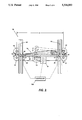
- FIG. 1 is top internal schematic view of one example of a widely adjustably feed path for a UIM system and unit, for operatively connecting with and receiving the output of copy sheets of a conventional printer, shown by the input arrow.
- This UIM unit is shown here operating as an interface module receiving sheets at the left hand side for transporting output from the right end or side of the printer apparatus to an exemplary output unit or module the UIM right side, however right side printer output may alternatively be received at the left side of the UIM;
- FIG. 2 is a cross-sectional view of the UIM embodiment of FIG. 1 taken through line "FIG. 2" thereof;
- FIG. 3 is a frontal view with the covers removed of the UIM of FIGS. 1 and 2;
- FIGS. 4 and 5 are similar to FIG. 3 (with the support rails in phantom for clarity) but with the feed path shown realigned in two different positions;
- FIG. 6 schematically shows a front view of one example of an overall printing and finishing system incorporating said UIM example, illustrating its small effect in the overall size of the combined unit; and also showing an additional said UIM between a finisher module and a mailbox and stacker module.
- the disclosed universal interface module or UIM provides a simply but highly adjustable paper path transport that enables processors with widely differing sheet output position levels or heights to interface with a wide variety of other sheet processing units or modules of widely differing input levels or heights.
- Providing one single highly flexible and adaptable interface unit can eliminate substantial engineering time and work for separate specialized interfaces otherwise needed for a particular printing machine to feed its output sheets a particular third party finisher, sorter, mailbox, folder or other sheet processing unit or module. These units can vary widely in output and input levels. Often the desired input is at the top or bottom, especially for sorters or mailboxes with a typical vertical sheet transport running past a vertical array of bins.
- the disclosed UIM interconnect module readily provides for a variable input level which may be substantially different from its variable output level, and also provides for the resultant change in the sheet path length through the UIM module.
- UIM 10 shown in the Figures, it will be appreciated that this is merely an example of the claimed system.
- the printers 12 to which this UIM 10 may be operatively connected is partially shown schematically, since various printers may be so connected, with no printer modifications, as part of various systems.
- the UIM module or unit adapts or adjusts to various printer output levels to sequentially feed the printer output sheets from the printer into the sheet input entrance of the particular output unit or units 11 currently being used by the customer.
- the units or systems described herein are merely exemplary.
- the general reference number 11 will be used throughout for any selected individual output unit, and 12 for any printer (which, as noted, may be a printer, copier, or other reproduction device).
- the UIM 10 here provides a linear sheet feeding path 14 therethrough irrespective of its input or output height adjustments.
- This sheet feeding path 14 here has otherwise conventional frictional sheet feeding nips provided by sheet feeding wheels 13 [or belts] (with opposing idlers) preferably driven by a single reversible motor "M".
- the sheet path 14 is also defined and supported here by bi-directional generally planar telescoping sheet path baffles 20. These baffles 20 may be made of light weight relatively rigid plastic, or sheet metal. The baffles 20 may extend along one [as shown] or both sides of the sheet path 14. Other than as described herein, sheet path 14 may be generally conventional.
- This "universal" interconnecting sheet transport module 10 is preferably a fully enclosed, stand-alone, module on its own wheels, as shown, that can be wheeled into position between any two existing or future sheet reproduction machines and sheet output units to be operatively connected for sheet feeding from one to the other. Connection to a normal a.c. power outlet (or a tap from a connecting unit) for the small motor "M" may be provided. A wire harness carrying DFA interface command/control communications and tachometer feedback for motor speed control may also be provided. All that is required for sheet path interconnection is to simply initially adjust (raise or lower) the input and output ends 15, 16 of the sheet path 14 to set them to the respective output and input level of the respective units to be interconnected.
- This interconnect module 10 then interconnects the paper paths of the two units, i.e., feeds sheets from the output of one unit to the input of the other unit, irrespective of their levels. As shown, connecting the output of any printer or copier 12 to the input of any selected on-line finisher, sorter or other output accessory 11, to eliminate any operator sheet handling therebetween.
- This example UIM 10 provides a desirably simple, linear, through sheet transport path 14 designed to accommodate (adjust to) printer output heights over a range of about 560 mm to 1021 mm, measured from floor level, and comparable adjustability of its output level or height, to be able to mate with almost any known finishing devices and/or sorters or mailboxes. That range was selected by reviewing different equipment level requirements.
- this universally adaptable paper path interface module 10 can operatively attach to almost any reproduction unit even though they have individually widely different input and output heights and directions [output ends or sides] to deliver the documents to almost any designated feeding or finishing equipment at a different height.
- the exemplary system is thus compatible (retrofitable) with almost all existing copiers or printers and also future IOT's with input paper and output document paper path heights anywhere within this selected range from 560 mm (22 inches) to 1021 mm (40 inches) measured from the floor.
- this lower range level could be decreased even further if needed, and with a taller UIM, this upper range level can be further increased also.
- input and output path ends or "Y" baffle units, 15, 16 are provided at the opposite ends of the sheet feeding path 14, at opposite sides of the UIM 10. They are not, however, separately called inputs or outputs here, since they can desirably reverse those functions. They are individually adjustable in height independently of one another.
- These sheet feeding end slot units 15 and 16 in this example are each simply held in place by integral threaded pins 17 that manually slide up and down in slots 18, and are locked in position simply by manual knobs 19 thereon that frictionally hold sheet path 14 ends 15, 16 at their respective selected heights when knobs 19 are rotatably tightened.
- high friction (brake) tracks may be provided, with no locking system, or toothed vertical tracks with a releasable ratchet engagement.
- the path 14 ends 15, 16, may have "Y” or “V” shaped receiving or guiding-in baffles. This helps insure effective intercepting of the upstream incoming sheets, and guiding them into the first path 14 roller 13 nip, especially in those installations in which the angle of inclination of path 14 relative to the connecting unit is severe. Likewise at the path 14 output, to help paper to be directed downstream into the downstream receiving unit nip irrespective of that path connection angle.
- each said "V” or “Y” paper guide or entrance mouth can be designed to adjustably pivot around that respective end roll 13 shaft (e.g., be held in place by a tight fit with the shaft ends), or the baffle 20 end, so that it may be set at a proper or desired angle by the installer or tech rep at installation, when the transport 14 height and angle is set as described herein.
- This sheet input and/or output 15, 16 vertical repositioning also automatically moves therewith (and extends or contracts) the connecting telescoping baffles 20 of the feed-through path 14.
- it also moves the sheet path 14 drive rollers 13 and motor M, which are connected to baffles 20.
- the path 14 feed rollers 13 and their drive motor “M” desirably automatically move with those input and output 15, 16, as shown in phantom in FIG. 1. This is so that if the input 15 goes up while the output 16 goes down, or vice versa, or not, the entire paper path 14 may automatically adjust, incline and become substantially longer than the length of a horizontal (level) paper path connection through the UIM 10, and also vertically reposition.
- a lightweight sheet path 14 and motor M is desirably provided for ease of path 14 adjustment, and module 10 stability.
- the increase A' in the path 14 length, as that path 14 inclines, is the square root of the sum of the squares of the UIM 10 width A and the then-selected entrance to exit 15 minus 16 height differential B; minus A (since A is also the minimum (horizontal) path length).
- This increase A' in path length can be substantial. However, it is transparent to the user, since it is automatically provided.
- the relative and maximum increase or difference A'-max (between the minimum A and maximum A+A' path 14 length) increases for a narrower UIM 10.
- the UIM should be as narrow as possible, to save overall office space and allow more machine locations to be used.
- the designed width and height of the UIM module thus may vary depending on the maximum extent of the height differences it must accommodate.
- the manufactured UIM width is desirably a single constant width of preferably less than about 40 cm (16 inches) or so, and preferably only about 30 to 40 cm in width. That allows the UIM 10 to still be self-standing (relatively stable), but adds little overall length to the units it interconnects.
- the path 14 length varies greatly depending on the input/output entrance 15, 16 level differential.
- This change in path 14 length may also affect the desired number of sheet feeding nips in path 14. More and closer drive rollers 13 may be provided, especially if it is desired to positively feed through small (in the feeding dimension) sheets, such as envelopes fed in long-edge first or landscape orientation. That way the path 14 may desirably accommodate a full range of sheet products as well as accommodating a maximum extension of the path 14 length (when the input and output 15, 16 are furthest apart) without losing positive sheet feeder 13 nip engagement.
- a standard UIM 10 height of about 92 cm. (36 inches) may be used. If desired, the UIM top cover may pivot up (and be retained up) at at least one side together with that end of the paper path 14, to increase its height range on that side, and/or for jam clearance or repair access.
- One example of optional means to fully enclose the UIM 10 yet allow the desired unimpeded path repositioning movement is also noted.
- One or both of the sides of the UIM 10 having the end unit 15, 16 may be connected to (above and below the sheet entrance slot) a flexible, heavy plastic or tambour curtain wall or "windowshade,” respectively.
- a flexible, heavy plastic or tambour curtain wall or "windowshade” can automatically unroll and roll up on spring loaded rollers at the top and bottom of unit 10.
- the respective side edges of these windowshades may be slideably supported in channels or tracks in the UIM 10 frame.
- the input and output sides of the UIM 10 can remain safely enclosed at all times irrespective of the repositioning of input and/or output levels thereon.
- a side of unit 10 docked directly adjacent a sidewall of a unit 11 or 12 is blocked thereby, and does not need its own sidewall.
- the motor M can also be interlocked not to run unless so docked.
- a variable speed motor "M" driving the sheet feed transport path 14 rollers 13 is desirable. It may be speed controlled by a tachometer feedback system, or the feeding speed may be set by the installer, or automatically set from a conventional sheet path sheet edge sensor 25 or 26 at the incoming sheet input side (15 or 16) of the UIM, which can detect the time between incoming sheets in a conventional manner.
- the sensors 25, 26 may also conventionally provide sheet jam sensing, by monitoring the sheet feeding time from one sensor at one end of path 14 to the other.
- the sensors 25, 26 may be conventionally connected to a conventional programmable controller 100, as shown in FIG. 3. Controller 100 can also provide speed and reversibility control for drive motor M.
- This input sensing by sensors 25 or 26 can also be used to automatically reverse the sheet feeding direction for left or right paper input feeding.
- the reversal of UIM sheet feeding direction could alternatively be accomplished by reversing the unit, a drive belt, or some other modification at installation, a single variable speed/reversible motor M accomplishes both functions.
- the sheet feeder path 14 through the UIM 10 is desirably easily reversible.
- the UIM is operatively connecting to a left side or end output of a printer (to feed sheets to a left-side connected sorter, mailbox, finisher or other output processor)
- the feed path 14 rollers or belts are driven so that the UIM 10 feeds sheets from right to left through the unit.
- the unit feeds sheets from left to right. This can be provided by the reversible drive motor "M" reversing the feed rollers 13.
- the motor M reversal can be by an installer or operator switch therefor. Or, as noted, motor M direction can be automatically switched by sensing which sheet sensor 25 or 26 is first activated. However, reversal could also be provided by a clutch or reversible belt drive easily changed by the tech rep or machine installer at the time of installation. E.g., a drive belt between the drive motor "M” and its driven feed rollers 13 may be re-mounted in a "figure 8" path rather than the normal belt loop path to provide drive reversal in a known manner.
- the baffles 20 are designed not to catch or stub sheet edges in either direction, even at a telescoping or sliding overlap area. This can be done by interdigitating baffle fingers or extensions mating with turned-down ends with baffle cut-outs or notches, in a known manner, or otherwise.
- a type of telescoping "tongue and groove" baffle 20 is shown here which is bi-directional.
- the feed rollers 13 are shown driven by a belt tensioned by a movable “dancer roll” to accommodate the sheet path 14 length changes and maintain driving of the rollers 13 at the ends of the path 14. If desired, these end rollers 13 may also have an adjustable nip orientation, as shown in phantom in FIG. 4. As also shown, (especially FIGS. 1 and 3) the (top) idler roll of the central roller 13 may be pivotally mounted to lift up for jam clearance.
- the UIM can be designed to be installed in mirror image. That is, with the UIM being front to back reversible, so as to reverse both the paper path feed direction and the sheet input and/or output in that manner.
- the sheet feed path therethrough can be conventionally unidirectional.
- This reversibility can be provided by a unit 10 rear cover attractive enough in appearance to be used as the unit 10 front cover; or front and rear covers which can be easily removed and interchanged. This has the added advantage of only requiring a printer 12 output level adjustment range on one (consistent) side of the unit 10, and only the desired output device 11 input height range on the other side of the unit 10, rather than providing the maximum range for either on both sides.
- an interface unit 10 is to provide optional additional on-line sheet treatment subsystems in the UIM module sheet path itself, or in an input path thereto, or in various inter-connected output devices 11, or combinations thereof.
- These functions can include, for example, a sheet rotator, sheet inverter, sheet hole punch, signature folder, Z-folder, sheet inserter, purge tray, etc., or combinations thereof.
- These are all well known, per se, and need not be shown in detail here. They may be located in a removable and replaceable sub-module, so as to be able to easily meet various customer needs by easily substituting one such functional unit or sub-unit for another.
- sheet rotators operate by moving one side of the sheet faster than the other, by holding or much more slowly feeding the sheet in one sheet feed nip on one side of the feed path than the other (as with a variable speed motor or drive) until the sheet rotates 90 degrees.
- sheet rotators are shown, for example, in U.S. Pat. Nos. 5,090,638; 3,861,673; 4,473,857; 4,830,356 and 5,145,168; and some of them are shown in interface modules.
- a large, e.g., 17 inch, sheet is signaled by the printer 12 as being sent, or detected by UIM sheet path sensors, such as 25, 26, then such a sheet can be rotated by a sheet rotator in the sheet path as described above, so as to ultimately stack short-edge first in an output unit 11 bin.
- a sheet folder is provided in the sheet path, the large sheet can be folded before stacking.
- the sorter or mailbox bins need not be oversized just to accommodate such abnormal large size sheets.
- EK U.S. Pat. No. 4,602,775 and Fuji Xerox U.S. Pat. No. 5,172,162 show an interface module with an inverter or other sheet processor between a printer or copier and a sorter, finisher, or other output unit.
- Examples of on-line Z-fold and other sheet folder systems are in U.S. Pat. No. 5,026,556 issued Dec. 31, 1991 to B. P. Mandel.
- Examples of on-line sheet hole punching units include Xerox Corporation U.S. Pat. No. 4,819,021; and U.S. Pat. Nos. 4,998,030 and 4,763,167.
- sheet inverter patents include Xerox Corporation U.S. Pat. Nos. 3,833,911; 3,917,257; 4,359,217; and 4,673,176. The first two show an optional inverter in association with a sorter, as in the Xerox Corporation "4500" copier. Examples of cover or other sheet inserters, etc., are disclosed in the Xerox XDJ publication of November/December 1991, pages 381-383; and U.S. Pat. Nos. 4,626,156; 4,924,265; 5,080,340; and 4,602,776. Sheets may be fed from various sheet trays and feeders at times selected by the printer or controller to be interposed (interleaved) with job sheets from the printer going into the same sheet path to the same stacker and/or compiler/stapler.
- sheet path side registration is desired in the disclosed UIM sheet path 14, (or before or after) that can also be provided.
- sheet feeding side registration systems and hardware include Xerox Corporation U.S. Pat. Nos. 4,487,407; 4,411,418; 4,621,801; 4,744,555; 4,809,968; 4,919,318, and 5,065,998.
- Another possible option is a selectable face up or face down inverter/stacker.
- One example is in an allowed Xerox Corporation U.S. Pat. Nos. 5,201,517, issued Apr. 13, 1993 to Denis Stemmle, D/89465, "Orbiting Nip Plural Mode Sheet Output with Faceup or Facedown Stacking".
- sheet processing output modules 11 can also provide an alternate, gated, by-pass sheet feeder path on through the module or unit 11 into another unit 11 for increased bin capacity or further such sheet processing options, as is well known for ganged sorter units.
- another UIM 10 can be used to operatively connect between two units 11, such as a finisher unit and a mailbox and/or stacker unit.
- a UIM 10 may be used at a printer 10 input to connect a high capacity sheet feeder to a printer clean sheet input.
- the UIM can thus connect with or provide interposer functionality for a host of paper handling accessory features or systems such as: finishers (staplers stitchers, glue binders, etc.), cover or tab inserters, sheet inverters or rotators, hole punches, sheet folders (center, signature, or "Z-fold"), hicap feeders, slitter/perforators, booklet makers, etc..
- finishers tapelers stitchers, glue binders, etc.
- cover or tab inserters sheet inverters or rotators
- hole punches sheet folders (center, signature, or "Z-fold")
- hicap feeders hicap feeders
- slitter/perforators booklet makers, etc.
- a multitude of other post processing options can also be employed in or on the UIM, or in units it provides sheet feeding connections to, such as: MICR tape stamping [e.g., as in Xerox Corporation U.S. Pat. No. 5,083,157], Color foil/holographic foil application, UV ink annotation,
- the Xerox "DocuTech” 135 Signature Booklet Maker which adapts to "5090"/DT135, 860 mm and 1021 mm output heights, but is not adjustable nor adaptable to other copier/printer outputs. They are all somewhat adjustable, for floor level/mismatch etc., but are all for a specific printer output to a specific finishing application in height and direction.
Abstract
Description
Claims (9)
Priority Applications (5)
| Application Number | Priority Date | Filing Date | Title |
|---|---|---|---|
| US08/066,385 US5326093A (en) | 1993-05-24 | 1993-05-24 | Universal interface module interconnecting various copiers and printers with various sheet output processors |
| CA002119476A CA2119476C (en) | 1993-05-24 | 1994-03-21 | Universal interface module interconnecting various copiers and printers with various sheet output processors |
| DE69404003T DE69404003T2 (en) | 1993-05-24 | 1994-05-13 | Universal interface module for connecting various copiers or reproduction devices with various sheet output devices |
| JP6099421A JPH0710341A (en) | 1993-05-24 | 1994-05-13 | General purpose interface module |
| EP94303439A EP0627671B1 (en) | 1993-05-24 | 1994-05-13 | Universal interface module interconnecting various copiers and printers with various sheet output processors |
Applications Claiming Priority (1)
| Application Number | Priority Date | Filing Date | Title |
|---|---|---|---|
| US08/066,385 US5326093A (en) | 1993-05-24 | 1993-05-24 | Universal interface module interconnecting various copiers and printers with various sheet output processors |
Publications (1)
| Publication Number | Publication Date |
|---|---|
| US5326093A true US5326093A (en) | 1994-07-05 |
Family
ID=22069184
Family Applications (1)
| Application Number | Title | Priority Date | Filing Date |
|---|---|---|---|
| US08/066,385 Expired - Lifetime US5326093A (en) | 1993-05-24 | 1993-05-24 | Universal interface module interconnecting various copiers and printers with various sheet output processors |
Country Status (5)
| Country | Link |
|---|---|
| US (1) | US5326093A (en) |
| EP (1) | EP0627671B1 (en) |
| JP (1) | JPH0710341A (en) |
| CA (1) | CA2119476C (en) |
| DE (1) | DE69404003T2 (en) |
Cited By (155)
| Publication number | Priority date | Publication date | Assignee | Title |
|---|---|---|---|---|
| US5398919A (en) * | 1989-03-06 | 1995-03-21 | Suter; Walter | Apparatus for collecting and transporting groups of paper sheets |
| US5553843A (en) * | 1994-12-13 | 1996-09-10 | Xerox Corporation | Adapter system to integrate reproduction apparatus to sheet output processing apparatus with lateral registration |
| US5630578A (en) * | 1996-03-25 | 1997-05-20 | Xerox Corporation | Low manual effort system for removably mounting paper handling modules to reproduction machines |
| US5660383A (en) * | 1994-05-14 | 1997-08-26 | Eastman Kodak Company | Sheet recording material transport apparatus |
| US5723825A (en) * | 1996-04-01 | 1998-03-03 | Pitney Bowes Inc. | Transport apparatus for a weighing module |
| US5752154A (en) * | 1993-02-07 | 1998-05-12 | Canon Kabushiki Kaisha | Sheet post-treatment apparatus of line-up free type |
| US5806842A (en) * | 1996-06-28 | 1998-09-15 | Bdt Products, Inc. | Output paper sheet finishing module and method of using same |
| EP0870707A1 (en) * | 1997-04-11 | 1998-10-14 | Xerox Corporation | Jam clearance features for modular-type decurler having continuous bending nip |
| WO1998056588A1 (en) * | 1997-06-13 | 1998-12-17 | Bdt Products, Inc. | Sheet presenter and method of using same |
| US6435743B2 (en) * | 1999-10-14 | 2002-08-20 | Eastman Kodak Company | Printing apparatus |
| EP1251091A2 (en) * | 2001-04-16 | 2002-10-23 | Ricoh Company, Ltd. | Apparatus for transferring paper sheets |
| US20040144221A1 (en) * | 2003-01-29 | 2004-07-29 | Xerox Corporation | Sheet preparation module architecture and control methods |
| US20040247353A1 (en) * | 2003-06-05 | 2004-12-09 | Xerox Corporation | Printer with integral automatic pre-printed sheets insertion system |
| US20040247365A1 (en) * | 2003-06-06 | 2004-12-09 | Xerox Corporation | Universal flexible plural printer to plural finisher sheet integration system |
| US20040253031A1 (en) * | 2003-06-10 | 2004-12-16 | Konica Minolta Business Technologies, Inc. | Paper handling apparatus and image forming system |
| US20050135855A1 (en) * | 2003-12-17 | 2005-06-23 | Sang-Cheol Park | Printing apparatus having function of scanner |
| US20050158094A1 (en) * | 2004-01-21 | 2005-07-21 | Xerox Corporation | High print rate merging and finishing system for parallel printing |
| US20050285323A1 (en) * | 2004-06-18 | 2005-12-29 | Terje Gulbrandsen | Sheet handling apparatus |
| US20060012102A1 (en) * | 2004-06-30 | 2006-01-19 | Xerox Corporation | Flexible paper path using multidirectional path modules |
| US20060034631A1 (en) * | 2004-08-13 | 2006-02-16 | Xerox Corporation | Multiple object sources controlled and/or selected based on a common sensor |
| US20060033771A1 (en) * | 2004-08-13 | 2006-02-16 | Xerox Corporation. | Parallel printing architecture with containerized image marking engines |
| US20060039727A1 (en) * | 2004-08-23 | 2006-02-23 | Xerox Corporation | Printing system with horizontal highway and single pass duplex |
| US20060039729A1 (en) * | 2004-08-23 | 2006-02-23 | Xerox Corporation | Parallel printing architecture using image marking engine modules |
| US20060039728A1 (en) * | 2004-08-23 | 2006-02-23 | Xerox Corporation | Printing system with inverter disposed for media velocity buffering and registration |
| US20060067756A1 (en) * | 2004-09-28 | 2006-03-30 | Xerox Corporation | printing system |
| US20060067757A1 (en) * | 2004-09-28 | 2006-03-30 | Xerox Corporation | Printing system |
| US20060066885A1 (en) * | 2004-09-29 | 2006-03-30 | Xerox Corporation | Printing system |
| US20060114497A1 (en) * | 2004-11-30 | 2006-06-01 | Xerox Corporation | Printing system |
| US20060115306A1 (en) * | 2004-11-30 | 2006-06-01 | Xerox Corporation | Addressable fusing for an integrated printing system |
| US20060115288A1 (en) * | 2004-11-30 | 2006-06-01 | Xerox Corporation | Glossing system for use in a TIPP architecture |
| US20060114313A1 (en) * | 2004-11-30 | 2006-06-01 | Xerox Corporation | Printing system |
| US20060115284A1 (en) * | 2004-11-30 | 2006-06-01 | Xerox Corporation. | Semi-automatic image quality adjustment for multiple marking engine systems |
| US20060115285A1 (en) * | 2004-11-30 | 2006-06-01 | Xerox Corporation | Xerographic device streak failure recovery |
| US20060115287A1 (en) * | 2004-11-30 | 2006-06-01 | Xerox Corporation | Glossing system for use in a printing system |
| US20060132815A1 (en) * | 2004-11-30 | 2006-06-22 | Palo Alto Research Center Incorporated | Printing systems |
| US20060139395A1 (en) * | 2004-12-24 | 2006-06-29 | Atsuhisa Nakashima | Ink Jet Printer |
| US20060176336A1 (en) * | 2005-02-04 | 2006-08-10 | Xerox Corporation | Printing systems |
| US20060197966A1 (en) * | 2005-03-02 | 2006-09-07 | Xerox Corporation | Gray balance for a printing system of multiple marking engines |
| US20060215240A1 (en) * | 2005-03-25 | 2006-09-28 | Xerox Corporation | Image quality control method and apparatus for multiple marking engine systems |
| US20060214359A1 (en) * | 2005-03-25 | 2006-09-28 | Xerox Corporation | Inverter with return/bypass paper path |
| US20060214364A1 (en) * | 2005-03-25 | 2006-09-28 | Xerox Corporation | Sheet registration within a media inverter |
| US20060221159A1 (en) * | 2005-03-31 | 2006-10-05 | Xerox Corporation. | Parallel printing architecture with parallel horizontal printing modules |
| US20060222378A1 (en) * | 2005-03-29 | 2006-10-05 | Xerox Corporation. | Printing system |
| US20060222384A1 (en) * | 2005-03-31 | 2006-10-05 | Xerox Corporation | Image on paper registration alignment |
| US20060221362A1 (en) * | 2005-03-31 | 2006-10-05 | Xerox Corporation | Printing system |
| US20060222393A1 (en) * | 2005-03-31 | 2006-10-05 | Xerox Corporation | Printing system |
| US20060230403A1 (en) * | 2005-04-08 | 2006-10-12 | Palo Alto Research Center Incorporated | Coordination in a distributed system |
| US20060227350A1 (en) * | 2005-04-08 | 2006-10-12 | Palo Alto Research Center Incorporated | Synchronization in a distributed system |
| US20060230201A1 (en) * | 2005-04-08 | 2006-10-12 | Palo Alto Research Center Incorporated | Communication in a distributed system |
| US20060233569A1 (en) * | 2004-11-30 | 2006-10-19 | Xerox Corporation | Systems and methods for reducing image registration errors |
| US20060235547A1 (en) * | 2005-04-08 | 2006-10-19 | Palo Alto Research Center Incorporated | On-the-fly state synchronization in a distributed system |
| US20060238778A1 (en) * | 2005-04-20 | 2006-10-26 | Xerox Corporation | Printing systems |
| US20060237899A1 (en) * | 2005-04-19 | 2006-10-26 | Xerox Corporation | Media transport system |
| US20060244980A1 (en) * | 2005-04-27 | 2006-11-02 | Xerox Corporation | Image quality adjustment method and system |
| US20060250636A1 (en) * | 2005-05-05 | 2006-11-09 | Xerox Corporation | Printing system and scheduling method |
| US20060269310A1 (en) * | 2005-05-25 | 2006-11-30 | Xerox Corporation | Printing systems |
| US20060268287A1 (en) * | 2005-05-25 | 2006-11-30 | Xerox Corporation | Automated promotion of monochrome jobs for HLC production printers |
| US20060268317A1 (en) * | 2005-05-25 | 2006-11-30 | Xerox Corporation | Scheduling system |
| US20060268318A1 (en) * | 2005-05-25 | 2006-11-30 | Xerox Corporation | Printing system |
| US20060274334A1 (en) * | 2005-06-07 | 2006-12-07 | Xerox Corporation | Low cost adjustment method for printing systems |
| US20060274337A1 (en) * | 2005-06-02 | 2006-12-07 | Xerox Corporation | Inter-separation decorrelator |
| US20060280517A1 (en) * | 2005-06-14 | 2006-12-14 | Xerox Corporation | Warm-up of multiple integrated marking engines |
| US20060285857A1 (en) * | 2005-06-20 | 2006-12-21 | Xerox Corporation | Printing platform |
| US20060291927A1 (en) * | 2005-06-24 | 2006-12-28 | Xerox Corporation | Glossing subsystem for a printing device |
| US20060290760A1 (en) * | 2005-06-28 | 2006-12-28 | Xerox Corporation. | Addressable irradiation of images |
| US20060290047A1 (en) * | 2005-06-24 | 2006-12-28 | Xerox Corporation | Printing system sheet feeder |
| US20060291930A1 (en) * | 2005-06-24 | 2006-12-28 | Xerox Corporation | Printing system |
| US20070002403A1 (en) * | 2005-06-30 | 2007-01-04 | Xerox Corporation | Method and system for processing scanned patches for use in imaging device calibration |
| US20070002085A1 (en) * | 2005-06-30 | 2007-01-04 | Xerox Corporation | High availability printing systems |
| US20070024894A1 (en) * | 2005-07-26 | 2007-02-01 | Xerox Corporation | Printing system |
| US20070041745A1 (en) * | 2005-08-22 | 2007-02-22 | Xerox Corporation | Modular marking architecture for wide media printing platform |
| US20070047976A1 (en) * | 2005-08-30 | 2007-03-01 | Xerox Corporation | Consumable selection in a printing system |
| US20070052991A1 (en) * | 2005-09-08 | 2007-03-08 | Xerox Corporation | Methods and systems for determining banding compensation parameters in printing systems |
| US20070071465A1 (en) * | 2005-09-23 | 2007-03-29 | Xerox Corporation | Printing system |
| US20070070455A1 (en) * | 2005-09-23 | 2007-03-29 | Xerox Corporation | Maximum gamut strategy for the printing systems |
| US20070081064A1 (en) * | 2005-10-12 | 2007-04-12 | Xerox Corporation | Media path crossover for printing system |
| US20070081828A1 (en) * | 2005-10-11 | 2007-04-12 | Xerox Corporation | Printing system with balanced consumable usage |
| US20070085333A1 (en) * | 2005-09-21 | 2007-04-19 | Pitney Bowes Incorporated | Mailpiece fabrication system |
| US20070103743A1 (en) * | 2005-11-04 | 2007-05-10 | Xerox Corporation | Method for correcting integrating cavity effect for calibration and/or characterization targets |
| US20070103707A1 (en) * | 2005-11-04 | 2007-05-10 | Xerox Corporation | Scanner characterization for printer calibration |
| US20070110301A1 (en) * | 2005-11-15 | 2007-05-17 | Xerox Corporation | Gamut selection in multi-engine systems |
| US20070116479A1 (en) * | 2005-11-23 | 2007-05-24 | Xerox Corporation | Media pass through mode for multi-engine system |
| US20070120935A1 (en) * | 2005-11-30 | 2007-05-31 | Xerox Corporation | Media path crossover clearance for printing system |
| US20070120933A1 (en) * | 2005-11-30 | 2007-05-31 | Xerox Corporation | Printing system |
| US20070122193A1 (en) * | 2005-11-28 | 2007-05-31 | Xerox Corporation | Multiple IOT photoreceptor belt seam synchronization |
| US20070120305A1 (en) * | 2005-11-30 | 2007-05-31 | Xerox Corporation | Radial merge module for printing system |
| US20070140767A1 (en) * | 2005-12-20 | 2007-06-21 | Xerox Corporation | Printing system architecture with center cross-over and interposer by-pass path |
| US20070140711A1 (en) * | 2005-12-21 | 2007-06-21 | Xerox Corporation | Media path diagnostics with hyper module elements |
| US20070146742A1 (en) * | 2005-12-22 | 2007-06-28 | Xerox Corporation | Method and system for color correction using both spatial correction and printer calibration techniques |
| US20070145676A1 (en) * | 2005-12-23 | 2007-06-28 | Palo Alto Research Center Incorporated | Universal variable pitch interface interconnecting fixed pitch sheet processing machines |
| US20070159670A1 (en) * | 2005-12-23 | 2007-07-12 | Xerox Corporation | Printing system |
| US20070177189A1 (en) * | 2006-01-27 | 2007-08-02 | Xerox Corporation | Printing system and bottleneck obviation |
| US20070183811A1 (en) * | 2006-02-08 | 2007-08-09 | Xerox Corporation | Multi-development system print engine |
| US20070195355A1 (en) * | 2006-02-22 | 2007-08-23 | Xerox Corporation | Multi-marking engine printing platform |
| US20070201097A1 (en) * | 2006-02-27 | 2007-08-30 | Xerox Corporation | System for masking print defects |
| US20070204226A1 (en) * | 2006-02-28 | 2007-08-30 | Palo Alto Research Center Incorporated. | System and method for manufacturing system design and shop scheduling using network flow modeling |
| US20070216746A1 (en) * | 2006-03-17 | 2007-09-20 | Xerox Corporation | Page scheduling for printing architectures |
| US20070217796A1 (en) * | 2006-03-17 | 2007-09-20 | Xerox Corporation | Fault isolation of visible defects with manual module shutdown options |
| US20070236747A1 (en) * | 2006-04-06 | 2007-10-11 | Xerox Corporation | Systems and methods to measure banding print defects |
| US20070257426A1 (en) * | 2006-05-04 | 2007-11-08 | Xerox Corporation | Diverter assembly, printing system and method |
| US20070263238A1 (en) * | 2006-05-12 | 2007-11-15 | Xerox Corporation | Automatic image quality control of marking processes |
| US20070264037A1 (en) * | 2006-05-12 | 2007-11-15 | Xerox Corporation | Process controls methods and apparatuses for improved image consistency |
| US20070297841A1 (en) * | 2006-06-23 | 2007-12-27 | Xerox Corporation | Continuous feed printing system |
| US20080008492A1 (en) * | 2006-07-06 | 2008-01-10 | Xerox Corporation | Power regulator of multiple integrated marking engines |
| US20080018915A1 (en) * | 2006-07-13 | 2008-01-24 | Xerox Corporation | Parallel printing system |
| US20080062245A1 (en) * | 2006-09-12 | 2008-03-13 | Xerox Corporation | Sensor module docking arrangement with multiple degrees of freedom constraint |
| US20080073837A1 (en) * | 2006-09-27 | 2008-03-27 | Xerox Corporation | Sheet buffering system |
| US20080099984A1 (en) * | 2006-10-31 | 2008-05-01 | Xerox Corporation | Shaft driving apparatus |
| US20080112743A1 (en) * | 2006-11-09 | 2008-05-15 | Xerox Corporation | Print media rotary transport apparatus and method |
| US20080126860A1 (en) * | 2006-09-15 | 2008-05-29 | Palo Alto Research Center Incorporated | Fault management for a printing system |
| US20080137110A1 (en) * | 2006-12-11 | 2008-06-12 | Xerox Corporation | Method and system for identifying optimal media for calibration and control |
| US20080137111A1 (en) * | 2006-12-11 | 2008-06-12 | Xerox Corporation | Data binding in multiple marking engine printing systems |
| US20080147234A1 (en) * | 2006-12-14 | 2008-06-19 | Palo Alto Research Center Incorporated | Module identification method and system for path connectivity in modular systems |
| US20080143043A1 (en) * | 2006-12-19 | 2008-06-19 | Xerox Corporation | Bidirectional media sheet transport apparatus |
| US20080174802A1 (en) * | 2007-01-23 | 2008-07-24 | Xerox Corporation | Preemptive redirection in printing systems |
| US20080196606A1 (en) * | 2007-02-20 | 2008-08-21 | Xerox Corporation | Efficient cross-stream printing system |
| US20080260445A1 (en) * | 2007-04-18 | 2008-10-23 | Xerox Corporation | Method of controlling automatic electrostatic media sheet printing |
| US20080268839A1 (en) * | 2007-04-27 | 2008-10-30 | Ayers John I | Reducing a number of registration termination massages in a network for cellular devices |
| US20080266592A1 (en) * | 2007-04-30 | 2008-10-30 | Xerox Corporation | Scheduling system |
| US20080278735A1 (en) * | 2007-05-09 | 2008-11-13 | Xerox Corporation | Registration method using sensed image marks and digital realignment |
| US20080300707A1 (en) * | 2007-05-29 | 2008-12-04 | Palo Alto Research Center Incorporated. | System and method for on-line planning utilizing multiple planning queues |
| US20080300708A1 (en) * | 2007-05-29 | 2008-12-04 | Palo Alto Research Center Incorporated. | Model-based planning using query-based component executable instructions |
| US20080300706A1 (en) * | 2007-05-29 | 2008-12-04 | Palo Alto Research Center Incorporated. | System and method for real-time system control using precomputed plans |
| US20080301690A1 (en) * | 2004-08-23 | 2008-12-04 | Palo Alto Research Center Incorporated | Model-based planning with multi-capacity resources |
| US20090033954A1 (en) * | 2007-08-03 | 2009-02-05 | Xerox Corporation | Color job output matching for a printing system |
| US7496412B2 (en) | 2005-07-29 | 2009-02-24 | Xerox Corporation | Control method using dynamic latitude allocation and setpoint modification, system using the control method, and computer readable recording media containing the control method |
| US20090080955A1 (en) * | 2007-09-26 | 2009-03-26 | Xerox Corporation | Content-changing document and method of producing same |
| US7559549B2 (en) | 2006-12-21 | 2009-07-14 | Xerox Corporation | Media feeder feed rate |
| US7590501B2 (en) | 2007-08-28 | 2009-09-15 | Xerox Corporation | Scanner calibration robust to lamp warm-up |
| US7649645B2 (en) | 2005-06-21 | 2010-01-19 | Xerox Corporation | Method of ordering job queue of marking systems |
| US20100053664A1 (en) * | 2008-09-04 | 2010-03-04 | Xerox Corporation | Run cost optimization for multi-engine printing system |
| US7676191B2 (en) | 2007-03-05 | 2010-03-09 | Xerox Corporation | Method of duplex printing on sheet media |
| US7679631B2 (en) | 2006-05-12 | 2010-03-16 | Xerox Corporation | Toner supply arrangement |
| US20100091334A1 (en) * | 2008-10-15 | 2010-04-15 | Xerox Corporation | Digital compensation method and apparatus |
| US7706737B2 (en) | 2005-11-30 | 2010-04-27 | Xerox Corporation | Mixed output printing system |
| US20100135702A1 (en) * | 2008-12-02 | 2010-06-03 | Xerox Corporation | Method and apparatus for measuring color-to-color registration |
| US7742185B2 (en) | 2004-08-23 | 2010-06-22 | Xerox Corporation | Print sequence scheduling for reliability |
| US7826090B2 (en) | 2005-12-21 | 2010-11-02 | Xerox Corporation | Method and apparatus for multiple printer calibration using compromise aim |
| US20110109947A1 (en) * | 2007-04-27 | 2011-05-12 | Xerox Corporation | Optical scanner with non-redundant overwriting |
| US20110121508A1 (en) * | 2009-11-25 | 2011-05-26 | Marsh Jeffrey D | Auxiliary feed conveyor |
| US7963518B2 (en) | 2006-01-13 | 2011-06-21 | Xerox Corporation | Printing system inverter apparatus and method |
| US7976012B2 (en) | 2009-04-28 | 2011-07-12 | Xerox Corporation | Paper feeder for modular printers |
| US20110215516A1 (en) * | 2010-03-05 | 2011-09-08 | Kabushiki Kaisha Toshiba | Image forming apparatus, sheet guide apparatus and sheet guide method |
| CN102190194A (en) * | 2010-03-05 | 2011-09-21 | 株式会社东芝 | Sheet guide device and sheet guiding method |
| US8081329B2 (en) | 2005-06-24 | 2011-12-20 | Xerox Corporation | Mixed output print control method and system |
| US8145335B2 (en) | 2006-12-19 | 2012-03-27 | Palo Alto Research Center Incorporated | Exception handling |
| US8203750B2 (en) | 2007-08-01 | 2012-06-19 | Xerox Corporation | Color job reprint set-up for a printing system |
| US8259369B2 (en) | 2005-06-30 | 2012-09-04 | Xerox Corporation | Color characterization or calibration targets with noise-dependent patch size or number |
| US8330965B2 (en) | 2006-04-13 | 2012-12-11 | Xerox Corporation | Marking engine selection |
| US20130121793A1 (en) * | 2011-11-10 | 2013-05-16 | Hid Global Corporation | Credential manufacturing device substrate shuttle |
| CN103448353A (en) * | 2013-08-27 | 2013-12-18 | 深圳报业集团印务有限公司 | Transformation method of Roland C75 printable wide and narrow newspaper and double width rotary press of printable wide and narrow newspaper |
| US20150034452A1 (en) * | 2013-07-31 | 2015-02-05 | Ncr Corporation | Media item transportation |
| EP3156357A1 (en) * | 2015-10-14 | 2017-04-19 | Xerox Corporation | Exit roll assembly |
| EP3152142B1 (en) * | 2014-06-05 | 2020-04-22 | Hewlett-Packard Development Company, L.P. | Printing device, corresponding printing system, and method of operating a printing device |
| US10933665B2 (en) | 2017-03-30 | 2021-03-02 | Hewlett-Packard Development Company, L.P. | Module to increase medium storage capacity |
Families Citing this family (5)
| Publication number | Priority date | Publication date | Assignee | Title |
|---|---|---|---|---|
| US6405410B1 (en) | 1999-06-17 | 2002-06-18 | Nishikawa Kasei Co., Ltd. | Retractable assist grip and mounting method thereof |
| CA2368211A1 (en) | 2000-02-18 | 2001-08-23 | Sugatsune Kogyo Co., Ltd. | Chair with backrest and rotating damper device |
| JP2004029443A (en) | 2002-06-26 | 2004-01-29 | Hitachi Printing Solutions Ltd | Image forming device |
| DE102004013898A1 (en) * | 2004-03-22 | 2005-10-13 | Eastman Kodak Co. | Boom for a printing machine |
| JP4151687B2 (en) | 2005-09-01 | 2008-09-17 | トヨタ車体株式会社 | Vehicle door opening and closing device |
Citations (31)
| Publication number | Priority date | Publication date | Assignee | Title |
|---|---|---|---|---|
| US2490381A (en) * | 1946-05-21 | 1949-12-06 | James J Shields | Elevating conveyer |
| US3071237A (en) * | 1961-01-30 | 1963-01-01 | Benjamin L Powell | Pipe handling apparatus |
| US3765670A (en) * | 1972-09-13 | 1973-10-16 | Norfin | Retainer for sheet transfer in sorting machine |
| US3848867A (en) * | 1972-09-20 | 1974-11-19 | Norfin | No-counter sorter-stacker |
| US3853314A (en) * | 1972-11-13 | 1974-12-10 | E Anderson | Collating machine |
| US3866904A (en) * | 1972-12-29 | 1975-02-18 | Xerox Corp | Multiple feed sorting apparatus |
| US3944217A (en) * | 1973-11-23 | 1976-03-16 | Emf Corporation | Tower type sorting and collating apparatus |
| US3963235A (en) * | 1972-10-13 | 1976-06-15 | Norfin, Inc. | Adjustable feed level for sorting device |
| US4322069A (en) * | 1979-11-02 | 1982-03-30 | Konishiroku Photo Industry Co., Ltd. | Sheet sorting apparatus |
| US4353543A (en) * | 1979-09-28 | 1982-10-12 | Ricoh Co., Ltd. | Sorter connection apparatus |
| US4515458A (en) * | 1981-05-21 | 1985-05-07 | Canon Kabushiki Kaisha | Image forming apparatus |
| US4548403A (en) * | 1981-11-18 | 1985-10-22 | Minolta Camera Kabushiki Kaisha | Sorter |
| US4580775A (en) * | 1984-03-02 | 1986-04-08 | Ikegani Tsushinki Company, Ltd. | Sheet sorting apparatus |
| US4602775A (en) * | 1985-04-08 | 1986-07-29 | Eastman Kodak Company | Modular cover inserter unit |
| US4615521A (en) * | 1983-04-30 | 1986-10-07 | Dainippon Screen Manufacturing Co., Ltd. | Elevator between transfer passages |
| US4671505A (en) * | 1984-09-11 | 1987-06-09 | Ikegami Tsushinki Co., Ltd. | Sorting apparatus |
| JPS62201767A (en) * | 1986-02-28 | 1987-09-05 | Sharp Corp | Suction type sheet distributing device |
| US4691914A (en) * | 1986-01-21 | 1987-09-08 | Gradco Systems, Inc. | Sheet receiver |
| US4700940A (en) * | 1986-07-01 | 1987-10-20 | King Theodas C | Blueprint copy collating apparatus |
| DE3718131A1 (en) * | 1987-05-29 | 1988-12-15 | Kodak Ag | Device for transporting film sheets |
| US4828415A (en) * | 1987-09-22 | 1989-05-09 | Mitsubishi Denki K.K. | Printer |
| US4830356A (en) * | 1987-08-03 | 1989-05-16 | Xerox Corporation | Passive "pinwheel" copy sheet rotator |
| US4881730A (en) * | 1986-01-20 | 1989-11-21 | O/A Technologies, Inc. | Sorter |
| US4900009A (en) * | 1987-04-20 | 1990-02-13 | Canon Kabushiki Kaisha | Sorter |
| US4913426A (en) * | 1985-12-20 | 1990-04-03 | O/A Technologies, Inc. | Sorter |
| US5078385A (en) * | 1988-11-29 | 1992-01-07 | Kabushiki Kaisha Toshiba | Sorting apparatus having variable length guide plates |
| US5101241A (en) * | 1989-11-20 | 1992-03-31 | Kabushiki Kaisha Toshiba | Telescopic paper guide means movable to selected receiving trays |
| US5145168A (en) * | 1990-11-02 | 1992-09-08 | Xerox Corporation | Counter-clockwise single sheet rotator |
| US5172162A (en) * | 1990-12-10 | 1992-12-15 | Fuji Xerox, Co., Ltd. | Apparatus for connecting an image recording device to a sheet processor |
| US5172908A (en) * | 1990-03-27 | 1992-12-22 | Helmut Steinhilber | Sorting device for storing sheet-form recording media |
| US5222730A (en) * | 1990-11-26 | 1993-06-29 | Mita Industrial Co., Ltd. | Sheeet conveyor joint mechanism |
Family Cites Families (1)
| Publication number | Priority date | Publication date | Assignee | Title |
|---|---|---|---|---|
| US3861673A (en) * | 1973-10-29 | 1975-01-21 | Xerox Corp | Bi-directional sheet transport |
-
1993
- 1993-05-24 US US08/066,385 patent/US5326093A/en not_active Expired - Lifetime
-
1994
- 1994-03-21 CA CA002119476A patent/CA2119476C/en not_active Expired - Lifetime
- 1994-05-13 JP JP6099421A patent/JPH0710341A/en not_active Withdrawn
- 1994-05-13 DE DE69404003T patent/DE69404003T2/en not_active Expired - Fee Related
- 1994-05-13 EP EP94303439A patent/EP0627671B1/en not_active Expired - Lifetime
Patent Citations (32)
| Publication number | Priority date | Publication date | Assignee | Title |
|---|---|---|---|---|
| US2490381A (en) * | 1946-05-21 | 1949-12-06 | James J Shields | Elevating conveyer |
| US3071237A (en) * | 1961-01-30 | 1963-01-01 | Benjamin L Powell | Pipe handling apparatus |
| US3765670A (en) * | 1972-09-13 | 1973-10-16 | Norfin | Retainer for sheet transfer in sorting machine |
| US3848867A (en) * | 1972-09-20 | 1974-11-19 | Norfin | No-counter sorter-stacker |
| US3963235A (en) * | 1972-10-13 | 1976-06-15 | Norfin, Inc. | Adjustable feed level for sorting device |
| US3853314A (en) * | 1972-11-13 | 1974-12-10 | E Anderson | Collating machine |
| US3866904A (en) * | 1972-12-29 | 1975-02-18 | Xerox Corp | Multiple feed sorting apparatus |
| US3944217A (en) * | 1973-11-23 | 1976-03-16 | Emf Corporation | Tower type sorting and collating apparatus |
| US4353543A (en) * | 1979-09-28 | 1982-10-12 | Ricoh Co., Ltd. | Sorter connection apparatus |
| US4322069A (en) * | 1979-11-02 | 1982-03-30 | Konishiroku Photo Industry Co., Ltd. | Sheet sorting apparatus |
| US4515458A (en) * | 1981-05-21 | 1985-05-07 | Canon Kabushiki Kaisha | Image forming apparatus |
| US4548403A (en) * | 1981-11-18 | 1985-10-22 | Minolta Camera Kabushiki Kaisha | Sorter |
| US4615521A (en) * | 1983-04-30 | 1986-10-07 | Dainippon Screen Manufacturing Co., Ltd. | Elevator between transfer passages |
| US4580775A (en) * | 1984-03-02 | 1986-04-08 | Ikegani Tsushinki Company, Ltd. | Sheet sorting apparatus |
| US4671505A (en) * | 1984-09-11 | 1987-06-09 | Ikegami Tsushinki Co., Ltd. | Sorting apparatus |
| US4602775A (en) * | 1985-04-08 | 1986-07-29 | Eastman Kodak Company | Modular cover inserter unit |
| US4913426A (en) * | 1985-12-20 | 1990-04-03 | O/A Technologies, Inc. | Sorter |
| US4881730A (en) * | 1986-01-20 | 1989-11-21 | O/A Technologies, Inc. | Sorter |
| US4691914A (en) * | 1986-01-21 | 1987-09-08 | Gradco Systems, Inc. | Sheet receiver |
| JPS62201767A (en) * | 1986-02-28 | 1987-09-05 | Sharp Corp | Suction type sheet distributing device |
| US4700940A (en) * | 1986-07-01 | 1987-10-20 | King Theodas C | Blueprint copy collating apparatus |
| US4900009A (en) * | 1987-04-20 | 1990-02-13 | Canon Kabushiki Kaisha | Sorter |
| DE3718131A1 (en) * | 1987-05-29 | 1988-12-15 | Kodak Ag | Device for transporting film sheets |
| US4830356A (en) * | 1987-08-03 | 1989-05-16 | Xerox Corporation | Passive "pinwheel" copy sheet rotator |
| US4828415A (en) * | 1987-09-22 | 1989-05-09 | Mitsubishi Denki K.K. | Printer |
| US5099274A (en) * | 1988-08-22 | 1992-03-24 | Eastman Kodak Company | Device for transporting film sheets |
| US5078385A (en) * | 1988-11-29 | 1992-01-07 | Kabushiki Kaisha Toshiba | Sorting apparatus having variable length guide plates |
| US5101241A (en) * | 1989-11-20 | 1992-03-31 | Kabushiki Kaisha Toshiba | Telescopic paper guide means movable to selected receiving trays |
| US5172908A (en) * | 1990-03-27 | 1992-12-22 | Helmut Steinhilber | Sorting device for storing sheet-form recording media |
| US5145168A (en) * | 1990-11-02 | 1992-09-08 | Xerox Corporation | Counter-clockwise single sheet rotator |
| US5222730A (en) * | 1990-11-26 | 1993-06-29 | Mita Industrial Co., Ltd. | Sheeet conveyor joint mechanism |
| US5172162A (en) * | 1990-12-10 | 1992-12-15 | Fuji Xerox, Co., Ltd. | Apparatus for connecting an image recording device to a sheet processor |
Cited By (288)
| Publication number | Priority date | Publication date | Assignee | Title |
|---|---|---|---|---|
| US5398919A (en) * | 1989-03-06 | 1995-03-21 | Suter; Walter | Apparatus for collecting and transporting groups of paper sheets |
| US5752154A (en) * | 1993-02-07 | 1998-05-12 | Canon Kabushiki Kaisha | Sheet post-treatment apparatus of line-up free type |
| US5660383A (en) * | 1994-05-14 | 1997-08-26 | Eastman Kodak Company | Sheet recording material transport apparatus |
| US5553843A (en) * | 1994-12-13 | 1996-09-10 | Xerox Corporation | Adapter system to integrate reproduction apparatus to sheet output processing apparatus with lateral registration |
| US5630578A (en) * | 1996-03-25 | 1997-05-20 | Xerox Corporation | Low manual effort system for removably mounting paper handling modules to reproduction machines |
| US5723825A (en) * | 1996-04-01 | 1998-03-03 | Pitney Bowes Inc. | Transport apparatus for a weighing module |
| US5806842A (en) * | 1996-06-28 | 1998-09-15 | Bdt Products, Inc. | Output paper sheet finishing module and method of using same |
| US6003864A (en) * | 1997-04-11 | 1999-12-21 | Xerox Corporation | Jam clearance features for modular-type decurler having continuous bending nip |
| EP0870707A1 (en) * | 1997-04-11 | 1998-10-14 | Xerox Corporation | Jam clearance features for modular-type decurler having continuous bending nip |
| WO1998056588A1 (en) * | 1997-06-13 | 1998-12-17 | Bdt Products, Inc. | Sheet presenter and method of using same |
| US6435743B2 (en) * | 1999-10-14 | 2002-08-20 | Eastman Kodak Company | Printing apparatus |
| EP1251091A2 (en) * | 2001-04-16 | 2002-10-23 | Ricoh Company, Ltd. | Apparatus for transferring paper sheets |
| EP1251091A3 (en) * | 2001-04-16 | 2003-06-18 | Ricoh Company, Ltd. | Apparatus for transferring paper sheets |
| US6663099B2 (en) | 2001-04-16 | 2003-12-16 | Ricoh Company, Ltd. | Apparatus for transferring paper sheets |
| US20040144221A1 (en) * | 2003-01-29 | 2004-07-29 | Xerox Corporation | Sheet preparation module architecture and control methods |
| US7137943B2 (en) * | 2003-01-29 | 2006-11-21 | Xerox Corporation | Sheet preparation module architecture and control methods |
| US20040247353A1 (en) * | 2003-06-05 | 2004-12-09 | Xerox Corporation | Printer with integral automatic pre-printed sheets insertion system |
| US20040253033A1 (en) * | 2003-06-06 | 2004-12-16 | Xerox Corporation. | Universal flexible plural printer to plural finisher sheet integration system |
| US7320461B2 (en) | 2003-06-06 | 2008-01-22 | Xerox Corporation | Multifunction flexible media interface system |
| US20040247365A1 (en) * | 2003-06-06 | 2004-12-09 | Xerox Corporation | Universal flexible plural printer to plural finisher sheet integration system |
| US7226049B2 (en) | 2003-06-06 | 2007-06-05 | Xerox Corporation | Universal flexible plural printer to plural finisher sheet integration system |
| US20040253031A1 (en) * | 2003-06-10 | 2004-12-16 | Konica Minolta Business Technologies, Inc. | Paper handling apparatus and image forming system |
| US20050135855A1 (en) * | 2003-12-17 | 2005-06-23 | Sang-Cheol Park | Printing apparatus having function of scanner |
| US6925283B1 (en) | 2004-01-21 | 2005-08-02 | Xerox Corporation | High print rate merging and finishing system for printing |
| US6973286B2 (en) | 2004-01-21 | 2005-12-06 | Xerox Corporation | High print rate merging and finishing system for parallel printing |
| US6959165B2 (en) | 2004-01-21 | 2005-10-25 | Xerox Corporation | High print rate merging and finishing system for printing |
| US20050158097A1 (en) * | 2004-01-21 | 2005-07-21 | Xerox Corporation | High print rate merging and finishing system for printing |
| US20050158094A1 (en) * | 2004-01-21 | 2005-07-21 | Xerox Corporation | High print rate merging and finishing system for parallel printing |
| US20050285323A1 (en) * | 2004-06-18 | 2005-12-29 | Terje Gulbrandsen | Sheet handling apparatus |
| US7677543B2 (en) | 2004-06-18 | 2010-03-16 | Terje Gulbrandsen | Sheet handling apparatus |
| US20060012102A1 (en) * | 2004-06-30 | 2006-01-19 | Xerox Corporation | Flexible paper path using multidirectional path modules |
| US7396012B2 (en) | 2004-06-30 | 2008-07-08 | Xerox Corporation | Flexible paper path using multidirectional path modules |
| US20060034631A1 (en) * | 2004-08-13 | 2006-02-16 | Xerox Corporation | Multiple object sources controlled and/or selected based on a common sensor |
| US20060033771A1 (en) * | 2004-08-13 | 2006-02-16 | Xerox Corporation. | Parallel printing architecture with containerized image marking engines |
| US7206532B2 (en) | 2004-08-13 | 2007-04-17 | Xerox Corporation | Multiple object sources controlled and/or selected based on a common sensor |
| US7188929B2 (en) | 2004-08-13 | 2007-03-13 | Xerox Corporation | Parallel printing architecture with containerized image marking engines |
| US20060039727A1 (en) * | 2004-08-23 | 2006-02-23 | Xerox Corporation | Printing system with horizontal highway and single pass duplex |
| US7123873B2 (en) | 2004-08-23 | 2006-10-17 | Xerox Corporation | Printing system with inverter disposed for media velocity buffering and registration |
| US20060039728A1 (en) * | 2004-08-23 | 2006-02-23 | Xerox Corporation | Printing system with inverter disposed for media velocity buffering and registration |
| US7024152B2 (en) | 2004-08-23 | 2006-04-04 | Xerox Corporation | Printing system with horizontal highway and single pass duplex |
| US20080301690A1 (en) * | 2004-08-23 | 2008-12-04 | Palo Alto Research Center Incorporated | Model-based planning with multi-capacity resources |
| US20060039729A1 (en) * | 2004-08-23 | 2006-02-23 | Xerox Corporation | Parallel printing architecture using image marking engine modules |
| US20070031170A1 (en) * | 2004-08-23 | 2007-02-08 | Dejong Joannes N | Printing system with inverter disposed for media velocity buffering and registration |
| US7136616B2 (en) | 2004-08-23 | 2006-11-14 | Xerox Corporation | Parallel printing architecture using image marking engine modules |
| US7742185B2 (en) | 2004-08-23 | 2010-06-22 | Xerox Corporation | Print sequence scheduling for reliability |
| US7421241B2 (en) | 2004-08-23 | 2008-09-02 | Xerox Corporation | Printing system with inverter disposed for media velocity buffering and registration |
| US9250967B2 (en) | 2004-08-23 | 2016-02-02 | Palo Alto Research Center Incorporated | Model-based planning with multi-capacity resources |
| US20060067757A1 (en) * | 2004-09-28 | 2006-03-30 | Xerox Corporation | Printing system |
| US20060067756A1 (en) * | 2004-09-28 | 2006-03-30 | Xerox Corporation | printing system |
| US7324779B2 (en) | 2004-09-28 | 2008-01-29 | Xerox Corporation | Printing system with primary and secondary fusing devices |
| US7336920B2 (en) | 2004-09-28 | 2008-02-26 | Xerox Corporation | Printing system |
| US20060066885A1 (en) * | 2004-09-29 | 2006-03-30 | Xerox Corporation | Printing system |
| US7751072B2 (en) | 2004-09-29 | 2010-07-06 | Xerox Corporation | Automated modification of a marking engine in a printing system |
| US7672634B2 (en) | 2004-11-30 | 2010-03-02 | Xerox Corporation | Addressable fusing for an integrated printing system |
| US20060114497A1 (en) * | 2004-11-30 | 2006-06-01 | Xerox Corporation | Printing system |
| US7162172B2 (en) | 2004-11-30 | 2007-01-09 | Xerox Corporation | Semi-automatic image quality adjustment for multiple marking engine systems |
| US7283762B2 (en) | 2004-11-30 | 2007-10-16 | Xerox Corporation | Glossing system for use in a printing architecture |
| US7245856B2 (en) | 2004-11-30 | 2007-07-17 | Xerox Corporation | Systems and methods for reducing image registration errors |
| US20060115288A1 (en) * | 2004-11-30 | 2006-06-01 | Xerox Corporation | Glossing system for use in a TIPP architecture |
| US20060233569A1 (en) * | 2004-11-30 | 2006-10-19 | Xerox Corporation | Systems and methods for reducing image registration errors |
| US7412180B2 (en) | 2004-11-30 | 2008-08-12 | Xerox Corporation | Glossing system for use in a printing system |
| US20060114313A1 (en) * | 2004-11-30 | 2006-06-01 | Xerox Corporation | Printing system |
| US7305194B2 (en) | 2004-11-30 | 2007-12-04 | Xerox Corporation | Xerographic device streak failure recovery |
| US7310108B2 (en) | 2004-11-30 | 2007-12-18 | Xerox Corporation | Printing system |
| US20060115306A1 (en) * | 2004-11-30 | 2006-06-01 | Xerox Corporation | Addressable fusing for an integrated printing system |
| US20060132815A1 (en) * | 2004-11-30 | 2006-06-22 | Palo Alto Research Center Incorporated | Printing systems |
| US7791751B2 (en) * | 2004-11-30 | 2010-09-07 | Palo Alto Research Corporation | Printing systems |
| US20060115287A1 (en) * | 2004-11-30 | 2006-06-01 | Xerox Corporation | Glossing system for use in a printing system |
| US20060115285A1 (en) * | 2004-11-30 | 2006-06-01 | Xerox Corporation | Xerographic device streak failure recovery |
| US20060115284A1 (en) * | 2004-11-30 | 2006-06-01 | Xerox Corporation. | Semi-automatic image quality adjustment for multiple marking engine systems |
| US20060139395A1 (en) * | 2004-12-24 | 2006-06-29 | Atsuhisa Nakashima | Ink Jet Printer |
| US7226158B2 (en) | 2005-02-04 | 2007-06-05 | Xerox Corporation | Printing systems |
| US20060176336A1 (en) * | 2005-02-04 | 2006-08-10 | Xerox Corporation | Printing systems |
| US8014024B2 (en) | 2005-03-02 | 2011-09-06 | Xerox Corporation | Gray balance for a printing system of multiple marking engines |
| US20060197966A1 (en) * | 2005-03-02 | 2006-09-07 | Xerox Corporation | Gray balance for a printing system of multiple marking engines |
| US7416185B2 (en) | 2005-03-25 | 2008-08-26 | Xerox Corporation | Inverter with return/bypass paper path |
| US7258340B2 (en) | 2005-03-25 | 2007-08-21 | Xerox Corporation | Sheet registration within a media inverter |
| US20060215240A1 (en) * | 2005-03-25 | 2006-09-28 | Xerox Corporation | Image quality control method and apparatus for multiple marking engine systems |
| US20060214359A1 (en) * | 2005-03-25 | 2006-09-28 | Xerox Corporation | Inverter with return/bypass paper path |
| US7697151B2 (en) | 2005-03-25 | 2010-04-13 | Xerox Corporation | Image quality control method and apparatus for multiple marking engine systems |
| US20060214364A1 (en) * | 2005-03-25 | 2006-09-28 | Xerox Corporation | Sheet registration within a media inverter |
| US20060222378A1 (en) * | 2005-03-29 | 2006-10-05 | Xerox Corporation. | Printing system |
| US7206536B2 (en) | 2005-03-29 | 2007-04-17 | Xerox Corporation | Printing system with custom marking module and method of printing |
| US7272334B2 (en) | 2005-03-31 | 2007-09-18 | Xerox Corporation | Image on paper registration alignment |
| US20060221159A1 (en) * | 2005-03-31 | 2006-10-05 | Xerox Corporation. | Parallel printing architecture with parallel horizontal printing modules |
| US20060222384A1 (en) * | 2005-03-31 | 2006-10-05 | Xerox Corporation | Image on paper registration alignment |
| US20060221362A1 (en) * | 2005-03-31 | 2006-10-05 | Xerox Corporation | Printing system |
| US7444108B2 (en) | 2005-03-31 | 2008-10-28 | Xerox Corporation | Parallel printing architecture with parallel horizontal printing modules |
| US20060222393A1 (en) * | 2005-03-31 | 2006-10-05 | Xerox Corporation | Printing system |
| US7245844B2 (en) | 2005-03-31 | 2007-07-17 | Xerox Corporation | Printing system |
| US7305198B2 (en) | 2005-03-31 | 2007-12-04 | Xerox Corporation | Printing system |
| US8819103B2 (en) | 2005-04-08 | 2014-08-26 | Palo Alto Research Center, Incorporated | Communication in a distributed system |
| US20060235547A1 (en) * | 2005-04-08 | 2006-10-19 | Palo Alto Research Center Incorporated | On-the-fly state synchronization in a distributed system |
| US20060230403A1 (en) * | 2005-04-08 | 2006-10-12 | Palo Alto Research Center Incorporated | Coordination in a distributed system |
| US7873962B2 (en) | 2005-04-08 | 2011-01-18 | Xerox Corporation | Distributed control systems and methods that selectively activate respective coordinators for respective tasks |
| US20060227350A1 (en) * | 2005-04-08 | 2006-10-12 | Palo Alto Research Center Incorporated | Synchronization in a distributed system |
| US20060230201A1 (en) * | 2005-04-08 | 2006-10-12 | Palo Alto Research Center Incorporated | Communication in a distributed system |
| US7791741B2 (en) | 2005-04-08 | 2010-09-07 | Palo Alto Research Center Incorporated | On-the-fly state synchronization in a distributed system |
| US7566053B2 (en) | 2005-04-19 | 2009-07-28 | Xerox Corporation | Media transport system |
| US20060237899A1 (en) * | 2005-04-19 | 2006-10-26 | Xerox Corporation | Media transport system |
| US7593130B2 (en) | 2005-04-20 | 2009-09-22 | Xerox Corporation | Printing systems |
| US20060238778A1 (en) * | 2005-04-20 | 2006-10-26 | Xerox Corporation | Printing systems |
| US20060244980A1 (en) * | 2005-04-27 | 2006-11-02 | Xerox Corporation | Image quality adjustment method and system |
| US7224913B2 (en) | 2005-05-05 | 2007-05-29 | Xerox Corporation | Printing system and scheduling method |
| US20060250636A1 (en) * | 2005-05-05 | 2006-11-09 | Xerox Corporation | Printing system and scheduling method |
| US20100238505A1 (en) * | 2005-05-25 | 2010-09-23 | Xerox Corporation | Scheduling system |
| US20060269310A1 (en) * | 2005-05-25 | 2006-11-30 | Xerox Corporation | Printing systems |
| US20060268287A1 (en) * | 2005-05-25 | 2006-11-30 | Xerox Corporation | Automated promotion of monochrome jobs for HLC production printers |
| US20060268317A1 (en) * | 2005-05-25 | 2006-11-30 | Xerox Corporation | Scheduling system |
| US20060268318A1 (en) * | 2005-05-25 | 2006-11-30 | Xerox Corporation | Printing system |
| US7302199B2 (en) | 2005-05-25 | 2007-11-27 | Xerox Corporation | Document processing system and methods for reducing stress therein |
| US7995225B2 (en) | 2005-05-25 | 2011-08-09 | Xerox Corporation | Scheduling system |
| US7787138B2 (en) | 2005-05-25 | 2010-08-31 | Xerox Corporation | Scheduling system |
| US7619769B2 (en) | 2005-05-25 | 2009-11-17 | Xerox Corporation | Printing system |
| US20060274337A1 (en) * | 2005-06-02 | 2006-12-07 | Xerox Corporation | Inter-separation decorrelator |
| US7486416B2 (en) | 2005-06-02 | 2009-02-03 | Xerox Corporation | Inter-separation decorrelator |
| US20060274334A1 (en) * | 2005-06-07 | 2006-12-07 | Xerox Corporation | Low cost adjustment method for printing systems |
| US8004729B2 (en) | 2005-06-07 | 2011-08-23 | Xerox Corporation | Low cost adjustment method for printing systems |
| US20060280517A1 (en) * | 2005-06-14 | 2006-12-14 | Xerox Corporation | Warm-up of multiple integrated marking engines |
| US7308218B2 (en) | 2005-06-14 | 2007-12-11 | Xerox Corporation | Warm-up of multiple integrated marking engines |
| US20060285857A1 (en) * | 2005-06-20 | 2006-12-21 | Xerox Corporation | Printing platform |
| US7245838B2 (en) | 2005-06-20 | 2007-07-17 | Xerox Corporation | Printing platform |
| US7649645B2 (en) | 2005-06-21 | 2010-01-19 | Xerox Corporation | Method of ordering job queue of marking systems |
| US7310493B2 (en) | 2005-06-24 | 2007-12-18 | Xerox Corporation | Multi-unit glossing subsystem for a printing device |
| US8081329B2 (en) | 2005-06-24 | 2011-12-20 | Xerox Corporation | Mixed output print control method and system |
| US20060290047A1 (en) * | 2005-06-24 | 2006-12-28 | Xerox Corporation | Printing system sheet feeder |
| US20060291930A1 (en) * | 2005-06-24 | 2006-12-28 | Xerox Corporation | Printing system |
| US7387297B2 (en) | 2005-06-24 | 2008-06-17 | Xerox Corporation | Printing system sheet feeder using rear and front nudger rolls |
| US20060291927A1 (en) * | 2005-06-24 | 2006-12-28 | Xerox Corporation | Glossing subsystem for a printing device |
| US7451697B2 (en) | 2005-06-24 | 2008-11-18 | Xerox Corporation | Printing system |
| US20060290760A1 (en) * | 2005-06-28 | 2006-12-28 | Xerox Corporation. | Addressable irradiation of images |
| US7433627B2 (en) | 2005-06-28 | 2008-10-07 | Xerox Corporation | Addressable irradiation of images |
| US8203768B2 (en) | 2005-06-30 | 2012-06-19 | Xerox Corporaiton | Method and system for processing scanned patches for use in imaging device calibration |
| US8259369B2 (en) | 2005-06-30 | 2012-09-04 | Xerox Corporation | Color characterization or calibration targets with noise-dependent patch size or number |
| US20070002085A1 (en) * | 2005-06-30 | 2007-01-04 | Xerox Corporation | High availability printing systems |
| US20070002403A1 (en) * | 2005-06-30 | 2007-01-04 | Xerox Corporation | Method and system for processing scanned patches for use in imaging device calibration |
| US20070024894A1 (en) * | 2005-07-26 | 2007-02-01 | Xerox Corporation | Printing system |
| US7647018B2 (en) | 2005-07-26 | 2010-01-12 | Xerox Corporation | Printing system |
| US7496412B2 (en) | 2005-07-29 | 2009-02-24 | Xerox Corporation | Control method using dynamic latitude allocation and setpoint modification, system using the control method, and computer readable recording media containing the control method |
| US7466940B2 (en) | 2005-08-22 | 2008-12-16 | Xerox Corporation | Modular marking architecture for wide media printing platform |
| US20070041745A1 (en) * | 2005-08-22 | 2007-02-22 | Xerox Corporation | Modular marking architecture for wide media printing platform |
| US20070047976A1 (en) * | 2005-08-30 | 2007-03-01 | Xerox Corporation | Consumable selection in a printing system |
| US7474861B2 (en) | 2005-08-30 | 2009-01-06 | Xerox Corporation | Consumable selection in a printing system |
| US20070052991A1 (en) * | 2005-09-08 | 2007-03-08 | Xerox Corporation | Methods and systems for determining banding compensation parameters in printing systems |
| US7911652B2 (en) | 2005-09-08 | 2011-03-22 | Xerox Corporation | Methods and systems for determining banding compensation parameters in printing systems |
| US20070085333A1 (en) * | 2005-09-21 | 2007-04-19 | Pitney Bowes Incorporated | Mailpiece fabrication system |
| US7458578B2 (en) * | 2005-09-21 | 2008-12-02 | Pitney Bowes Inc. | Mailpiece fabrication system |
| US7430380B2 (en) | 2005-09-23 | 2008-09-30 | Xerox Corporation | Printing system |
| US20070070455A1 (en) * | 2005-09-23 | 2007-03-29 | Xerox Corporation | Maximum gamut strategy for the printing systems |
| US7495799B2 (en) | 2005-09-23 | 2009-02-24 | Xerox Corporation | Maximum gamut strategy for the printing systems |
| US20070071465A1 (en) * | 2005-09-23 | 2007-03-29 | Xerox Corporation | Printing system |
| US20070081828A1 (en) * | 2005-10-11 | 2007-04-12 | Xerox Corporation | Printing system with balanced consumable usage |
| US7444088B2 (en) | 2005-10-11 | 2008-10-28 | Xerox Corporation | Printing system with balanced consumable usage |
| US7811017B2 (en) | 2005-10-12 | 2010-10-12 | Xerox Corporation | Media path crossover for printing system |
| US20070081064A1 (en) * | 2005-10-12 | 2007-04-12 | Xerox Corporation | Media path crossover for printing system |
| US7719716B2 (en) | 2005-11-04 | 2010-05-18 | Xerox Corporation | Scanner characterization for printer calibration |
| US8711435B2 (en) | 2005-11-04 | 2014-04-29 | Xerox Corporation | Method for correcting integrating cavity effect for calibration and/or characterization targets |
| US20070103743A1 (en) * | 2005-11-04 | 2007-05-10 | Xerox Corporation | Method for correcting integrating cavity effect for calibration and/or characterization targets |
| US20070103707A1 (en) * | 2005-11-04 | 2007-05-10 | Xerox Corporation | Scanner characterization for printer calibration |
| US7660460B2 (en) | 2005-11-15 | 2010-02-09 | Xerox Corporation | Gamut selection in multi-engine systems |
| US20070110301A1 (en) * | 2005-11-15 | 2007-05-17 | Xerox Corporation | Gamut selection in multi-engine systems |
| US20070116479A1 (en) * | 2005-11-23 | 2007-05-24 | Xerox Corporation | Media pass through mode for multi-engine system |
| US7280771B2 (en) | 2005-11-23 | 2007-10-09 | Xerox Corporation | Media pass through mode for multi-engine system |
| US20070122193A1 (en) * | 2005-11-28 | 2007-05-31 | Xerox Corporation | Multiple IOT photoreceptor belt seam synchronization |
| US7519314B2 (en) | 2005-11-28 | 2009-04-14 | Xerox Corporation | Multiple IOT photoreceptor belt seam synchronization |
| US7575232B2 (en) | 2005-11-30 | 2009-08-18 | Xerox Corporation | Media path crossover clearance for printing system |
| US20070120305A1 (en) * | 2005-11-30 | 2007-05-31 | Xerox Corporation | Radial merge module for printing system |
| US7636543B2 (en) | 2005-11-30 | 2009-12-22 | Xerox Corporation | Radial merge module for printing system |
| US20090267285A1 (en) * | 2005-11-30 | 2009-10-29 | Xerox Corporation | Media path crossover clearance for printing system |
| US20070120933A1 (en) * | 2005-11-30 | 2007-05-31 | Xerox Corporation | Printing system |
| US7922288B2 (en) | 2005-11-30 | 2011-04-12 | Xerox Corporation | Printing system |
| US7706737B2 (en) | 2005-11-30 | 2010-04-27 | Xerox Corporation | Mixed output printing system |
| US20070120935A1 (en) * | 2005-11-30 | 2007-05-31 | Xerox Corporation | Media path crossover clearance for printing system |
| US8276909B2 (en) | 2005-11-30 | 2012-10-02 | Xerox Corporation | Media path crossover clearance for printing system |
| US20070140767A1 (en) * | 2005-12-20 | 2007-06-21 | Xerox Corporation | Printing system architecture with center cross-over and interposer by-pass path |
| US7912416B2 (en) | 2005-12-20 | 2011-03-22 | Xerox Corporation | Printing system architecture with center cross-over and interposer by-pass path |
| US8351840B2 (en) | 2005-12-20 | 2013-01-08 | Xerox Corporation | Printing system architecture with center cross-over and interposer by-pass path |
| US7756428B2 (en) | 2005-12-21 | 2010-07-13 | Xerox Corp. | Media path diagnostics with hyper module elements |
| US7826090B2 (en) | 2005-12-21 | 2010-11-02 | Xerox Corporation | Method and apparatus for multiple printer calibration using compromise aim |
| US20070140711A1 (en) * | 2005-12-21 | 2007-06-21 | Xerox Corporation | Media path diagnostics with hyper module elements |
| US20070146742A1 (en) * | 2005-12-22 | 2007-06-28 | Xerox Corporation | Method and system for color correction using both spatial correction and printer calibration techniques |
| US8488196B2 (en) | 2005-12-22 | 2013-07-16 | Xerox Corporation | Method and system for color correction using both spatial correction and printer calibration techniques |
| US8102564B2 (en) | 2005-12-22 | 2012-01-24 | Xerox Corporation | Method and system for color correction using both spatial correction and printer calibration techniques |
| EP1801054A3 (en) * | 2005-12-23 | 2011-05-04 | Palo Alto Research Center Incorporated | Universal Variable Pitch Interface Interconnecting Fixed Pitch Sheet Processing Machines |
| US7624981B2 (en) * | 2005-12-23 | 2009-12-01 | Palo Alto Research Center Incorporated | Universal variable pitch interface interconnecting fixed pitch sheet processing machines |
| US7746524B2 (en) | 2005-12-23 | 2010-06-29 | Xerox Corporation | Bi-directional inverter printing apparatus and method |
| US20070159670A1 (en) * | 2005-12-23 | 2007-07-12 | Xerox Corporation | Printing system |
| US20070145676A1 (en) * | 2005-12-23 | 2007-06-28 | Palo Alto Research Center Incorporated | Universal variable pitch interface interconnecting fixed pitch sheet processing machines |
| US7963518B2 (en) | 2006-01-13 | 2011-06-21 | Xerox Corporation | Printing system inverter apparatus and method |
| US8477333B2 (en) | 2006-01-27 | 2013-07-02 | Xerox Corporation | Printing system and bottleneck obviation through print job sequencing |
| US20070177189A1 (en) * | 2006-01-27 | 2007-08-02 | Xerox Corporation | Printing system and bottleneck obviation |
| US20070183811A1 (en) * | 2006-02-08 | 2007-08-09 | Xerox Corporation | Multi-development system print engine |
| US7630669B2 (en) | 2006-02-08 | 2009-12-08 | Xerox Corporation | Multi-development system print engine |
| US20070195355A1 (en) * | 2006-02-22 | 2007-08-23 | Xerox Corporation | Multi-marking engine printing platform |
| US8194262B2 (en) | 2006-02-27 | 2012-06-05 | Xerox Corporation | System for masking print defects |
| US20070201097A1 (en) * | 2006-02-27 | 2007-08-30 | Xerox Corporation | System for masking print defects |
| US8407077B2 (en) | 2006-02-28 | 2013-03-26 | Palo Alto Research Center Incorporated | System and method for manufacturing system design and shop scheduling using network flow modeling |
| US20070204226A1 (en) * | 2006-02-28 | 2007-08-30 | Palo Alto Research Center Incorporated. | System and method for manufacturing system design and shop scheduling using network flow modeling |
| US7542059B2 (en) | 2006-03-17 | 2009-06-02 | Xerox Corporation | Page scheduling for printing architectures |
| US7493055B2 (en) | 2006-03-17 | 2009-02-17 | Xerox Corporation | Fault isolation of visible defects with manual module shutdown options |
| US20070217796A1 (en) * | 2006-03-17 | 2007-09-20 | Xerox Corporation | Fault isolation of visible defects with manual module shutdown options |
| US20070216746A1 (en) * | 2006-03-17 | 2007-09-20 | Xerox Corporation | Page scheduling for printing architectures |
| US7965397B2 (en) | 2006-04-06 | 2011-06-21 | Xerox Corporation | Systems and methods to measure banding print defects |
| US20070236747A1 (en) * | 2006-04-06 | 2007-10-11 | Xerox Corporation | Systems and methods to measure banding print defects |
| US8330965B2 (en) | 2006-04-13 | 2012-12-11 | Xerox Corporation | Marking engine selection |
| US7681883B2 (en) | 2006-05-04 | 2010-03-23 | Xerox Corporation | Diverter assembly, printing system and method |
| US20070257426A1 (en) * | 2006-05-04 | 2007-11-08 | Xerox Corporation | Diverter assembly, printing system and method |
| US7800777B2 (en) | 2006-05-12 | 2010-09-21 | Xerox Corporation | Automatic image quality control of marking processes |
| US7382993B2 (en) | 2006-05-12 | 2008-06-03 | Xerox Corporation | Process controls methods and apparatuses for improved image consistency |
| US20070263238A1 (en) * | 2006-05-12 | 2007-11-15 | Xerox Corporation | Automatic image quality control of marking processes |
| US7679631B2 (en) | 2006-05-12 | 2010-03-16 | Xerox Corporation | Toner supply arrangement |
| US20070264037A1 (en) * | 2006-05-12 | 2007-11-15 | Xerox Corporation | Process controls methods and apparatuses for improved image consistency |
| US7865125B2 (en) | 2006-06-23 | 2011-01-04 | Xerox Corporation | Continuous feed printing system |
| US20070297841A1 (en) * | 2006-06-23 | 2007-12-27 | Xerox Corporation | Continuous feed printing system |
| US20080008492A1 (en) * | 2006-07-06 | 2008-01-10 | Xerox Corporation | Power regulator of multiple integrated marking engines |
| US7856191B2 (en) | 2006-07-06 | 2010-12-21 | Xerox Corporation | Power regulator of multiple integrated marking engines |
| US7924443B2 (en) | 2006-07-13 | 2011-04-12 | Xerox Corporation | Parallel printing system |
| US20080018915A1 (en) * | 2006-07-13 | 2008-01-24 | Xerox Corporation | Parallel printing system |
| US20080062245A1 (en) * | 2006-09-12 | 2008-03-13 | Xerox Corporation | Sensor module docking arrangement with multiple degrees of freedom constraint |
| US7417662B2 (en) * | 2006-09-12 | 2008-08-26 | Xerox Corporation | Sensor module docking arrangement with multiple degrees of freedom constraint |
| US20080126860A1 (en) * | 2006-09-15 | 2008-05-29 | Palo Alto Research Center Incorporated | Fault management for a printing system |
| US8607102B2 (en) | 2006-09-15 | 2013-12-10 | Palo Alto Research Center Incorporated | Fault management for a printing system |
| US20100258999A1 (en) * | 2006-09-27 | 2010-10-14 | Xerox Corporation | Sheet buffering system |
| US20080073837A1 (en) * | 2006-09-27 | 2008-03-27 | Xerox Corporation | Sheet buffering system |
| US7766327B2 (en) | 2006-09-27 | 2010-08-03 | Xerox Corporation | Sheet buffering system |
| US8322720B2 (en) | 2006-09-27 | 2012-12-04 | Xerox Corporation | Sheet buffering system |
| US7857309B2 (en) | 2006-10-31 | 2010-12-28 | Xerox Corporation | Shaft driving apparatus |
| US20080099984A1 (en) * | 2006-10-31 | 2008-05-01 | Xerox Corporation | Shaft driving apparatus |
| US7819401B2 (en) | 2006-11-09 | 2010-10-26 | Xerox Corporation | Print media rotary transport apparatus and method |
| US20080112743A1 (en) * | 2006-11-09 | 2008-05-15 | Xerox Corporation | Print media rotary transport apparatus and method |
| US8159713B2 (en) | 2006-12-11 | 2012-04-17 | Xerox Corporation | Data binding in multiple marking engine printing systems |
| US20080137110A1 (en) * | 2006-12-11 | 2008-06-12 | Xerox Corporation | Method and system for identifying optimal media for calibration and control |
| US20080137111A1 (en) * | 2006-12-11 | 2008-06-12 | Xerox Corporation | Data binding in multiple marking engine printing systems |
| US7969624B2 (en) | 2006-12-11 | 2011-06-28 | Xerox Corporation | Method and system for identifying optimal media for calibration and control |
| US7945346B2 (en) | 2006-12-14 | 2011-05-17 | Palo Alto Research Center Incorporated | Module identification method and system for path connectivity in modular systems |
| US20080147234A1 (en) * | 2006-12-14 | 2008-06-19 | Palo Alto Research Center Incorporated | Module identification method and system for path connectivity in modular systems |
| US20080143043A1 (en) * | 2006-12-19 | 2008-06-19 | Xerox Corporation | Bidirectional media sheet transport apparatus |
| US8100523B2 (en) | 2006-12-19 | 2012-01-24 | Xerox Corporation | Bidirectional media sheet transport apparatus |
| US8145335B2 (en) | 2006-12-19 | 2012-03-27 | Palo Alto Research Center Incorporated | Exception handling |
| US7559549B2 (en) | 2006-12-21 | 2009-07-14 | Xerox Corporation | Media feeder feed rate |
| US8693021B2 (en) | 2007-01-23 | 2014-04-08 | Xerox Corporation | Preemptive redirection in printing systems |
| US20080174802A1 (en) * | 2007-01-23 | 2008-07-24 | Xerox Corporation | Preemptive redirection in printing systems |
| US7934825B2 (en) | 2007-02-20 | 2011-05-03 | Xerox Corporation | Efficient cross-stream printing system |
| US20080196606A1 (en) * | 2007-02-20 | 2008-08-21 | Xerox Corporation | Efficient cross-stream printing system |
| US7676191B2 (en) | 2007-03-05 | 2010-03-09 | Xerox Corporation | Method of duplex printing on sheet media |
| US20080260445A1 (en) * | 2007-04-18 | 2008-10-23 | Xerox Corporation | Method of controlling automatic electrostatic media sheet printing |
| US8049935B2 (en) | 2007-04-27 | 2011-11-01 | Xerox Corp. | Optical scanner with non-redundant overwriting |
| US20080268839A1 (en) * | 2007-04-27 | 2008-10-30 | Ayers John I | Reducing a number of registration termination massages in a network for cellular devices |
| US20110109947A1 (en) * | 2007-04-27 | 2011-05-12 | Xerox Corporation | Optical scanner with non-redundant overwriting |
| US20080266592A1 (en) * | 2007-04-30 | 2008-10-30 | Xerox Corporation | Scheduling system |
| US8253958B2 (en) | 2007-04-30 | 2012-08-28 | Xerox Corporation | Scheduling system |
| US8169657B2 (en) | 2007-05-09 | 2012-05-01 | Xerox Corporation | Registration method using sensed image marks and digital realignment |
| US20080278735A1 (en) * | 2007-05-09 | 2008-11-13 | Xerox Corporation | Registration method using sensed image marks and digital realignment |
| US20080300707A1 (en) * | 2007-05-29 | 2008-12-04 | Palo Alto Research Center Incorporated. | System and method for on-line planning utilizing multiple planning queues |
| US20080300706A1 (en) * | 2007-05-29 | 2008-12-04 | Palo Alto Research Center Incorporated. | System and method for real-time system control using precomputed plans |
| US20080300708A1 (en) * | 2007-05-29 | 2008-12-04 | Palo Alto Research Center Incorporated. | Model-based planning using query-based component executable instructions |
| US7925366B2 (en) | 2007-05-29 | 2011-04-12 | Xerox Corporation | System and method for real-time system control using precomputed plans |
| US7590464B2 (en) | 2007-05-29 | 2009-09-15 | Palo Alto Research Center Incorporated | System and method for on-line planning utilizing multiple planning queues |
| US7689311B2 (en) | 2007-05-29 | 2010-03-30 | Palo Alto Research Center Incorporated | Model-based planning using query-based component executable instructions |
| US8587833B2 (en) | 2007-08-01 | 2013-11-19 | Xerox Corporation | Color job reprint set-up for a printing system |
| US8203750B2 (en) | 2007-08-01 | 2012-06-19 | Xerox Corporation | Color job reprint set-up for a printing system |
| US7697166B2 (en) | 2007-08-03 | 2010-04-13 | Xerox Corporation | Color job output matching for a printing system |
| US20090033954A1 (en) * | 2007-08-03 | 2009-02-05 | Xerox Corporation | Color job output matching for a printing system |
| US7590501B2 (en) | 2007-08-28 | 2009-09-15 | Xerox Corporation | Scanner calibration robust to lamp warm-up |
| US20090080955A1 (en) * | 2007-09-26 | 2009-03-26 | Xerox Corporation | Content-changing document and method of producing same |
| US8693012B2 (en) | 2008-09-04 | 2014-04-08 | Xerox Corporation | Run cost optimization for multi-engine printing system |
| US20100053664A1 (en) * | 2008-09-04 | 2010-03-04 | Xerox Corporation | Run cost optimization for multi-engine printing system |
| EP2161657A2 (en) | 2008-09-04 | 2010-03-10 | Xerox Corporation | Run cost optimization for multi-engine printing system |
| US20100091334A1 (en) * | 2008-10-15 | 2010-04-15 | Xerox Corporation | Digital compensation method and apparatus |
| US8045218B2 (en) | 2008-10-15 | 2011-10-25 | Xerox Corporation | Digital compensation method and apparatus using image-to-image distortion map relating reference mark grids |
| US20100135702A1 (en) * | 2008-12-02 | 2010-06-03 | Xerox Corporation | Method and apparatus for measuring color-to-color registration |
| US8204416B2 (en) | 2008-12-02 | 2012-06-19 | Xerox Corporation | Method and apparatus for measuring color-to-color registration |
| US7976012B2 (en) | 2009-04-28 | 2011-07-12 | Xerox Corporation | Paper feeder for modular printers |
| US20110121508A1 (en) * | 2009-11-25 | 2011-05-26 | Marsh Jeffrey D | Auxiliary feed conveyor |
| US8408545B2 (en) * | 2009-11-25 | 2013-04-02 | Perfect Systems, Llc | Auxiliary feed conveyor |
| CN102190194A (en) * | 2010-03-05 | 2011-09-21 | 株式会社东芝 | Sheet guide device and sheet guiding method |
| US20110215516A1 (en) * | 2010-03-05 | 2011-09-08 | Kabushiki Kaisha Toshiba | Image forming apparatus, sheet guide apparatus and sheet guide method |
| US20130121793A1 (en) * | 2011-11-10 | 2013-05-16 | Hid Global Corporation | Credential manufacturing device substrate shuttle |
| US8876110B2 (en) * | 2011-11-10 | 2014-11-04 | Assa Abloy Ab | Credential manufacturing device substrate shuttle |
| US20150034452A1 (en) * | 2013-07-31 | 2015-02-05 | Ncr Corporation | Media item transportation |
| CN104346861A (en) * | 2013-07-31 | 2015-02-11 | Ncr公司 | Media item transportation |
| US9082246B2 (en) * | 2013-07-31 | 2015-07-14 | Ncr Corporation | Media item transportation |
| EP2832673A3 (en) * | 2013-07-31 | 2015-07-15 | NCR Corporation | Apparatus for transporting an item of media, media item processing module, and method of transporting an item of media |
| CN103448353B (en) * | 2013-08-27 | 2015-10-07 | 深圳报业集团印务有限公司 | LoranC system 75 can print width report remodeling method and can print width report double width rotary press |
| CN103448353A (en) * | 2013-08-27 | 2013-12-18 | 深圳报业集团印务有限公司 | Transformation method of Roland C75 printable wide and narrow newspaper and double width rotary press of printable wide and narrow newspaper |
| EP3152142B1 (en) * | 2014-06-05 | 2020-04-22 | Hewlett-Packard Development Company, L.P. | Printing device, corresponding printing system, and method of operating a printing device |
| EP3156357A1 (en) * | 2015-10-14 | 2017-04-19 | Xerox Corporation | Exit roll assembly |
| US10933665B2 (en) | 2017-03-30 | 2021-03-02 | Hewlett-Packard Development Company, L.P. | Module to increase medium storage capacity |
Also Published As
| Publication number | Publication date |
|---|---|
| EP0627671B1 (en) | 1997-07-02 |
| EP0627671A3 (en) | 1995-04-05 |
| DE69404003T2 (en) | 1998-01-15 |
| JPH0710341A (en) | 1995-01-13 |
| DE69404003D1 (en) | 1997-08-07 |
| CA2119476C (en) | 1999-04-13 |
| EP0627671A2 (en) | 1994-12-07 |
| CA2119476A1 (en) | 1994-11-25 |
Similar Documents
| Publication | Publication Date | Title |
|---|---|---|
| US5326093A (en) | Universal interface module interconnecting various copiers and printers with various sheet output processors | |
| US5435544A (en) | Printer mailbox system signaling overdue removals of print jobs from mailbox bins | |
| US5390910A (en) | Modular multifunctional mailbox unit with interchangeable sub-modules | |
| US5328169A (en) | Mailbox or sorter bin use sensing system | |
| US5308058A (en) | Mailbox security door with automatic set lifter | |
| US5342034A (en) | Mailbox/compiler architecture | |
| US7706737B2 (en) | Mixed output printing system | |
| US5489969A (en) | Apparatus and method of controlling interposition of sheet in a stream of imaged substrates | |
| US6823154B2 (en) | Image forming apparatus | |
| JP3449565B2 (en) | Multiple job set division device | |
| US20060291018A1 (en) | Mixed output print control method and system | |
| US4708462A (en) | Auto duplex reproduction machine | |
| US5422705A (en) | System for selectively variable set delivery output in an electrostatographic printing machine | |
| US7753367B2 (en) | System of opposing alternate higher speed sheet feeding from the same sheet stack | |
| EP0706096A1 (en) | Dual path sheet feeder system | |
| US5559595A (en) | Apparatus and method for scheduling inversions of post printing inserts | |
| US6131900A (en) | Sheets stacking system with disk type inverter-stacker at right angle to printer output | |
| EP0622694B1 (en) | A mailboxing system and sorter for feeding sheets from an output device into lockable mailbox bins | |
| JPH1138712A (en) | Image forming device | |
| US6250631B1 (en) | Sheet handling unit | |
| JP3832210B2 (en) | Paper supply device and image forming system using the same | |
| JPS6012859A (en) | Composite device of facsimile, copying machine and sorter | |
| JPH04368891A (en) | Binding apparatus | |
| JP2000200017A (en) | Image forming device and method | |
| JPH05591A (en) | Sheet processing method |
Legal Events
| Date | Code | Title | Description |
|---|---|---|---|
| AS | Assignment |
Owner name: XEROX CORPORATION, CONNECTICUT Free format text: ASSIGNMENT OF ASSIGNORS INTEREST;ASSIGNOR:SOLLITT, THOMAS E.;REEL/FRAME:006563/0184 Effective date: 19930520 |
|
| STPP | Information on status: patent application and granting procedure in general |
Free format text: APPLICATION UNDERGOING PREEXAM PROCESSING |
|
| FPAY | Fee payment |
Year of fee payment: 4 |
|
| FPAY | Fee payment |
Year of fee payment: 8 |
|
| AS | Assignment |
Owner name: BANK ONE, NA, AS ADMINISTRATIVE AGENT, ILLINOIS Free format text: SECURITY INTEREST;ASSIGNOR:XEROX CORPORATION;REEL/FRAME:013153/0001 Effective date: 20020621 |
|
| AS | Assignment |
Owner name: JPMORGAN CHASE BANK, AS COLLATERAL AGENT, TEXAS Free format text: SECURITY AGREEMENT;ASSIGNOR:XEROX CORPORATION;REEL/FRAME:015134/0476 Effective date: 20030625 Owner name: JPMORGAN CHASE BANK, AS COLLATERAL AGENT,TEXAS Free format text: SECURITY AGREEMENT;ASSIGNOR:XEROX CORPORATION;REEL/FRAME:015134/0476 Effective date: 20030625 |
|
| FPAY | Fee payment |
Year of fee payment: 12 |
|
| AS | Assignment |
Owner name: XEROX CORPORATION, CONNECTICUT Free format text: RELEASE BY SECURED PARTY;ASSIGNOR:JPMORGAN CHASE BANK, N.A. AS SUCCESSOR-IN-INTEREST ADMINISTRATIVE AGENT AND COLLATERAL AGENT TO JPMORGAN CHASE BANK;REEL/FRAME:066728/0193 Effective date: 20220822 |