US5799301A - Apparatus and method for performing adaptive similarity searching in a sequence database - Google Patents
Apparatus and method for performing adaptive similarity searching in a sequence database Download PDFInfo
- Publication number
- US5799301A US5799301A US08/513,583 US51358395A US5799301A US 5799301 A US5799301 A US 5799301A US 51358395 A US51358395 A US 51358395A US 5799301 A US5799301 A US 5799301A
- Authority
- US
- United States
- Prior art keywords
- sequences
- sequence
- stored
- database
- target sequence
- Prior art date
- Legal status (The legal status is an assumption and is not a legal conclusion. Google has not performed a legal analysis and makes no representation as to the accuracy of the status listed.)
- Expired - Fee Related
Links
Images


Classifications
-
- G—PHYSICS
- G06—COMPUTING; CALCULATING OR COUNTING
- G06F—ELECTRIC DIGITAL DATA PROCESSING
- G06F16/00—Information retrieval; Database structures therefor; File system structures therefor
- G06F16/20—Information retrieval; Database structures therefor; File system structures therefor of structured data, e.g. relational data
- G06F16/24—Querying
- G06F16/245—Query processing
- G06F16/2458—Special types of queries, e.g. statistical queries, fuzzy queries or distributed queries
- G06F16/2465—Query processing support for facilitating data mining operations in structured databases
-
- Y—GENERAL TAGGING OF NEW TECHNOLOGICAL DEVELOPMENTS; GENERAL TAGGING OF CROSS-SECTIONAL TECHNOLOGIES SPANNING OVER SEVERAL SECTIONS OF THE IPC; TECHNICAL SUBJECTS COVERED BY FORMER USPC CROSS-REFERENCE ART COLLECTIONS [XRACs] AND DIGESTS
- Y10—TECHNICAL SUBJECTS COVERED BY FORMER USPC
- Y10S—TECHNICAL SUBJECTS COVERED BY FORMER USPC CROSS-REFERENCE ART COLLECTIONS [XRACs] AND DIGESTS
- Y10S707/00—Data processing: database and file management or data structures
- Y10S707/99931—Database or file accessing
- Y10S707/99933—Query processing, i.e. searching
-
- Y—GENERAL TAGGING OF NEW TECHNOLOGICAL DEVELOPMENTS; GENERAL TAGGING OF CROSS-SECTIONAL TECHNOLOGIES SPANNING OVER SEVERAL SECTIONS OF THE IPC; TECHNICAL SUBJECTS COVERED BY FORMER USPC CROSS-REFERENCE ART COLLECTIONS [XRACs] AND DIGESTS
- Y10—TECHNICAL SUBJECTS COVERED BY FORMER USPC
- Y10S—TECHNICAL SUBJECTS COVERED BY FORMER USPC CROSS-REFERENCE ART COLLECTIONS [XRACs] AND DIGESTS
- Y10S707/00—Data processing: database and file management or data structures
- Y10S707/99931—Database or file accessing
- Y10S707/99933—Query processing, i.e. searching
- Y10S707/99935—Query augmenting and refining, e.g. inexact access
-
- Y—GENERAL TAGGING OF NEW TECHNOLOGICAL DEVELOPMENTS; GENERAL TAGGING OF CROSS-SECTIONAL TECHNOLOGIES SPANNING OVER SEVERAL SECTIONS OF THE IPC; TECHNICAL SUBJECTS COVERED BY FORMER USPC CROSS-REFERENCE ART COLLECTIONS [XRACs] AND DIGESTS
- Y10—TECHNICAL SUBJECTS COVERED BY FORMER USPC
- Y10S—TECHNICAL SUBJECTS COVERED BY FORMER USPC CROSS-REFERENCE ART COLLECTIONS [XRACs] AND DIGESTS
- Y10S707/00—Data processing: database and file management or data structures
- Y10S707/99931—Database or file accessing
- Y10S707/99933—Query processing, i.e. searching
- Y10S707/99936—Pattern matching access
Definitions
- the present invention relates to an information handling system and, more particularly, to an efficient technique for performing phenomena search and for retrieving similar sequences from a sequence database in a client/server information handling system.
- Temporal or spatial-temporal data constitutes a large portion of data stored in computers.
- Another prior art method has been proposed to match subsequences by generating the first few Fourier coefficients of all possible subsequences of a given length for each sequence in the database.
- the two-Fourier-coefficient representation of each subsequences can be viewed as a point in two-dimensional feature space.
- the locations of several points in the Fourier domain, each of which corresponds to a subsequence, can be combined and approximately represented by a rectangle, thus reducing the overall requirement on storage space.
- This method neither solves the scaling problem nor retains sufficient information in the feature space and can thus cause a significant number of false alarms.
- an apparatus and a method includes segmenting each sequence to be stored in the database into nonoverlapping or minimally overlapping subsequences with equal length; each subsequence is then normalized using a normalization procedure (for instance, with respect to the energy or to the maximum amplitude) and transformed into a series of coefficients in the feature space.
- the search is based on a combination of indexing and hierarchical correlation in the feature space between the target sequence and the subsequences. Indexing in the feature space is performed at first to prune the search space and terminates when the search space does not decrease any further. Correlation is then performed between the target sequence and the search space. The correlation between the target sequence and the sequences in the search space is performed first at the lowest level in the hierarchy.
- a match is declared when the correlated result is larger than a specific threshold. Sequences that fail to satisfy the matching criterion are discarded. The process is continued at the following level until the highest level is reached. Because of the hierarchical search, linear scan of the entire sequence can be avoided.
- FIG. 1 is a block diagram of a system illustrating a database management system server serving queries issued from clients through a network according to the present invention.
- FIG. 2 is an example of a process of performing template matching in data mining operation in accordance with the present invention.
- FIG. 3 illustrates an example of the representation of four sequences in their feature space in accordance with the present invention.
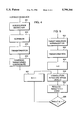
- FIG. 4 is a flow chart of an index construction program in accordance with the present invention.
- FIG. 5 is a flow chart of an indexing process in accordance with the present invention.
- FIG. 1 A database management system that incorporates the capability of performing similarity matches as a possible data mining operation in accordance with the present invention is shown in FIG. 1.
- a user issues a query from a client system (101) through a network (102) to a database management system server (103) (DBMSS).
- database management system server (103) database management system server
- the query is then processed by the query engine (104).
- the query engine searches the database stored on DASD (105) (direct access storage devices) attached to the system according to the search criteria specified by or generated from the query.
- the query results are then transmitted back to the client through the network.
- DASD direct access storage devices
- FIG. 2 shows a specific example of the similarity search process.
- time sequences (203) stored in the database (105) in FIG. 1.
- Each time sequence could represent the stock price fluctuations, quarterly sales volume, or the bond yield.
- a query (201) issued by a client (101) could be to search and find those sequences with a trend similar to that of a template (202).
- the indexing process of the present invention consists of two parts.
- the first part is indexing in the feature space.
- the implementation of the indexing can be those taught in the prior art such as R-tree indexing.
- the indexing process terminates when any one of the following conditions occur:
- R + -tree and R*-tree are taught, for example, in "The R*-tree: an efficient and robust access method for points and rectangles," by N. Beckmann et al. in Proceeding of ACM SIGMOD, pp. 322-331, 1990.
- a threshold can be set up for detecting the existence of each condition.
- the result of the indexing is a much reduced set of sequences.
- a hierarchical correlation is then performed on the stored set of sequences produced by the indexing process, as shown in FIG. 3.
- DBMSS 103 controls the storage of four sequences (301) and their corresponding transformed coefficients (302).
- the template specified by query 201 indicates a target sequence (303) to be matched against.
- the first step is thus to transform the target sequence 303 into the feature space 302 with the same transformation methods used for transforming the other sequences in the database.
- This step will generate a set of coefficients in the feature space (304).
- the hierarchical correlation is performed first on the region of the feature space that ensures the highest discrimination.
- the order of the regions (305) used in query 201 is 2, 1, 3, 4, based on the computation of the histogram of the distribution of the coefficients.
- the first region used in query 201 has the highest number of large coefficients.
- the similarity measure proposed in this invention is defined as follows:
- the metric for measuring the similarity between ⁇ x i ⁇ and ⁇ y i ⁇ is ##EQU1## where J is the J th possible subsequence, C j is a scaling constant and z J i is the J th possible subsequence of y i , defined as
- K is determined empirically.
- the first step (401) in the index construction process is to extract the subsequences from a long sequence.
- a sliding window is used to slice a long data series into subseries before they are analyzed. There are two parameters for the movement of the sliding window:
- the second step (402) is to normalize the sliced series ⁇ y ij ⁇ of length N, thus generating a new series ⁇ y ij ⁇ of unit energy, ##EQU2## where the energy E of a series is defined as ##EQU3##
- the third step (403) is to apply an orthonormal transformation to the normalized sequences.
- the Fourier coefficients ⁇ Y i ,j ⁇ of the normalized sequence ⁇ y ij ⁇ are computed from (2).
- the length of the resulting set of coefficients ⁇ Y i ,j ⁇ is equal to the length of the original normalized sliced sequence ⁇ y i ,j ⁇ .
- the transformed coefficients can be regrouped into nonintersecting subsets and subsequently compressed using various lossless compression techniques (104) such as runlength coding, huffman coding, or lossy compressing techniques (vector quantization, etc.).
- various lossless compression techniques such as runlength coding, huffman coding, or lossy compressing techniques (vector quantization, etc.).
- the coefficients are segmented into nonoverlapped groups either (a) during the index construction time or (b) at the indexing time. For some other transformation techniques such as subband coding and discrete wavelet transformation, the grouping is determined at the index construction time.
- Q is the number of coefficients within each group.
- the size of each group is designed so that the speed of the correlation process is maximized.
- the following is an example of a procedure to partition the feature space for efficient searching.
- T(n) be the minimum value of the threshold that ensures that the matching algorithm based on the first n features does not reject a matching sequence when the noise is of the defined type and the SNR is less than or equal to the fixed value.
- f 1 (n) be the computational cost of using the first n Fourier coefficients in the search.
- f 2 (n, T) be a measure of the selectivity of the matching algorithm, for instance, the percentage of sequences that are rejected as a function of the number of features used and of the threshold T(n).
- f 1 (n) is an increasing function of n (possibly convex)
- f 2 (n,T) is a nonincreasing function of n for every fixed value of the SNR.
- the function f 1 (n) can be determined a-priori, given the algorithm used for the subsequence matching and the architecture of the computer.
- the threshold T(n) can be determined experimentally using the test set V and artificially generated noise.
- the function f 2 (n,T) can be empirically determined by means of the training set S and the test set V.
- the selection process can be iteratively repeated on the feature not yet used. Also, the training set is iteratively modified to contain only the sequences that we accepted during the previous stage.
- the Fourier coefficients (or the features in the generic feature space) are obtained (502) by computing
- the hierarchical correlation (504) consists of computing the correlation between ⁇ x i ⁇ and ⁇ y n i ⁇ starting from level 0 (503) as follows:
- the correlation results at j th level is the sum of the correlation at level j-1 or the new correlation, X j i Y j i
- the similarity measure is the maximum value of the correlation at each level i, obtained by computing the inverse Fourier transform of C O R R j i at each level j
- a sequence is discarded (506) if the correlation result is less than a threshold.
Abstract
An apparatus and method includes segmenting each sequence to be stored in a database into nonoverlapping or minimally overlapping subsequences with equal length. Each subsequence is then normalized using a normalization procedure (such as normalized with respect to the energy or maximum amplitude of each sequence) and transformed into a series of coefficients in a feature space. The search is based on hierarchical correlation in the feature space between the target sequence with the subsequences. The correlation between the target sequence and the stored sequences is performed first at the lowest level in the hierarchy. At any given level, a match is declared when the correlated result is larger than a specific threshold. Sequences that fail to satisfy the matching criterion are discarded. The process is continued at the following level until the highest level is reached. Because of the hierarchical search, linear scan of the entire sequence can be avoided.
Description
The present invention relates to an information handling system and, more particularly, to an efficient technique for performing phenomena search and for retrieving similar sequences from a sequence database in a client/server information handling system.
Temporal or spatial-temporal data constitutes a large portion of data stored in computers. Several new emerging applications, such as
identification of companies with similar patterns of growth,
determining products with similar selling patterns, and
discovering stocks with similar price movement,
in various business-related areas and
identification of specific weather patterns,
identification of specific geological features,
identification of specific environmental pollutions, and
identification of astrophysics patterns
in various scientific areas require similarity matches as opposed to exact matches.
Much of the prior art has focused on exact queries.
One example of a prior art search technique is described in an article entitled "Efficient Similarity Search in Sequence Database," by Agrawal et al., published in Fourth International Conference on Foundations of Data Organization and Algorithms, Chicago, 1993. The article describes a fast-searching method to perform similarity match based on the computation of the mean square error of the first few Fourier coefficient of two sequences. However, this method does not address the issue related to scaling and possible phase difference between two sequences.
Another prior art method has been proposed to match subsequences by generating the first few Fourier coefficients of all possible subsequences of a given length for each sequence in the database. The two-Fourier-coefficient representation of each subsequences can be viewed as a point in two-dimensional feature space. The locations of several points in the Fourier domain, each of which corresponds to a subsequence, can be combined and approximately represented by a rectangle, thus reducing the overall requirement on storage space. This method neither solves the scaling problem nor retains sufficient information in the feature space and can thus cause a significant number of false alarms.
It is a primary object of the present invention to construct a database that allows similarity matches which are insensitive to the possible scale and phase differences between the stored and the test series. Furthermore, many more features from the original temporal and/or spatio-temporal sequences are retained, thus reducing the possibility of false alarms.
Accordingly, an apparatus and a method includes segmenting each sequence to be stored in the database into nonoverlapping or minimally overlapping subsequences with equal length; each subsequence is then normalized using a normalization procedure (for instance, with respect to the energy or to the maximum amplitude) and transformed into a series of coefficients in the feature space. The search is based on a combination of indexing and hierarchical correlation in the feature space between the target sequence and the subsequences. Indexing in the feature space is performed at first to prune the search space and terminates when the search space does not decrease any further. Correlation is then performed between the target sequence and the search space. The correlation between the target sequence and the sequences in the search space is performed first at the lowest level in the hierarchy. At any given level, a match is declared when the correlated result is larger than a specific threshold. Sequences that fail to satisfy the matching criterion are discarded. The process is continued at the following level until the highest level is reached. Because of the hierarchical search, linear scan of the entire sequence can be avoided.
The foregoing has outlined the features and advantages of the present invention so that the detailed description of a preferred embodiment of the invention, which follows, may be better understood.
For a more complete understanding of the present invention, and the features and advantages thereof, reference is made to the detailed description of embodiments of the invention in conjunction with the accompanying drawing in which:
FIG. 1 is a block diagram of a system illustrating a database management system server serving queries issued from clients through a network according to the present invention.
FIG. 2 is an example of a process of performing template matching in data mining operation in accordance with the present invention.
FIG. 3 illustrates an example of the representation of four sequences in their feature space in accordance with the present invention.
FIG. 4 is a flow chart of an index construction program in accordance with the present invention.
FIG. 5 is a flow chart of an indexing process in accordance with the present invention.
A database management system that incorporates the capability of performing similarity matches as a possible data mining operation in accordance with the present invention is shown in FIG. 1. A user issues a query from a client system (101) through a network (102) to a database management system server (103) (DBMSS). Note that in such a client/server environment, multiple clients and servers can be configured so that the data in the database is either partitioned or replicated among database management servers. The query is then processed by the query engine (104). The query engine searches the database stored on DASD (105) (direct access storage devices) attached to the system according to the search criteria specified by or generated from the query. The query results are then transmitted back to the client through the network.
FIG. 2 shows a specific example of the similarity search process. There are 10 time sequences (203) stored in the database (105) in FIG. 1. Each time sequence could represent the stock price fluctuations, quarterly sales volume, or the bond yield. A query (201) issued by a client (101) could be to search and find those sequences with a trend similar to that of a template (202).
The indexing process of the present invention consists of two parts. The first part is indexing in the feature space. The implementation of the indexing can be those taught in the prior art such as R-tree indexing. However, the indexing process terminates when any one of the following conditions occur:
(1) There are too many multipaths search (which would occur in R+ -tree);
(2) The pruning due to each additional level of traversing is not effective (which could occur in R*-tree).
Both R+ -tree and R*-tree are taught, for example, in "The R*-tree: an efficient and robust access method for points and rectangles," by N. Beckmann et al. in Proceeding of ACM SIGMOD, pp. 322-331, 1990. A threshold can be set up for detecting the existence of each condition.
The result of the indexing is a much reduced set of sequences. A hierarchical correlation is then performed on the stored set of sequences produced by the indexing process, as shown in FIG. 3. DBMSS 103 controls the storage of four sequences (301) and their corresponding transformed coefficients (302). The template specified by query 201 indicates a target sequence (303) to be matched against. The first step is thus to transform the target sequence 303 into the feature space 302 with the same transformation methods used for transforming the other sequences in the database. This step will generate a set of coefficients in the feature space (304). The feature space has been divided into K (K=4 in this example) regions. The hierarchical correlation is performed first on the region of the feature space that ensures the highest discrimination. In this example, the order of the regions (305) used in query 201 is 2, 1, 3, 4, based on the computation of the histogram of the distribution of the coefficients. The first region used in query 201 has the highest number of large coefficients. Hence, the hierarchical correlation process can be adaptively modified using the target sequence.
This process is explained in further detail below.
(1) Definitions:
The similarity measure proposed in this invention is defined as follows:
Let {xi } and {yi } be the two series to be compared, let n be the length of {xi }, N be the length of {yi }, and without loss of generality that n≦N. We shall later relax the last assumption.
The metric for measuring the similarity between {xi } and {yi } is ##EQU1## where J is the Jth possible subsequence, Cj is a scaling constant and zJ i is the Jth possible subsequence of yi, defined as
z.sub.i.sup.J =y.sub.mi+k (2)
where m is the sampling period and k is the initial sampling delay. Here we have limited the discussion to uniformly sampled sequences {zJ i } from {yi } with a possible phase adjustment k. However, its generalization to nonuniform sampling is straightforward.
In the proposed sequence matching algorithm, each stored sequence {yi } is represented by {Yk }, the Fourier coefficients of {yi } where k=1..K and K≦N. The value of K is determined empirically.
Fourier transformation is adopted in the preferred embodiment, even though other transformation methods such as discrete cosine transform and discrete wavelet transform can also be used.
In the following, major components of the matching technique are described.
(1) Index Construction Process (FIG. 4)
The first step (401) in the index construction process is to extract the subsequences from a long sequence. A sliding window is used to slice a long data series into subseries before they are analyzed. There are two parameters for the movement of the sliding window:
1. size of the window, and
2. increments (i.e., sliding steps) of the window.
The use of a sliding window to generate versions of the sequences {yi,l }, . . . , {yi,L } from the original sequence {yi } removes the boundary effects during slicing a long stream of data into several subseries, at the expense of increasing the redundancy of the data storage. If the window size is M and the window moves at increments of αM, then the redundancy is 1/α. If α equals 1, the redundancy equals 1 and there is no overlap of data between adjacent windows. This windowing operation is essential for performing phase-independent similarity match. Metadata is computed for each subsequence extracted in step 401. The metadata includes, but is not limited to, the length, the slope, first and higher order statistics of the subesequence, as well as the parameters used in normalization step 402. The computation of metadata is well known in the art, and is done for efficiency reasons.
The second step (402) is to normalize the sliced series {yij } of length N, thus generating a new series {yij } of unit energy, ##EQU2## where the energy E of a series is defined as ##EQU3##
The third step (403) is to apply an orthonormal transformation to the normalized sequences.
The Fourier coefficients {Yi,j } of the normalized sequence {yij } are computed from (2). The length of the resulting set of coefficients {Yi,j } is equal to the length of the original normalized sliced sequence {yi,j }.
The transformed coefficients can be regrouped into nonintersecting subsets and subsequently compressed using various lossless compression techniques (104) such as runlength coding, huffman coding, or lossy compressing techniques (vector quantization, etc.).
(2) Grouping of Coefficients
After the Fourier coefficients {Yi,j } are computed for each normalized sliced sequence {yi,j }, the coefficients are segmented into nonoverlapped groups either (a) during the index construction time or (b) at the indexing time. For some other transformation techniques such as subband coding and discrete wavelet transformation, the grouping is determined at the index construction time.
After partitioning of the Fourier coefficients {Yi,j } into P nonoverlapping groups, the ith coefficients within the pth group is
Y.sub.i,j.sup.p =Y.sub.pQ+i,j (5)
where Q is the number of coefficients within each group. The size of each group is designed so that the speed of the correlation process is maximized. The following is an example of a procedure to partition the feature space for efficient searching.
Select from the database (for instance, at random) a group of sequences, and call it the training set S. Construct a set of test subsequences V. Let the feature space be the space of Fourier coefficients of the sequences. Order the coefficients according to their natural ordering. Assume a model for noise (for instance, additive white Gaussian noise or AWGN) and fix a signal to noise ratio (SNR).
Now define a threshold T(n) and two functions f1 (n) and f2 (n,T) as follows:
Let T(n) be the minimum value of the threshold that ensures that the matching algorithm based on the first n features does not reject a matching sequence when the noise is of the defined type and the SNR is less than or equal to the fixed value.
Let f1 (n) be the computational cost of using the first n Fourier coefficients in the search.
Let f2 (n, T) be a measure of the selectivity of the matching algorithm, for instance, the percentage of sequences that are rejected as a function of the number of features used and of the threshold T(n).
In general, f1 (n) is an increasing function of n (possibly convex), while f2 (n,T) is a nonincreasing function of n for every fixed value of the SNR.
The function f1 (n) can be determined a-priori, given the algorithm used for the subsequence matching and the architecture of the computer. The threshold T(n) can be determined experimentally using the test set V and artificially generated noise. Once T(n) is fixed, the function f2 (n,T) can be empirically determined by means of the training set S and the test set V.
A cost function, for instance c(n)=f1 (n)+(1+r)f2 (n,T) is defined and a value of n that minimizes it is found. Again, note that both f2 and T are estimated from the training and test sets.
Once n is fixed, the selection process can be iteratively repeated on the feature not yet used. Also, the training set is iteratively modified to contain only the sequences that we accepted during the previous stage.
(3) Matching Process (FIG. 5)
The process of matching a temporal or a spatio-temporal database is shown in FIG. 5 and discussed below.
The first step (501) is to normalize the target sequence {xi } using the same normalization procedure as in the index construction process. If the length of the target sequence is smaller than the length of a segment, the target sequence {xi } is padded with zeros by setting xi =0 for i=n+1 . . . N+n-1.
The Fourier coefficients (or the features in the generic feature space) are obtained (502) by computing
X.sub.i =Fourier{x.sub.i } (6)
The hierarchical correlation (504) consists of computing the correlation between {xi } and {yn i } starting from level 0 (503) as follows:
CORR.sub.i.sup.0 =X.sub.i.sup.0 Y.sub.i.sup.0 (7)
The ith level is related to the pth group through a mapping function i=f(p) where the mapping function f(.), the order in which the correlation coefficients are computed, is designed so that the distinction capability of the correlation between the target sequence and the stored sequence is maximized at each level (and yields maximum filtering capability). This could be achieved by either of the following two techniques:
1. compute the total energy within each group and order the relative importance of each group by the total energy of each group, or
2. compute the variance (or entropy) of each group and order the groups according to their variance.
The correlation results at jth level is the sum of the correlation at level j-1 or the new correlation, Xj i Yj i
CORR.sub.i.sup.j =CORR.sub.i.sup.j-1 +X.sub.i.sup.j Y.sub.i.sup.j (8)
The similarity measure is the maximum value of the correlation at each level i, obtained by computing the inverse Fourier transform of C O R Rj i at each level j
corr.sub.i =Fourier.sup.-1 {CORR.sub.i }. (9)
Thus, the final measure is
S=max{corr.sub.i } (10)
A sequence is discarded (506) if the correlation result is less than a threshold. As a result of the described process, many sequences in the database that do not present similarity with the test sequence, in the sense of the metric defined in Eq. (1), can be quickly discarded at each level of the hierarchical search, thus reducing the overall computation requirements.
Now that the invention has been described by way of the preferred embodiment, it should be understood that various modifications, substitutions and alterations will occur to those of skill in the art without departing from the spirit or scope of the invention as defined by the appended claims.
Claims (9)
1. A method for detecting a similarity between a target data sequence and one or more data sequences stored in a database comprising the steps of:
retrieving a subset of the stored sequences based on the target sequence and an indexing technique, wherein each of said stored sequences and said target sequence have a numerical value, and wherein each of said stored sequences and said target sequence are stored in a feature space;
correlating, based on the numerical values, between said target sequence and said one or more stored sequences at a first level of a predetermined hierarchy in said feature space;
testing a result of said correlating step against a predetermined threshold value;
declaring a match between said target sequence and said one or more stored sequences if said result of said correlating step is greater than said predetermined threshold value.
2. A method, for detecting a similarity between a target data sequence and one or more data sequences stored in a database, according to claim 1, further comprising the step of:
repeating said steps of correlating and testing at a next level of said predetermined hierarchy in said feature space if a match is not declared as a result of said testing step executed at a previous level of said predetermined hierarchy.
3. A method for constructing a representation of a database of sequences for detecting a similarity, comprising the steps of:
applying a feature extraction function to each of a plurality of stored objects in said database, to create a sequence with reduced dimensions;
extracting subsequences having less than a predetermined level of overlapping from the original sequence;
normalizing each extracted subsequence;
computing metadata for each extacted subsequence;
transforming said normalized subsequences; and
compressing coefficients of said transformed normalized subsequences.
4. A method for constructing a representation of a database of sequences for detecting a similarity according to claim 3, further comprising the step of:
determining a grouping of said coefficients based on a target sequence.
5. A method for constructing a representation of a database of sequences for detecting a similarity according to claim 3, further comprising the step of:
determining relative importance value for each group of coefficients based on a target sequence.
6. A method for constructing a representation according to claim 3, further comprising the steps of:
normalizing said target sequence;
transforming said normalized target sequence;
applying a transformed domain convolution between said target sequence and said sequences stored in said database in a feature space; and
pruning a set of sequences such that said set of sequences are selected only when the maximum value of the convolution result in a level of the hierarchy is above a predetermined threshold.
7. A method for correlating between a target data sequence and one or more data sequences stored in a database, comprising the steps of:
transforming said target sequence into a feature space to generate a first set of coefficients representing said target data sequence in said feature space;
computing a first characteristic for each group in a plurality of groups in said target data sequence and said one or more stored data sequences; and
ordering each said group in order of said first characteristic to maximize the distinction capability of correlation between said target data sequence and said stored sequence.
8. A method according to claim 7 wherein said first characteristic is a representation of energy within each said group.
9. A method according to claim 7 wherein said first characteristic is a measure of variance of each said group.
Priority Applications (1)
| Application Number | Priority Date | Filing Date | Title |
|---|---|---|---|
| US08/513,583 US5799301A (en) | 1995-08-10 | 1995-08-10 | Apparatus and method for performing adaptive similarity searching in a sequence database |
Applications Claiming Priority (1)
| Application Number | Priority Date | Filing Date | Title |
|---|---|---|---|
| US08/513,583 US5799301A (en) | 1995-08-10 | 1995-08-10 | Apparatus and method for performing adaptive similarity searching in a sequence database |
Publications (1)
| Publication Number | Publication Date |
|---|---|
| US5799301A true US5799301A (en) | 1998-08-25 |
Family
ID=24043877
Family Applications (1)
| Application Number | Title | Priority Date | Filing Date |
|---|---|---|---|
| US08/513,583 Expired - Fee Related US5799301A (en) | 1995-08-10 | 1995-08-10 | Apparatus and method for performing adaptive similarity searching in a sequence database |
Country Status (1)
| Country | Link |
|---|---|
| US (1) | US5799301A (en) |
Cited By (24)
| Publication number | Priority date | Publication date | Assignee | Title |
|---|---|---|---|---|
| US5930789A (en) * | 1995-05-09 | 1999-07-27 | International Business Machines Corporation | System and method for discovering similar time sequences in databases |
| US5940825A (en) * | 1996-10-04 | 1999-08-17 | International Business Machines Corporation | Adaptive similarity searching in sequence databases |
| US5983224A (en) * | 1997-10-31 | 1999-11-09 | Hitachi America, Ltd. | Method and apparatus for reducing the computational requirements of K-means data clustering |
| US6009424A (en) * | 1996-09-04 | 1999-12-28 | Atr Interpreting Telecommunications Research Laboratories | Similarity search apparatus for searching unit string based on similarity |
| US6148295A (en) * | 1997-12-30 | 2000-11-14 | International Business Machines Corporation | Method for computing near neighbors of a query point in a database |
| WO2001003010A1 (en) * | 1999-07-01 | 2001-01-11 | Honeywell Inc. | Content-based retrieval of series data |
| WO2001046771A2 (en) * | 1999-12-20 | 2001-06-28 | Korea Advanced Institute Of Science And Technology | A subsequence matching method using duality in constructing windows in time-series databases |
| US6298351B1 (en) * | 1997-04-11 | 2001-10-02 | International Business Machines Corporation | Modifying an unreliable training set for supervised classification |
| US20030158850A1 (en) * | 2002-02-20 | 2003-08-21 | Lawrence Technologies, L.L.C. | System and method for identifying relationships between database records |
| US6618727B1 (en) * | 1999-09-22 | 2003-09-09 | Infoglide Corporation | System and method for performing similarity searching |
| US20030177110A1 (en) * | 2002-03-15 | 2003-09-18 | Fujitsu Limited | Profile information recommendation method, program and apparatus |
| US20040024755A1 (en) * | 2002-08-05 | 2004-02-05 | Rickard John Terrell | System and method for indexing non-textual data |
| US6735589B2 (en) * | 2001-06-07 | 2004-05-11 | Microsoft Corporation | Method of reducing dimensionality of a set of attributes used to characterize a sparse data set |
| US20040236735A1 (en) * | 2001-01-12 | 2004-11-25 | Microsoft Corporation | Database aggregation query result estimator |
| US6882997B1 (en) * | 1999-08-25 | 2005-04-19 | The Research Foundation Of Suny At Buffalo | Wavelet-based clustering method for managing spatial data in very large databases |
| US20050097120A1 (en) * | 2003-10-31 | 2005-05-05 | Fuji Xerox Co., Ltd. | Systems and methods for organizing data |
| US6941317B1 (en) | 1999-09-14 | 2005-09-06 | Eragen Biosciences, Inc. | Graphical user interface for display and analysis of biological sequence data |
| US20060112264A1 (en) * | 2004-11-24 | 2006-05-25 | International Business Machines Corporation | Method and Computer Program Product for Finding the Longest Common Subsequences Between Files with Applications to Differential Compression |
| US20070112754A1 (en) * | 2005-11-15 | 2007-05-17 | Honeywell International Inc. | Method and apparatus for identifying data of interest in a database |
| US20070112747A1 (en) * | 2005-11-15 | 2007-05-17 | Honeywell International Inc. | Method and apparatus for identifying data of interest in a database |
| WO2008129458A1 (en) * | 2007-04-18 | 2008-10-30 | Koninklijke Philips Electronics N.V. | A method for data mining dna frequency based spectra |
| US7668845B1 (en) | 2004-02-18 | 2010-02-23 | Microsoft Corporation | C-tree for multi-attribute indexing |
| US20110131101A1 (en) * | 2007-03-05 | 2011-06-02 | Mohamed Sherif Danish | Display and search interface for product database |
| US10956402B2 (en) | 2018-04-13 | 2021-03-23 | Visa International Service Association | Method and system for automatically detecting errors in at least one date entry using image maps |
Citations (22)
| Publication number | Priority date | Publication date | Assignee | Title |
|---|---|---|---|---|
| US4598385A (en) * | 1980-09-12 | 1986-07-01 | U.S. Philips Corporation | Device for associative searching in a sequential data stream composed of data records |
| US4700294A (en) * | 1982-10-15 | 1987-10-13 | Becton Dickinson And Company | Data storage system having means for compressing input data from sets of correlated parameters |
| US5049881A (en) * | 1990-06-18 | 1991-09-17 | Intersecting Concepts, Inc. | Apparatus and method for very high data rate-compression incorporating lossless data compression and expansion utilizing a hashing technique |
| US5133052A (en) * | 1988-08-04 | 1992-07-21 | Xerox Corporation | Interactive graphical search and replace utility for computer-resident synthetic graphic image editors |
| US5317730A (en) * | 1991-01-11 | 1994-05-31 | International Business Machines Corporation | System for modifying persistent database based upon set of data elements formed after selective insertion or deletion |
| US5432902A (en) * | 1988-07-18 | 1995-07-11 | Fujitsu Limited | Method of selecting a menu in accordance with a maximum correlation between a user input and stored parameters |
| US5438628A (en) * | 1993-04-19 | 1995-08-01 | Xerox Corporation | Method for matching text images and documents using character shape codes |
| US5450504A (en) * | 1992-05-19 | 1995-09-12 | Calia; James | Method for finding a most likely matching of a target facial image in a data base of facial images |
| US5485611A (en) * | 1994-12-30 | 1996-01-16 | Intel Corporation | Video database indexing and method of presenting video database index to a user |
| US5497486A (en) * | 1994-03-15 | 1996-03-05 | Salvatore J. Stolfo | Method of merging large databases in parallel |
| US5524240A (en) * | 1994-05-24 | 1996-06-04 | Panasonic Technologies, Inc. | Method and apparatus for storage and retrieval of handwritten information |
| US5537586A (en) * | 1992-04-30 | 1996-07-16 | Individual, Inc. | Enhanced apparatus and methods for retrieving and selecting profiled textural information records from a database of defined category structures |
| US5546575A (en) * | 1994-05-23 | 1996-08-13 | Basil E. Potter & Associates, Inc. | Encoding method for compressing a tabular database by selecting effective compression routines for each field and structure of partitions of equal sized records |
| US5548755A (en) * | 1995-02-17 | 1996-08-20 | International Business Machines Corporation | System for optimizing correlated SQL queries in a relational database using magic decorrelation |
| US5577249A (en) * | 1992-07-31 | 1996-11-19 | International Business Machines Corporation | Method for finding a reference token sequence in an original token string within a database of token strings using appended non-contiguous substrings |
| US5614927A (en) * | 1995-01-13 | 1997-03-25 | Bell Communications Research, Inc. | Protecting confidential information in a database for enabling targeted advertising in a communications network |
| US5631972A (en) * | 1995-05-04 | 1997-05-20 | Ferris; Stephen | Hyperladder fingerprint matcher |
| US5668897A (en) * | 1994-03-15 | 1997-09-16 | Stolfo; Salvatore J. | Method and apparatus for imaging, image processing and data compression merge/purge techniques for document image databases |
| US5684999A (en) * | 1993-12-06 | 1997-11-04 | Matsushita Electric Industrial Co., Ltd. | Apparatus and a method for retrieving image objects based on correlation with natural language sentence parameters |
| US5687190A (en) * | 1995-10-20 | 1997-11-11 | Otc Telecom | Non-coherent direct sequence spread spectrum receiver for detecting bit/symbol chip sequences using threshold comparisons of chip sequence correlations |
| US5706498A (en) * | 1993-09-27 | 1998-01-06 | Hitachi Device Engineering Co., Ltd. | Gene database retrieval system where a key sequence is compared to database sequences by a dynamic programming device |
| US5710833A (en) * | 1995-04-20 | 1998-01-20 | Massachusetts Institute Of Technology | Detection, recognition and coding of complex objects using probabilistic eigenspace analysis |
-
1995
- 1995-08-10 US US08/513,583 patent/US5799301A/en not_active Expired - Fee Related
Patent Citations (22)
| Publication number | Priority date | Publication date | Assignee | Title |
|---|---|---|---|---|
| US4598385A (en) * | 1980-09-12 | 1986-07-01 | U.S. Philips Corporation | Device for associative searching in a sequential data stream composed of data records |
| US4700294A (en) * | 1982-10-15 | 1987-10-13 | Becton Dickinson And Company | Data storage system having means for compressing input data from sets of correlated parameters |
| US5432902A (en) * | 1988-07-18 | 1995-07-11 | Fujitsu Limited | Method of selecting a menu in accordance with a maximum correlation between a user input and stored parameters |
| US5133052A (en) * | 1988-08-04 | 1992-07-21 | Xerox Corporation | Interactive graphical search and replace utility for computer-resident synthetic graphic image editors |
| US5049881A (en) * | 1990-06-18 | 1991-09-17 | Intersecting Concepts, Inc. | Apparatus and method for very high data rate-compression incorporating lossless data compression and expansion utilizing a hashing technique |
| US5317730A (en) * | 1991-01-11 | 1994-05-31 | International Business Machines Corporation | System for modifying persistent database based upon set of data elements formed after selective insertion or deletion |
| US5537586A (en) * | 1992-04-30 | 1996-07-16 | Individual, Inc. | Enhanced apparatus and methods for retrieving and selecting profiled textural information records from a database of defined category structures |
| US5450504A (en) * | 1992-05-19 | 1995-09-12 | Calia; James | Method for finding a most likely matching of a target facial image in a data base of facial images |
| US5577249A (en) * | 1992-07-31 | 1996-11-19 | International Business Machines Corporation | Method for finding a reference token sequence in an original token string within a database of token strings using appended non-contiguous substrings |
| US5438628A (en) * | 1993-04-19 | 1995-08-01 | Xerox Corporation | Method for matching text images and documents using character shape codes |
| US5706498A (en) * | 1993-09-27 | 1998-01-06 | Hitachi Device Engineering Co., Ltd. | Gene database retrieval system where a key sequence is compared to database sequences by a dynamic programming device |
| US5684999A (en) * | 1993-12-06 | 1997-11-04 | Matsushita Electric Industrial Co., Ltd. | Apparatus and a method for retrieving image objects based on correlation with natural language sentence parameters |
| US5497486A (en) * | 1994-03-15 | 1996-03-05 | Salvatore J. Stolfo | Method of merging large databases in parallel |
| US5668897A (en) * | 1994-03-15 | 1997-09-16 | Stolfo; Salvatore J. | Method and apparatus for imaging, image processing and data compression merge/purge techniques for document image databases |
| US5546575A (en) * | 1994-05-23 | 1996-08-13 | Basil E. Potter & Associates, Inc. | Encoding method for compressing a tabular database by selecting effective compression routines for each field and structure of partitions of equal sized records |
| US5524240A (en) * | 1994-05-24 | 1996-06-04 | Panasonic Technologies, Inc. | Method and apparatus for storage and retrieval of handwritten information |
| US5485611A (en) * | 1994-12-30 | 1996-01-16 | Intel Corporation | Video database indexing and method of presenting video database index to a user |
| US5614927A (en) * | 1995-01-13 | 1997-03-25 | Bell Communications Research, Inc. | Protecting confidential information in a database for enabling targeted advertising in a communications network |
| US5548755A (en) * | 1995-02-17 | 1996-08-20 | International Business Machines Corporation | System for optimizing correlated SQL queries in a relational database using magic decorrelation |
| US5710833A (en) * | 1995-04-20 | 1998-01-20 | Massachusetts Institute Of Technology | Detection, recognition and coding of complex objects using probabilistic eigenspace analysis |
| US5631972A (en) * | 1995-05-04 | 1997-05-20 | Ferris; Stephen | Hyperladder fingerprint matcher |
| US5687190A (en) * | 1995-10-20 | 1997-11-11 | Otc Telecom | Non-coherent direct sequence spread spectrum receiver for detecting bit/symbol chip sequences using threshold comparisons of chip sequence correlations |
Non-Patent Citations (8)
| Title |
|---|
| Agrawal et al, Database mining: A Performance Perspective, IEEE, pp. 914 925, Dec. 1993. * |
| Agrawal et al, Database mining: A Performance Perspective, IEEE, pp. 914-925, Dec. 1993. |
| Agrawal et al, Efficient Similarity Search in Sequence Datbases, IBM, pp. 1 16, Mar. 1994. * |
| Agrawal et al, Efficient Similarity Search in Sequence Datbases, IBM, pp. 1-16, Mar. 1994. |
| Beckmann et al, The R* tree: An Efficient and Robus Access Method for Points and Rectangles, Praktische Informatick, pp. 322 332, 1990. * |
| Beckmann et al, The R*-tree: An Efficient and Robus Access Method for Points and Rectangles, Praktische Informatick, pp. 322-332, 1990. |
| Saridis et al, Analytic Formulation of Intelligent Machines as Neural Networks, IEEE, pp. 22 27, Dec. 1989. * |
| Saridis et al, Analytic Formulation of Intelligent Machines as Neural Networks, IEEE, pp. 22-27, Dec. 1989. |
Cited By (43)
| Publication number | Priority date | Publication date | Assignee | Title |
|---|---|---|---|---|
| US5930789A (en) * | 1995-05-09 | 1999-07-27 | International Business Machines Corporation | System and method for discovering similar time sequences in databases |
| US6009424A (en) * | 1996-09-04 | 1999-12-28 | Atr Interpreting Telecommunications Research Laboratories | Similarity search apparatus for searching unit string based on similarity |
| US5940825A (en) * | 1996-10-04 | 1999-08-17 | International Business Machines Corporation | Adaptive similarity searching in sequence databases |
| US6298351B1 (en) * | 1997-04-11 | 2001-10-02 | International Business Machines Corporation | Modifying an unreliable training set for supervised classification |
| US5983224A (en) * | 1997-10-31 | 1999-11-09 | Hitachi America, Ltd. | Method and apparatus for reducing the computational requirements of K-means data clustering |
| US6148295A (en) * | 1997-12-30 | 2000-11-14 | International Business Machines Corporation | Method for computing near neighbors of a query point in a database |
| WO2001003010A1 (en) * | 1999-07-01 | 2001-01-11 | Honeywell Inc. | Content-based retrieval of series data |
| US6754388B1 (en) | 1999-07-01 | 2004-06-22 | Honeywell Inc. | Content-based retrieval of series data |
| US6882997B1 (en) * | 1999-08-25 | 2005-04-19 | The Research Foundation Of Suny At Buffalo | Wavelet-based clustering method for managing spatial data in very large databases |
| US6941317B1 (en) | 1999-09-14 | 2005-09-06 | Eragen Biosciences, Inc. | Graphical user interface for display and analysis of biological sequence data |
| US6618727B1 (en) * | 1999-09-22 | 2003-09-09 | Infoglide Corporation | System and method for performing similarity searching |
| WO2001046771A3 (en) * | 1999-12-20 | 2002-08-15 | Korea Advanced Inst Sci & Tech | A subsequence matching method using duality in constructing windows in time-series databases |
| US6496817B1 (en) * | 1999-12-20 | 2002-12-17 | Korea Advanced Institute Of Science & Technology | Subsequence matching method using duality in constructing windows in time-series databases |
| WO2001046771A2 (en) * | 1999-12-20 | 2001-06-28 | Korea Advanced Institute Of Science And Technology | A subsequence matching method using duality in constructing windows in time-series databases |
| US7293037B2 (en) * | 2001-01-12 | 2007-11-06 | Microsoft Corporation | Database aggregation query result estimator |
| US20060053103A1 (en) * | 2001-01-12 | 2006-03-09 | Microsoft Corporation | Database aggregation query result estimator |
| US7191181B2 (en) * | 2001-01-12 | 2007-03-13 | Microsoft Corporation | Database aggregation query result estimator |
| US20040236735A1 (en) * | 2001-01-12 | 2004-11-25 | Microsoft Corporation | Database aggregation query result estimator |
| US6842753B2 (en) * | 2001-01-12 | 2005-01-11 | Microsoft Corporation | Sampling for aggregation queries |
| US7363301B2 (en) * | 2001-01-12 | 2008-04-22 | Microsoft Corporation | Database aggregation query result estimator |
| US20060036600A1 (en) * | 2001-01-12 | 2006-02-16 | Microsoft Corporation | Database aggregation query result estimator |
| US6735589B2 (en) * | 2001-06-07 | 2004-05-11 | Microsoft Corporation | Method of reducing dimensionality of a set of attributes used to characterize a sparse data set |
| US20030158850A1 (en) * | 2002-02-20 | 2003-08-21 | Lawrence Technologies, L.L.C. | System and method for identifying relationships between database records |
| US7246129B2 (en) | 2002-02-20 | 2007-07-17 | Lawrence P Nick | System and method for identifying relationships between database records |
| US7349928B2 (en) | 2002-02-20 | 2008-03-25 | Syngence Corporation | System and method for identifying relationships between database records |
| US7031969B2 (en) | 2002-02-20 | 2006-04-18 | Lawrence Technologies, Llc | System and method for identifying relationships between database records |
| US20060010144A1 (en) * | 2002-02-20 | 2006-01-12 | Lawrence Technologies, Llc | System and method for identifying relationships between database records |
| US20060123036A1 (en) * | 2002-02-20 | 2006-06-08 | Lawrence Technologies, Llc | System and method for identifying relationships between database records |
| US20030177110A1 (en) * | 2002-03-15 | 2003-09-18 | Fujitsu Limited | Profile information recommendation method, program and apparatus |
| US20040024755A1 (en) * | 2002-08-05 | 2004-02-05 | Rickard John Terrell | System and method for indexing non-textual data |
| WO2004013772A2 (en) * | 2002-08-05 | 2004-02-12 | Lockheed Martin Orincon Corporation | System and method for indexing non-textual data |
| WO2004013772A3 (en) * | 2002-08-05 | 2004-05-13 | Lockheed Martin Orincon Corp | System and method for indexing non-textual data |
| US20050097120A1 (en) * | 2003-10-31 | 2005-05-05 | Fuji Xerox Co., Ltd. | Systems and methods for organizing data |
| US7668845B1 (en) | 2004-02-18 | 2010-02-23 | Microsoft Corporation | C-tree for multi-attribute indexing |
| US20060112264A1 (en) * | 2004-11-24 | 2006-05-25 | International Business Machines Corporation | Method and Computer Program Product for Finding the Longest Common Subsequences Between Files with Applications to Differential Compression |
| US7487169B2 (en) | 2004-11-24 | 2009-02-03 | International Business Machines Corporation | Method for finding the longest common subsequences between files with applications to differential compression |
| US20070112747A1 (en) * | 2005-11-15 | 2007-05-17 | Honeywell International Inc. | Method and apparatus for identifying data of interest in a database |
| US20070112754A1 (en) * | 2005-11-15 | 2007-05-17 | Honeywell International Inc. | Method and apparatus for identifying data of interest in a database |
| US20110131101A1 (en) * | 2007-03-05 | 2011-06-02 | Mohamed Sherif Danish | Display and search interface for product database |
| US8209327B2 (en) * | 2007-03-05 | 2012-06-26 | Kelora Systems, Llc | Display and search interface for product database |
| WO2008129458A1 (en) * | 2007-04-18 | 2008-10-30 | Koninklijke Philips Electronics N.V. | A method for data mining dna frequency based spectra |
| US10956402B2 (en) | 2018-04-13 | 2021-03-23 | Visa International Service Association | Method and system for automatically detecting errors in at least one date entry using image maps |
| US11580092B2 (en) | 2018-04-13 | 2023-02-14 | Visa International Service Association | Method and system for automatically detecting errors in at least one data entry using image maps |
Similar Documents
| Publication | Publication Date | Title |
|---|---|---|
| US5799301A (en) | Apparatus and method for performing adaptive similarity searching in a sequence database | |
| Li et al. | Hierarchyscan: A hierarchical similarity search algorithm for databases of long sequences | |
| US5940825A (en) | Adaptive similarity searching in sequence databases | |
| Saito | Simultaneous noise suppression and signal compression using a library of orthonormal bases and the minimum description length criterion | |
| EP0806733B1 (en) | Method and apparatus for multi-resolution image searching | |
| US5734893A (en) | Progressive content-based retrieval of image and video with adaptive and iterative refinement | |
| KR100483321B1 (en) | The Device and Method for Similarity Search Using Hyper-rectangle Based Multidimensional Data Segmentation | |
| US8977067B1 (en) | Audio identification using wavelet-based signatures | |
| US7006714B2 (en) | Image retrieval device, image retrieval method and storage medium storing similar-image retrieval program | |
| EP1221662A2 (en) | Image retrieval method | |
| Doulamis et al. | Video content representation using optimal extraction of frames and scenes | |
| USRE43896E1 (en) | Image and video indexing scheme for content analysis | |
| US20090300055A1 (en) | Accurate content-based indexing and retrieval system | |
| Subramanya et al. | Wavelet-based indexing of audio data in audio/multimedia databases | |
| Zan et al. | Dynamic SAX parameter estimation for time series | |
| Li et al. | Wavelet methods in data mining | |
| Yadav et al. | Texture-based medical image retrieval in compressed domain using compressive sensing | |
| Devi et al. | Fast image retrieval using error diffusion block truncation coding and unsupervised clustering | |
| Idris et al. | Storage and retrieval of compressed images using wavelet vector quantization | |
| Huang et al. | Content-based color image retrieval via lifting scheme | |
| Albuz et al. | Scalable image indexing and retrieval using wavelets | |
| JP3497713B2 (en) | Information classification method, apparatus and system | |
| Heinz et al. | Adaptive wavelet density estimators over data streams | |
| Kubo et al. | Content-based image retrieval technique using wavelet-based shift and brightness invariant edge feature | |
| KR20010027936A (en) | Method and Apparatus for retrieving of texture image |
Legal Events
| Date | Code | Title | Description |
|---|---|---|---|
| AS | Assignment |
Owner name: IBM CORPORATION, NEW YORK Free format text: ASSIGNMENT OF ASSIGNORS INTEREST;ASSIGNORS:CASTELLI, VITTORIO;LI, CHUNG SHENG;YU, PHILIP S.;REEL/FRAME:007618/0989 Effective date: 19950809 |
|
| FPAY | Fee payment |
Year of fee payment: 4 |
|
| REMI | Maintenance fee reminder mailed | ||
| LAPS | Lapse for failure to pay maintenance fees | ||
| STCH | Information on status: patent discontinuation |
Free format text: PATENT EXPIRED DUE TO NONPAYMENT OF MAINTENANCE FEES UNDER 37 CFR 1.362 |
|
| FP | Lapsed due to failure to pay maintenance fee |
Effective date: 20060825 |