US6284971B1 - Enhanced safety coaxial cables - Google Patents
Enhanced safety coaxial cables Download PDFInfo
- Publication number
- US6284971B1 US6284971B1 US09/449,027 US44902799A US6284971B1 US 6284971 B1 US6284971 B1 US 6284971B1 US 44902799 A US44902799 A US 44902799A US 6284971 B1 US6284971 B1 US 6284971B1
- Authority
- US
- United States
- Prior art keywords
- coaxial cable
- outer shield
- conductor
- portions
- segmented
- Prior art date
- Legal status (The legal status is an assumption and is not a legal conclusion. Google has not performed a legal analysis and makes no representation as to the accuracy of the status listed.)
- Expired - Lifetime
Links
Images


Classifications
-
- H—ELECTRICITY
- H01—ELECTRIC ELEMENTS
- H01P—WAVEGUIDES; RESONATORS, LINES, OR OTHER DEVICES OF THE WAVEGUIDE TYPE
- H01P3/00—Waveguides; Transmission lines of the waveguide type
- H01P3/02—Waveguides; Transmission lines of the waveguide type with two longitudinal conductors
- H01P3/06—Coaxial lines
-
- H—ELECTRICITY
- H01—ELECTRIC ELEMENTS
- H01P—WAVEGUIDES; RESONATORS, LINES, OR OTHER DEVICES OF THE WAVEGUIDE TYPE
- H01P1/00—Auxiliary devices
- H01P1/20—Frequency-selective devices, e.g. filters
- H01P1/201—Filters for transverse electromagnetic waves
- H01P1/202—Coaxial filters
-
- A—HUMAN NECESSITIES
- A61—MEDICAL OR VETERINARY SCIENCE; HYGIENE
- A61N—ELECTROTHERAPY; MAGNETOTHERAPY; RADIATION THERAPY; ULTRASOUND THERAPY
- A61N1/00—Electrotherapy; Circuits therefor
- A61N1/02—Details
- A61N1/08—Arrangements or circuits for monitoring, protecting, controlling or indicating
- A61N1/086—Magnetic resonance imaging [MRI] compatible leads
-
- H—ELECTRICITY
- H01—ELECTRIC ELEMENTS
- H01B—CABLES; CONDUCTORS; INSULATORS; SELECTION OF MATERIALS FOR THEIR CONDUCTIVE, INSULATING OR DIELECTRIC PROPERTIES
- H01B11/00—Communication cables or conductors
- H01B11/18—Coaxial cables; Analogous cables having more than one inner conductor within a common outer conductor
- H01B11/1895—Particular features or applications
Definitions
- the present invention relates to enhanced safety coaxial cables which resist excessive heating and possible burns resulting from undesired induced RF currents on the electrical cables.
- coaxial cables having an inner axially oriented elongated conductor separated from an annular electrically conductive shield by a dielectric material has long been known.
- Such coaxial cables have been used in magnetic resonance imaging, as well as numerous other uses.
- some commercial MR coils such as the magnetic resonance coils of GE Medical Systems, for example, use patient safety modules. See FIG. 1 .
- This design decreases the unbalanced currents on the coaxial cable.
- this design effects reduction in radiation losses and common mode noise in the coil.
- the operating principle of the prior art design, shown in FIG. 1, is as follows:
- the signal inside the coaxial cable does not “see” the balun circuit.
- the balun circuit is effective only with respect to the currents flowing outside the coaxial cable as the unbalanced currents.
- the capacitor and the number turns of the coaxial cable is adjusted so that it resonates at the operating frequency.
- the circuit is encapsulated inside a “can” (or a metal box) with a ground connection at one end so that when an external RF pulse is applied, there will be no current induction in the balun circuit.
- the resonance circuit will behave as an open circuit for external RF signal and practically eliminates the unbalanced current flowing from cable to the coax.
- This circuit is an open circuit for the unbalanced current only.
- the common mode signal (the signal between the inner conductor and the shield of the coaxial cable) will not be affected by the presence of this circuit.
- balun circuits An extension of the above mentioned design is to use other kinds of balun circuits.
- the ARRL Handbook for Radio Amateurs some other balun circuit designs are shown. See R. Schetgen, “The ARRL Handbook for Radio Amateurs,” Seventy-Second, The American Radio Relay League, Newington, Conn. (1995). This design is based on the balun (balanced unbalanced transformer) circuit. A typical balun circuit is shown in FIG. 2 .
- the present invention provides a new cable design that will reduce the induced currents and hence the risk of excessive heating and burns in uses involving a magnetic resonance imaging scanner.
- This cable design is useful for increasing the safety of RF probes that are inserted into the body such as endorectal, esophageal, and intravascular RF probes.
- a coaxial cable which may be a magnetic resonance imaging cable having an elongated axially oriented inner conductor, an axially oriented outer shield conductor disposed in spaced surrounding relationship with respect to the inner conductor and a first dielectric material is interposed between the inner conductor and the outer shield conductor.
- the outer shield conductor is provided with an annular inner shield portion and a segmented inner outer shield portion. Electrically conductive means connect the inner shield portion with the outer shield portion segments.
- a second dielectric material having a higher dielectric constant than the first dielectric material is interposed between the inner shield portion and the segmented outer shield portions.
- FIG. 1 is an illustration of a prior art magnetic resonance coil.
- FIG. 2 is a schematic illustration of a prior art balun circuit.
- FIG. 3 is a cross-sectional view of one embodiment of coaxial cable of the present invention.
- FIG. 4 is a cross-sectional view of another embodiment of the coaxial cable of the present invention employing capacitors.
- FIG. 5 is a cross-sectional view of a further embodiment of the coaxial cable of the present invention showing both dielectric material and spacing of conductive elements employed in the outer shield conductor.
- FIG. 6 is a cross-sectional illustration of a coaxial cable of the present invention having modified form of segmented outer shield portions.
- magnetic resonance imaging refers to both the use of magnetic resonance apparatus and procedures to generate an image and in spectrographic uses.
- the induced current on a electrical cable is determined by the length, orientation of the cable, as well as the amount of applied RF power and the characteristics of the external RF coil that emits the RF power.
- the induced currents on the cable might be high depending on the orientation of the cable with respect to the transmitter.
- the cable length is smaller than quarter wavelength, the induced currents on the cable will be small regardless of the orientation of the cable.
- the best way to increase safety is to use a cable length less than the quarter wavelength.
- the dielectric constant of the body and the operating frequency determines the wavelength. For example, for a 1.5 T system, the operating frequency for proton is 63.9 MHz. At this frequency, the average dielectric constant of human body is approximately 77. The half wavelength is approximately 20 cm. Therefore, the bare cables inserted into the body that are longer than 20 cm can cause burns depending on their position. On the other hand, the cables with a length of 10 cm or less will have insignificant effect.
- the minimum cable length is much longer than 20 cm. Therefore, it is advisable to divide the cables in small segments.
- the present method to divide the cable into small segments from the perspective of external electromagnetic waves, while keeping the coaxial cable intact.
- FIGS. 3-6 Several embodiments of safe coaxial cable designs of the present invention are shown in FIGS. 3-6.
- a main objective is to develop a resonant structure embedded inside the cable so that at the operating frequency the structure will behave like an open circuit.
- FIG. 3 there is shown a first embodiment of a coaxial cable A of the present invention.
- the cable has a generally axially oriented inner conductor 2 , an outer shield conductor 4 which is positioned in relative spaced relationship with respect to the inner conductor 2 .
- a first dielectric material B is interposed between the inner conductor 2 and outer shield conductor 4 .
- the outer shield conductor 4 has an annular substantially continuous inner portion 8 and a plurality of axially extending outer shield portions such as 10 , 12 , 14 , 16 .
- the outer shield portions 10 , 12 , 14 , 16 are preferably annular and continuous and are generally aligned with each other having their end portions spaced from each other, such as space 20 between portions 14 and 16 , and space 22 between portions 12 and 14 , for example.
- a second dielectric material C is positioned between the inner shield portion 8 and the segmented outer shield portions 10 , 12 , 14 , 16 .
- Dielectric material C has a higher dielectric constant than dielectric material B.
- the inner dielectric material B preferably is a low loss and low dielectric constant material.
- the outer dielectric material C is preferably a low loss, high dielectric constant material. This results in impedance Z having a very high value.
- Each of the outer shield portions 10 , 12 , 14 , 16 is connected to the inner shield portion 8 , respectively, by electrically conductive means 30 , 32 , 34 , 36 which, in the form shown, extend generally radially.
- the axial length of each of the outer shield portions is established such that the impedance Z measured between the gaps, such as 20 , 22 , is of a very high value. It will be appreciated that while segmenting of the outer shield portions resists undesired induced RF currents that the total cable may be of any desired length.
- the structure on the shield of the cable can be thought as a lossy transmission line with a short circuit termination.
- the length of the individual outer shield portions 10 , 12 , 14 , 16 should be quarter wavelength where wavelength is calculated based on the dielectric constant of the material “C”.
- r 0 and r 1 respectively, be the radius of the inner shield portion 8 and outer shield portions 10 , 12 , 14 , 16 , respectively.
- the conductivity of the shield be ⁇ c and the dielectric constant and conductivity of the material “C” be ⁇ i and ⁇ i . In this case, the following relationship should be considered.
- the wavelength is independent of the geometry and is the function of the dielectric constant of the material in use. To reduce the total length that of the structure, the dielectric constant has to be maximized.
- the shield is made of copper and the dielectric material is tetrafluoroethylene which is offered under the trade designation Teflon.
- Copper has a conductivity of 5.8 ⁇ 10 7 ohm ⁇ 1 m ⁇ 1 and Teflon has a dielectric constant of 2.0 and conductivity of 1 ⁇ 10 ⁇ 16 ohm ⁇ 1 m ⁇ 1 (data was obtained from the web page of Dupont: ⁇ http://www.dupont.com/copr/markets/aerospace/products/240831b.html>).
- r 1 and r 0 are 1 mm and 0.5 mm, respectively.
- the length of the structure ( ⁇ /4) is calculated as 83 cm.
- R s 2.088 ⁇ 10 ⁇ 3 ohm
- R 1.00 ohm/m
- L 1.39 ⁇ 10 7 H/m
- C 1.61 ⁇ 10 ⁇ 10 F/m
- G 9.06 ⁇ 10 ⁇ 16 ohm ⁇ 1 /m.
- the “j” is the complex number % ⁇ 1. Given these values, impedance Z can be calculated as 2092 ⁇ 28j ohm. As can be seen, although the Z value is very reasonable, the length of the structure (83 cm) is much longer than needed.
- the coaxial cable of FIG. 4 has an axial cable 42 disposed generally centrally and an outer shield conductor 44 which contains an annular inner conductive portion 48 and a plurality of segmented outer shield portions 50 , 52 , 54 , 56 with gaps therebetween, such as 60 , 62 , for example.
- the capacitors, such as 70 , 72 may be a plurality of capacitors within a given outer shield portion 50 or an annular continuous one, such as a feed trough capacitor, or any combination which will provide the desired capacitance.
- Between the outer shield portions 50 , 52 for example, are capacitors 70 , 72 , respectively, with the value of the capacitors 70 , 72 and the length of the segment being selected so as to create a very high value for impedance “Z.”
- the value of the capacitor is properly selected and the length of each of the segments is tuned to effect a match so that the impedance Z has the maximum possible value.
- C 1 ⁇ ⁇ Im ⁇ ⁇ 1 Z 0 ⁇ tanh ⁇ ( ⁇ ⁇ ⁇ l ) ⁇ ( 3 )
- Re ⁇ . ⁇ and Im ⁇ . ⁇ give the real and imaginary part of its operant.
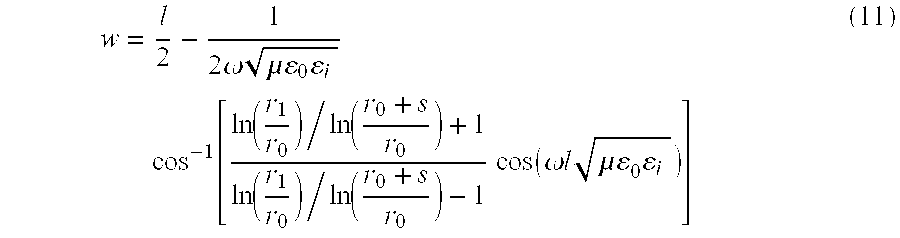
- FIG. 5 The embodiment shown in FIG. 5 is similar to the design in FIG. 4 with a difference that the capacitors were built with a structural change.
- high dielectric constant material is employed only in the regions where the outer shield portions and the inner shield portion are close to each other as at “s.”
- the desired high impedance value can be obtained in this manner even with the materials with dielectric constants of as low as 2.
- the values of 1, w, s, r 1 , and r 0 should be selected so the impedance Z has a very high value.
- the segmented inner shield portions, m such as 80 , have not only electrically conductive means 82 connecting the outer shield portions with the inner shield portion 84 , but also have radially inwardly projecting elements 90 which are electrically conductive and have a width w and terminate in a free end spaced a distance “s” from the outer surface of inner shield portion 84 .
- FIG. 6 A multi-layer safe-coaxial cable design is shown in FIG. 6 .
- This design has the same basic philosophy as the design shown in FIG. 3 . As it was discussed, the basic design requires a very high dielectric constant material or long structure. In FIG. 6, the embodiment multi-layer long structures are shown. While the length of conductor exposed to the external field is length “1”, the length of the structure is “21”. The formulation of the design is the same as given in the basic design, except length “1” in the equations has to be replaced by “21. ”
- a low loss, low dielectric constant material A which may be Teflon.
- Low loss, low dielectric constant material A is therefore interposed between the inner conductor E and the shield D.
- a low loss, high dielectric constant material C is interposed between the inner shield portion 100 and the outer shield portion 102 .
- This material may be titanium dioxide, for example.
- the outer conductive portions 102 , 104 have a length, and are interconnected with the inner shield portion 100 by an elongated conductive member 106 and a pair of generally radially oriented portion 108 , 110 to create a step-like arrangement.
- the coaxial cable is insulated with a low dielectric constant material B.
- the entire coaxial cable is, in the form shown, disposed within a human body portion F or other environment.
- the length 1 is chosen such that the impedance is maximized. This length is generally 1 ⁇ 8 wavelength in the dielectric material C. It is preferred that length “1” be less than the quarter wavelength of the medium F.
- the present invention provides sample designs for safe coaxial cable designs.
- the safety of these cables can further be increased by insulating the cable with a resinous plastic material.
- the calculations herein will not be effected by the insulation, because all the calculations shown here are related to the electrical properties of the inside of the structure.
- the effect of insulation will be significant for the external magnetic field. From the perspective of the external field, the apparent wavelength on the cable increases with the insulation. Therefore, the requirement for dividing the cable to very short outer shield portions can be relaxed to permit use of longer portions.
- the inner conductor can be formed from a plurality of conductor elements in contact with each other or spaced from each other.
- Reference herein to “an elongated axially oriented inner conductor” will embrace such a construction. The applications are not limited to the cables of the probes that will be inserted into the body. Any cable that has possibility of getting close to the patient will benefit from this design because of the increased safety.
- the invention is not limited to 64 MHz (proton resonance frequency at 1.5 Tesla). Using the generic formulation given herein, one may design safe-coaxial cables at practically all operating frequencies. The examples employed 64 MHz in our examples because it is the most commonly used frequency. Other common frequencies include 200 MHz, 170 MHz, 42 MHz, 21 MHz, 6.4 MHz.
- the safe-coax cable design may have application other than magnetic resonance imaging. It can be used in any circuit that requires low unbalanced currents at a specific operating frequency. For example, if the field pattern of an antenna is affected by the presence of a nearby cable this cable can be provided with the safe-coax structures described earlier.
Abstract
Description




Claims (15)
Priority Applications (1)
| Application Number | Priority Date | Filing Date | Title |
|---|---|---|---|
| US09/449,027 US6284971B1 (en) | 1998-11-25 | 1999-11-24 | Enhanced safety coaxial cables |
Applications Claiming Priority (2)
| Application Number | Priority Date | Filing Date | Title |
|---|---|---|---|
| US10995598P | 1998-11-25 | 1998-11-25 | |
| US09/449,027 US6284971B1 (en) | 1998-11-25 | 1999-11-24 | Enhanced safety coaxial cables |
Publications (1)
| Publication Number | Publication Date |
|---|---|
| US6284971B1 true US6284971B1 (en) | 2001-09-04 |
Family
ID=26807548
Family Applications (1)
| Application Number | Title | Priority Date | Filing Date |
|---|---|---|---|
| US09/449,027 Expired - Lifetime US6284971B1 (en) | 1998-11-25 | 1999-11-24 | Enhanced safety coaxial cables |
Country Status (1)
| Country | Link |
|---|---|
| US (1) | US6284971B1 (en) |
Cited By (114)
| Publication number | Priority date | Publication date | Assignee | Title |
|---|---|---|---|---|
| US20030050557A1 (en) * | 1998-11-04 | 2003-03-13 | Susil Robert C. | Systems and methods for magnetic-resonance-guided interventional procedures |
| US20030097064A1 (en) * | 2001-11-13 | 2003-05-22 | Dnyanesh Talpade | Impedance-matching apparatus and construction for intravascular device |
| US6606513B2 (en) | 2000-02-01 | 2003-08-12 | Surgi-Vision, Inc. | Magnetic resonance imaging transseptal needle antenna |
| US6636040B1 (en) | 1999-12-17 | 2003-10-21 | Fonar Corporation | MRI antenna |
| US6727698B1 (en) * | 1999-12-17 | 2004-04-27 | Fonar Corporation | MRI antennas including electrically connected inner and outer conductors, and MRI systems including such antennas |
| WO2004038443A1 (en) | 2002-10-23 | 2004-05-06 | Philips Intellectual Property & Standards Gmbh | Connection lead for an electrical accessory device of an mri system |
| WO2004044949A2 (en) * | 2002-11-08 | 2004-05-27 | Cascade Microtech, Inc. | Probe station with low noise characteristics |
| US20040181177A1 (en) * | 2000-11-20 | 2004-09-16 | Chris Lee | Guidewire and connector therefor |
| WO2004090914A1 (en) * | 2003-04-09 | 2004-10-21 | Philips Intellectual Property & Standards Gmbh | Transmission cable |
| US20040220470A1 (en) * | 2003-02-03 | 2004-11-04 | The John Hopkins University | Active MRI intramyocardial injection catheter with a deflectable distal section |
| US6847210B1 (en) | 1999-12-17 | 2005-01-25 | Fonar Corporation | MRI antenna |
| US20050113876A1 (en) * | 2003-04-02 | 2005-05-26 | Biophan Technologies, Inc. | Device and method for preventing magnetic-resonance imaging induced damage |
| US20050222657A1 (en) * | 2004-03-30 | 2005-10-06 | Wahlstrand Carl D | MRI-safe implantable lead |
| US20050251031A1 (en) * | 2004-05-06 | 2005-11-10 | Scimed Life Systems, Inc. | Apparatus and construction for intravascular device |
| US20050251032A1 (en) * | 2004-05-06 | 2005-11-10 | Scimed Life Systems, Inc. | Intravascular antenna |
| US20060055408A1 (en) * | 2004-09-11 | 2006-03-16 | General Electric Company | Balun arrangement and an installation method thereof for a magnetic resonance apparatus |
| US20060173285A1 (en) * | 2004-12-20 | 2006-08-03 | General Electric Company | Methods and systems for reducing RF-induced heating in magnetic resonance imaging |
| US20060187134A1 (en) * | 2005-02-18 | 2006-08-24 | Fumikazu Hoshi | Antenna |
| US20060252314A1 (en) * | 2005-05-04 | 2006-11-09 | Ergin Atalar | Electrical lead for an electronic device such as an implantable device |
| US7138813B2 (en) | 1999-06-30 | 2006-11-21 | Cascade Microtech, Inc. | Probe station thermal chuck with shielding for capacitive current |
| EP1776040A2 (en) * | 2004-08-09 | 2007-04-25 | The John Hopkins University | Implantable mri compatible stimulation leads and antennas and related systems and methods |
| WO2007047966A2 (en) | 2005-10-21 | 2007-04-26 | Surgi-Vision, Inc. | Mri-safe high impedance lead systems |
| US7412276B2 (en) | 1998-11-04 | 2008-08-12 | Johns Hopkins University School Of Medicine | Brain therapy |
| US20080243218A1 (en) * | 2007-03-19 | 2008-10-02 | Bottomley Paul A | Mri and rf compatible leads and related methods of operating and fabricating leads |
| US20080262584A1 (en) * | 2007-03-19 | 2008-10-23 | Bottomley Paul A | Methods and apparatus for fabricating leads with conductors and related flexible lead configurations |
| US20080306375A1 (en) * | 2007-06-07 | 2008-12-11 | Surgi-Vision, Inc. | Mri-guided medical interventional systems and methods |
| US7492172B2 (en) | 2003-05-23 | 2009-02-17 | Cascade Microtech, Inc. | Chuck for holding a device under test |
| US20090112084A1 (en) * | 2007-06-07 | 2009-04-30 | Surgi-Vision, Inc. | Mri-guided medical interventional systems and methods |
| US20090131783A1 (en) * | 2007-11-21 | 2009-05-21 | Surgi-Vision, Inc. | Methods, systems and computer program products for positioning a guidance apparatus relative to a patient |
| EP2062530A2 (en) | 2005-11-29 | 2009-05-27 | Surgi-Vision, Inc. | MRI-guided localization and/or lead placement systems, related methods, devices and computer program |
| US20090177077A1 (en) * | 2007-09-24 | 2009-07-09 | Surgi-Vision, Inc. | Mri-compatible patches and methods for using the same |
| US20100000780A1 (en) * | 2008-07-07 | 2010-01-07 | Haoqin Zhu | Floating segmented shield cable assembly |
| WO2010003215A1 (en) * | 2008-07-07 | 2010-01-14 | Imris Inc. | Floating segmented shield cable assembly |
| US7656172B2 (en) | 2005-01-31 | 2010-02-02 | Cascade Microtech, Inc. | System for testing semiconductors |
| US20100066371A1 (en) * | 2008-09-12 | 2010-03-18 | Kamal Vij | Intrabody mri stacked flat loop antennas and related systems |
| US7688062B2 (en) | 2000-09-05 | 2010-03-30 | Cascade Microtech, Inc. | Probe station |
| US7688091B2 (en) | 2003-12-24 | 2010-03-30 | Cascade Microtech, Inc. | Chuck with integrated wafer support |
| US20100094123A1 (en) * | 2007-01-30 | 2010-04-15 | Koninklijke Philips Electronics N. V. | Transmission line for rf signals without matching networks |
| US20100185198A1 (en) * | 2007-09-24 | 2010-07-22 | Peter Piferi | Head Fixation Assemblies for Medical Procedures |
| WO2010113133A1 (en) * | 2009-04-02 | 2010-10-07 | Koninklijke Philips Electronics N.V. | Devices and cabling for use in a multi-resonant magnetic resonance system |
| US7844343B2 (en) | 2004-03-30 | 2010-11-30 | Medtronic, Inc. | MRI-safe implantable medical device |
| US7848788B2 (en) | 1999-04-15 | 2010-12-07 | The Johns Hopkins University | Magnetic resonance imaging probe |
| US7853332B2 (en) | 2005-04-29 | 2010-12-14 | Medtronic, Inc. | Lead electrode for use in an MRI-safe implantable medical device |
| US20100317961A1 (en) * | 2009-06-16 | 2010-12-16 | Jenkins Kimble L | MRI-Guided Devices and MRI-Guided Interventional Systems that can Track and Generate Dynamic Visualizations of the Devices in near Real Time |
| US7877150B2 (en) | 2004-03-30 | 2011-01-25 | Medtronic, Inc. | Lead electrode for use in an MRI-safe implantable medical device |
| US20110037471A1 (en) * | 2009-08-12 | 2011-02-17 | Seiji Nozaki | Magnetic resonance imaging apparatus |
| US7898281B2 (en) | 2005-01-31 | 2011-03-01 | Cascade Mircotech, Inc. | Interface for testing semiconductors |
| US7969173B2 (en) | 2000-09-05 | 2011-06-28 | Cascade Microtech, Inc. | Chuck for holding a device under test |
| US8027736B2 (en) | 2005-04-29 | 2011-09-27 | Medtronic, Inc. | Lead electrode for use in an MRI-safe implantable medical device |
| EP2372830A1 (en) | 2010-04-05 | 2011-10-05 | Hitachi, Ltd. | Low-noise cable |
| USRE42856E1 (en) | 2002-05-29 | 2011-10-18 | MRI Interventions, Inc. | Magnetic resonance probes |
| JP2011222253A (en) * | 2010-04-08 | 2011-11-04 | Nec Corp | Cable |
| US8069491B2 (en) | 2003-10-22 | 2011-11-29 | Cascade Microtech, Inc. | Probe testing structure |
| US8095224B2 (en) | 2009-03-19 | 2012-01-10 | Greatbatch Ltd. | EMI shielded conduit assembly for an active implantable medical device |
| US8219208B2 (en) | 2001-04-13 | 2012-07-10 | Greatbatch Ltd. | Frequency selective passive component networks for active implantable medical devices utilizing an energy dissipating surface |
| US8275466B2 (en) | 2006-06-08 | 2012-09-25 | Greatbatch Ltd. | Band stop filter employing a capacitor and an inductor tank circuit to enhance MRI compatibility of active medical devices |
| US8280526B2 (en) | 2005-02-01 | 2012-10-02 | Medtronic, Inc. | Extensible implantable medical lead |
| US8315689B2 (en) | 2007-09-24 | 2012-11-20 | MRI Interventions, Inc. | MRI surgical systems for real-time visualizations using MRI image data and predefined data of surgical tools |
| US8319503B2 (en) | 2008-11-24 | 2012-11-27 | Cascade Microtech, Inc. | Test apparatus for measuring a characteristic of a device under test |
| US20120312578A1 (en) * | 2011-06-09 | 2012-12-13 | Samsung Electronics Co. Ltd. | Cylindrical electromagnetic bandgap and coaxial cable having the same |
| WO2012112829A3 (en) * | 2011-02-17 | 2013-02-28 | MRI Interventions, Inc. | Thin-sleeve apparatus for reducing rf coupling of devices in mri environments |
| US8447414B2 (en) | 2008-12-17 | 2013-05-21 | Greatbatch Ltd. | Switched safety protection circuit for an AIMD system during exposure to high power electromagnetic fields |
| US8457760B2 (en) | 2001-04-13 | 2013-06-04 | Greatbatch Ltd. | Switched diverter circuits for minimizing heating of an implanted lead and/or providing EMI protection in a high power electromagnetic field environment |
| US8483842B2 (en) | 2007-04-25 | 2013-07-09 | Medtronic, Inc. | Lead or lead extension having a conductive body and conductive body contact |
| US8509913B2 (en) | 2001-04-13 | 2013-08-13 | Greatbatch Ltd. | Switched diverter circuits for minimizing heating of an implanted lead and/or providing EMI protection in a high power electromagnetic field environment |
| US8600519B2 (en) | 2001-04-13 | 2013-12-03 | Greatbatch Ltd. | Transient voltage/current protection system for electronic circuits associated with implanted leads |
| WO2014044428A1 (en) * | 2012-09-24 | 2014-03-27 | Siemens Aktiengesellschaft | Method for producing a capacitor, and capacitor |
| US8882763B2 (en) | 2010-01-12 | 2014-11-11 | Greatbatch Ltd. | Patient attached bonding strap for energy dissipation from a probe or a catheter during magnetic resonance imaging |
| US8903505B2 (en) | 2006-06-08 | 2014-12-02 | Greatbatch Ltd. | Implantable lead bandstop filter employing an inductive coil with parasitic capacitance to enhance MRI compatibility of active medical devices |
| US8977355B2 (en) | 2001-04-13 | 2015-03-10 | Greatbatch Ltd. | EMI filter employing a capacitor and an inductor tank circuit having optimum component values |
| US8989840B2 (en) | 2004-03-30 | 2015-03-24 | Medtronic, Inc. | Lead electrode for use in an MRI-safe implantable medical device |
| US8989870B2 (en) | 2001-04-13 | 2015-03-24 | Greatbatch Ltd. | Tuned energy balanced system for minimizing heating and/or to provide EMI protection of implanted leads in a high power electromagnetic field environment |
| US9044593B2 (en) | 2007-02-14 | 2015-06-02 | Medtronic, Inc. | Discontinuous conductive filler polymer-matrix composites for electromagnetic shielding |
| US9078588B2 (en) | 2013-03-08 | 2015-07-14 | MRI Interventions, Inc. | MRI compatible intrabody stylets and related methods and systems |
| WO2015104112A1 (en) * | 2014-01-10 | 2015-07-16 | Siemens Aktiengesellschaft | Method for the production of a capacitor, capacitor, and use thereof |
| US9108066B2 (en) | 2008-03-20 | 2015-08-18 | Greatbatch Ltd. | Low impedance oxide resistant grounded capacitor for an AIMD |
| US9155877B2 (en) | 2004-03-30 | 2015-10-13 | Medtronic, Inc. | Lead electrode for use in an MRI-safe implantable medical device |
| US9186499B2 (en) | 2009-04-30 | 2015-11-17 | Medtronic, Inc. | Grounding of a shield within an implantable medical lead |
| US9192446B2 (en) | 2012-09-05 | 2015-11-24 | MRI Interventions, Inc. | Trajectory guide frame for MRI-guided surgeries |
| US9242090B2 (en) | 2001-04-13 | 2016-01-26 | MRI Interventions Inc. | MRI compatible medical leads |
| US9248283B2 (en) | 2001-04-13 | 2016-02-02 | Greatbatch Ltd. | Band stop filter comprising an inductive component disposed in a lead wire in series with an electrode |
| US9259290B2 (en) | 2009-06-08 | 2016-02-16 | MRI Interventions, Inc. | MRI-guided surgical systems with proximity alerts |
| US9295828B2 (en) | 2001-04-13 | 2016-03-29 | Greatbatch Ltd. | Self-resonant inductor wound portion of an implantable lead for enhanced MRI compatibility of active implantable medical devices |
| US9383421B2 (en) | 2013-03-12 | 2016-07-05 | MRI Interventions, Inc. | Intra-body medical devices for use in MRI environments |
| US9427596B2 (en) | 2013-01-16 | 2016-08-30 | Greatbatch Ltd. | Low impedance oxide resistant grounded capacitor for an AIMD |
| US9463317B2 (en) | 2012-04-19 | 2016-10-11 | Medtronic, Inc. | Paired medical lead bodies with braided conductive shields having different physical parameter values |
| US9731119B2 (en) | 2008-03-12 | 2017-08-15 | Medtronic, Inc. | System and method for implantable medical device lead shielding |
| WO2017142698A1 (en) | 2016-02-17 | 2017-08-24 | MRI Interventions, Inc. | Intrabody surgical fluid transfer assemblies with adjustable exposed cannula to needle tip length, related systems and methods |
| USRE46699E1 (en) | 2013-01-16 | 2018-02-06 | Greatbatch Ltd. | Low impedance oxide resistant grounded capacitor for an AIMD |
| US9891296B2 (en) | 2013-09-13 | 2018-02-13 | MRI Interventions, Inc. | Intrabody fluid transfer devices, systems and methods |
| US9931514B2 (en) | 2013-06-30 | 2018-04-03 | Greatbatch Ltd. | Low impedance oxide resistant grounded capacitor for an AIMD |
| US9993638B2 (en) | 2013-12-14 | 2018-06-12 | Medtronic, Inc. | Devices, systems and methods to reduce coupling of a shield and a conductor within an implantable medical lead |
| US10080889B2 (en) | 2009-03-19 | 2018-09-25 | Greatbatch Ltd. | Low inductance and low resistance hermetically sealed filtered feedthrough for an AIMD |
| US10105485B2 (en) | 2010-04-16 | 2018-10-23 | MRI Interventions, Inc. | MRI surgical systems including MRI-compatible surgical cannulae for transferring a substance to and/or from a patient |
| US10155111B2 (en) | 2014-07-24 | 2018-12-18 | Medtronic, Inc. | Methods of shielding implantable medical leads and implantable medical lead extensions |
| US10185002B2 (en) | 2015-06-04 | 2019-01-22 | General Electric Company | Systems and methods for MRI common mode traps |
| US10194945B2 (en) | 2013-03-15 | 2019-02-05 | DePuy Synthes Products, Inc. | External fixation system with radio frequency shielding |
| US10279171B2 (en) | 2014-07-23 | 2019-05-07 | Medtronic, Inc. | Methods of shielding implantable medical leads and implantable medical lead extensions |
| US10350421B2 (en) | 2013-06-30 | 2019-07-16 | Greatbatch Ltd. | Metallurgically bonded gold pocket pad for grounding an EMI filter to a hermetic terminal for an active implantable medical device |
| US10537730B2 (en) | 2007-02-14 | 2020-01-21 | Medtronic, Inc. | Continuous conductive materials for electromagnetic shielding |
| US10559409B2 (en) | 2017-01-06 | 2020-02-11 | Greatbatch Ltd. | Process for manufacturing a leadless feedthrough for an active implantable medical device |
| US10561837B2 (en) | 2011-03-01 | 2020-02-18 | Greatbatch Ltd. | Low equivalent series resistance RF filter for an active implantable medical device utilizing a ceramic reinforced metal composite filled via |
| US10589107B2 (en) | 2016-11-08 | 2020-03-17 | Greatbatch Ltd. | Circuit board mounted filtered feedthrough assembly having a composite conductive lead for an AIMD |
| US10610123B2 (en) | 2013-03-15 | 2020-04-07 | DePuy Synthes Products, Inc. | External fixation system with radio frequency shielding |
| US10905497B2 (en) | 2017-04-21 | 2021-02-02 | Clearpoint Neuro, Inc. | Surgical navigation systems |
| US10905888B2 (en) | 2018-03-22 | 2021-02-02 | Greatbatch Ltd. | Electrical connection for an AIMD EMI filter utilizing an anisotropic conductive layer |
| US10912945B2 (en) | 2018-03-22 | 2021-02-09 | Greatbatch Ltd. | Hermetic terminal for an active implantable medical device having a feedthrough capacitor partially overhanging a ferrule for high effective capacitance area |
| WO2021071561A1 (en) | 2019-10-08 | 2021-04-15 | Clearpoint Neuro, Inc. | Extension tube assembly and related medical fluid transfer systems and methods |
| US11022664B2 (en) | 2018-05-09 | 2021-06-01 | Clearpoint Neuro, Inc. | MRI compatible intrabody fluid transfer systems and related devices and methods |
| WO2021126336A1 (en) | 2019-12-19 | 2021-06-24 | Clearpoint Neuro, Inc. | Front-loadable fluid transfer assemblies and related medical fluid transfer systems |
| EP3892214A1 (en) | 2020-04-08 | 2021-10-13 | ClearPoint Neuro, Inc. | Mri surgical systems including mri-compatible surgical cannulas for transferring a substance to and/or from a patient |
| US11198014B2 (en) | 2011-03-01 | 2021-12-14 | Greatbatch Ltd. | Hermetically sealed filtered feedthrough assembly having a capacitor with an oxide resistant electrical connection to an active implantable medical device housing |
| WO2022034792A1 (en) * | 2020-08-11 | 2022-02-17 | 京セラ株式会社 | Supply device, and detecting device |
| US11253237B2 (en) | 2018-05-09 | 2022-02-22 | Clearpoint Neuro, Inc. | MRI compatible intrabody fluid transfer systems and related devices and methods |
Citations (17)
| Publication number | Priority date | Publication date | Assignee | Title |
|---|---|---|---|---|
| US2322971A (en) | 1939-04-11 | 1943-06-29 | Roosenstein Hans Otto | Shielded antenna feeder lead or line |
| US2812502A (en) | 1953-07-07 | 1957-11-05 | Bell Telephone Labor Inc | Transposed coaxial conductor system |
| US3601721A (en) | 1969-02-14 | 1971-08-24 | Justice Associates Inc | Low loss coaxial conductor using overlapped and insulated helical wound strips |
| US4004257A (en) | 1975-07-09 | 1977-01-18 | Vitek Electronics, Inc. | Transmission line filter |
| US4052661A (en) | 1975-05-14 | 1977-10-04 | The Perkin-Elmer Corporation | Nuclear magnetic resonance probe |
| US4365109A (en) | 1980-01-25 | 1982-12-21 | The United States Of America As Represented By The Secretary Of The Air Force | Coaxial cable design |
| US4620155A (en) | 1984-08-16 | 1986-10-28 | General Electric Company | Nuclear magnetic resonance imaging antenna subsystem having a plurality of non-orthogonal surface coils |
| US4649348A (en) | 1984-08-20 | 1987-03-10 | Technicare Corporation | Radio frequency coils for nuclear magnetic resonance imaging systems |
| US4680548A (en) | 1984-10-09 | 1987-07-14 | General Electric Company | Radio frequency field coil for NMR |
| US4692705A (en) | 1983-12-23 | 1987-09-08 | General Electric Company | Radio frequency field coil for NMR |
| US4740752A (en) | 1986-08-06 | 1988-04-26 | The Regents Of The University Of California | Non-overlapping qd MRI RF coil |
| US4820987A (en) | 1986-12-22 | 1989-04-11 | U.S. Philips Corporation | Magnetic resonance imaging apparatus comprising an activatable birdcage RF coil |
| US4859950A (en) | 1987-05-26 | 1989-08-22 | Elscint Ltd | Balun circuit for radio frequency coils in magnetic resonance systems |
| US4887039A (en) | 1988-12-22 | 1989-12-12 | General Electric Company | Method for providing multiple coaxial cable connections to a radio-frequency antenna without baluns |
| US4952879A (en) | 1988-04-26 | 1990-08-28 | U.S. Philips Corporation | Magnetic resonance apparatus with uncoupled RF coils |
| US5543712A (en) | 1994-12-22 | 1996-08-06 | The Regents Of The University Of California | Parasitic compensating matching circuit integral with ground breaker for MRI RF coils |
| US5621323A (en) | 1991-11-29 | 1997-04-15 | Magnetic Research, Inc. | Surface coil elements |
-
1999
- 1999-11-24 US US09/449,027 patent/US6284971B1/en not_active Expired - Lifetime
Patent Citations (17)
| Publication number | Priority date | Publication date | Assignee | Title |
|---|---|---|---|---|
| US2322971A (en) | 1939-04-11 | 1943-06-29 | Roosenstein Hans Otto | Shielded antenna feeder lead or line |
| US2812502A (en) | 1953-07-07 | 1957-11-05 | Bell Telephone Labor Inc | Transposed coaxial conductor system |
| US3601721A (en) | 1969-02-14 | 1971-08-24 | Justice Associates Inc | Low loss coaxial conductor using overlapped and insulated helical wound strips |
| US4052661A (en) | 1975-05-14 | 1977-10-04 | The Perkin-Elmer Corporation | Nuclear magnetic resonance probe |
| US4004257A (en) | 1975-07-09 | 1977-01-18 | Vitek Electronics, Inc. | Transmission line filter |
| US4365109A (en) | 1980-01-25 | 1982-12-21 | The United States Of America As Represented By The Secretary Of The Air Force | Coaxial cable design |
| US4692705A (en) | 1983-12-23 | 1987-09-08 | General Electric Company | Radio frequency field coil for NMR |
| US4620155A (en) | 1984-08-16 | 1986-10-28 | General Electric Company | Nuclear magnetic resonance imaging antenna subsystem having a plurality of non-orthogonal surface coils |
| US4649348A (en) | 1984-08-20 | 1987-03-10 | Technicare Corporation | Radio frequency coils for nuclear magnetic resonance imaging systems |
| US4680548A (en) | 1984-10-09 | 1987-07-14 | General Electric Company | Radio frequency field coil for NMR |
| US4740752A (en) | 1986-08-06 | 1988-04-26 | The Regents Of The University Of California | Non-overlapping qd MRI RF coil |
| US4820987A (en) | 1986-12-22 | 1989-04-11 | U.S. Philips Corporation | Magnetic resonance imaging apparatus comprising an activatable birdcage RF coil |
| US4859950A (en) | 1987-05-26 | 1989-08-22 | Elscint Ltd | Balun circuit for radio frequency coils in magnetic resonance systems |
| US4952879A (en) | 1988-04-26 | 1990-08-28 | U.S. Philips Corporation | Magnetic resonance apparatus with uncoupled RF coils |
| US4887039A (en) | 1988-12-22 | 1989-12-12 | General Electric Company | Method for providing multiple coaxial cable connections to a radio-frequency antenna without baluns |
| US5621323A (en) | 1991-11-29 | 1997-04-15 | Magnetic Research, Inc. | Surface coil elements |
| US5543712A (en) | 1994-12-22 | 1996-08-06 | The Regents Of The University Of California | Parasitic compensating matching circuit integral with ground breaker for MRI RF coils |
Non-Patent Citations (2)
| Title |
|---|
| C&M Corporation, "Engineering Design Guide", pp. 10 and 11, 1992.* |
| R. Schetgen, The ARRL Handbook for Radio Amateurs, Seventy-Second, The American Radio Relay League, pp. 19.10-19.17, Newington, CT (1995). |
Cited By (235)
| Publication number | Priority date | Publication date | Assignee | Title |
|---|---|---|---|---|
| US20030050557A1 (en) * | 1998-11-04 | 2003-03-13 | Susil Robert C. | Systems and methods for magnetic-resonance-guided interventional procedures |
| US7412276B2 (en) | 1998-11-04 | 2008-08-12 | Johns Hopkins University School Of Medicine | Brain therapy |
| US8099151B2 (en) | 1998-11-04 | 2012-01-17 | Johns Hopkins University School Of Medicine | System and method for magnetic-resonance-guided electrophysiologic and ablation procedures |
| US7822460B2 (en) | 1998-11-04 | 2010-10-26 | Surgi-Vision, Inc. | MRI-guided therapy methods and related systems |
| US7844319B2 (en) | 1998-11-04 | 2010-11-30 | Susil Robert C | Systems and methods for magnetic-resonance-guided interventional procedures |
| US9301705B2 (en) | 1998-11-04 | 2016-04-05 | Johns Hopkins University School Of Medicine | System and method for magnetic-resonance-guided electrophysiologic and ablation procedures |
| US7848788B2 (en) | 1999-04-15 | 2010-12-07 | The Johns Hopkins University | Magnetic resonance imaging probe |
| US7138813B2 (en) | 1999-06-30 | 2006-11-21 | Cascade Microtech, Inc. | Probe station thermal chuck with shielding for capacitive current |
| US6727698B1 (en) * | 1999-12-17 | 2004-04-27 | Fonar Corporation | MRI antennas including electrically connected inner and outer conductors, and MRI systems including such antennas |
| US7573432B1 (en) | 1999-12-17 | 2009-08-11 | Fonar Corporation | MRI antenna |
| US6847210B1 (en) | 1999-12-17 | 2005-01-25 | Fonar Corporation | MRI antenna |
| US6636040B1 (en) | 1999-12-17 | 2003-10-21 | Fonar Corporation | MRI antenna |
| US6606513B2 (en) | 2000-02-01 | 2003-08-12 | Surgi-Vision, Inc. | Magnetic resonance imaging transseptal needle antenna |
| US7969173B2 (en) | 2000-09-05 | 2011-06-28 | Cascade Microtech, Inc. | Chuck for holding a device under test |
| US7688062B2 (en) | 2000-09-05 | 2010-03-30 | Cascade Microtech, Inc. | Probe station |
| US20040181177A1 (en) * | 2000-11-20 | 2004-09-16 | Chris Lee | Guidewire and connector therefor |
| US9179857B2 (en) | 2000-11-20 | 2015-11-10 | MRI Interventions, Inc. | Guidewire and connector therefor |
| US9248283B2 (en) | 2001-04-13 | 2016-02-02 | Greatbatch Ltd. | Band stop filter comprising an inductive component disposed in a lead wire in series with an electrode |
| US8509913B2 (en) | 2001-04-13 | 2013-08-13 | Greatbatch Ltd. | Switched diverter circuits for minimizing heating of an implanted lead and/or providing EMI protection in a high power electromagnetic field environment |
| US9242090B2 (en) | 2001-04-13 | 2016-01-26 | MRI Interventions Inc. | MRI compatible medical leads |
| US8855785B1 (en) | 2001-04-13 | 2014-10-07 | Greatbatch Ltd. | Circuits for minimizing heating of an implanted lead and/or providing EMI protection in a high power electromagnetic field environment |
| US8751013B2 (en) | 2001-04-13 | 2014-06-10 | Greatbatch Ltd. | Switched diverter circuits for minimizing heating of an implanted lead and/or providing EMI protection in a high power electromagnetic field environment |
| US8600519B2 (en) | 2001-04-13 | 2013-12-03 | Greatbatch Ltd. | Transient voltage/current protection system for electronic circuits associated with implanted leads |
| US8977355B2 (en) | 2001-04-13 | 2015-03-10 | Greatbatch Ltd. | EMI filter employing a capacitor and an inductor tank circuit having optimum component values |
| US9295828B2 (en) | 2001-04-13 | 2016-03-29 | Greatbatch Ltd. | Self-resonant inductor wound portion of an implantable lead for enhanced MRI compatibility of active implantable medical devices |
| US8989870B2 (en) | 2001-04-13 | 2015-03-24 | Greatbatch Ltd. | Tuned energy balanced system for minimizing heating and/or to provide EMI protection of implanted leads in a high power electromagnetic field environment |
| US8457760B2 (en) | 2001-04-13 | 2013-06-04 | Greatbatch Ltd. | Switched diverter circuits for minimizing heating of an implanted lead and/or providing EMI protection in a high power electromagnetic field environment |
| US8219208B2 (en) | 2001-04-13 | 2012-07-10 | Greatbatch Ltd. | Frequency selective passive component networks for active implantable medical devices utilizing an energy dissipating surface |
| US7194297B2 (en) | 2001-11-13 | 2007-03-20 | Boston Scientific Scimed, Inc. | Impedance-matching apparatus and construction for intravascular device |
| US20030097064A1 (en) * | 2001-11-13 | 2003-05-22 | Dnyanesh Talpade | Impedance-matching apparatus and construction for intravascular device |
| USRE44736E1 (en) | 2002-05-29 | 2014-01-28 | MRI Interventions, Inc. | Magnetic resonance probes |
| USRE42856E1 (en) | 2002-05-29 | 2011-10-18 | MRI Interventions, Inc. | Magnetic resonance probes |
| US7205768B2 (en) | 2002-10-23 | 2007-04-17 | Koninklijke Philips Electronics N.V. | Connection lead for an electrical accessory device of an MRI system |
| US20050218897A1 (en) * | 2002-10-23 | 2005-10-06 | Koninkilke Philips Electronics N.V. | Connection lead for an electrical accessory device of an mri system |
| WO2004038443A1 (en) | 2002-10-23 | 2004-05-06 | Philips Intellectual Property & Standards Gmbh | Connection lead for an electrical accessory device of an mri system |
| US6847219B1 (en) * | 2002-11-08 | 2005-01-25 | Cascade Microtech, Inc. | Probe station with low noise characteristics |
| US20050104610A1 (en) * | 2002-11-08 | 2005-05-19 | Timothy Lesher | Probe station with low noise characteristics |
| WO2004044949A2 (en) * | 2002-11-08 | 2004-05-27 | Cascade Microtech, Inc. | Probe station with low noise characteristics |
| WO2004044949A3 (en) * | 2002-11-08 | 2004-10-14 | Cascade Microtech Inc | Probe station with low noise characteristics |
| US7725161B2 (en) | 2003-02-03 | 2010-05-25 | John Hopkins University | Active MRI intramyocardial injeciton catheter with a deflectable distal section |
| US20040220470A1 (en) * | 2003-02-03 | 2004-11-04 | The John Hopkins University | Active MRI intramyocardial injection catheter with a deflectable distal section |
| US8260399B2 (en) | 2003-02-03 | 2012-09-04 | Johns Hopkins University | Active MRI intramyocardial injection catheter with deflectable distal section |
| US20100198049A1 (en) * | 2003-02-03 | 2010-08-05 | Karmarkar Parag V | Active mri intramyocardial injection catheter with deflectable distal section |
| US20050113874A1 (en) * | 2003-04-02 | 2005-05-26 | Biophan Technologies, Inc. | Device and method for preventing magnetic-resonance imaging induced damage |
| US20050113876A1 (en) * | 2003-04-02 | 2005-05-26 | Biophan Technologies, Inc. | Device and method for preventing magnetic-resonance imaging induced damage |
| US7738942B2 (en) * | 2003-04-02 | 2010-06-15 | Medtronic, Inc. | Device and method for preventing magnetic-resonance imaging induced damage |
| US8323768B2 (en) | 2003-04-02 | 2012-12-04 | Medtronic, Inc. | Device and method for preventing magnetic-resonance imaging induced damage |
| WO2004090914A1 (en) * | 2003-04-09 | 2004-10-21 | Philips Intellectual Property & Standards Gmbh | Transmission cable |
| CN100362599C (en) * | 2003-04-09 | 2008-01-16 | 皇家飞利浦电子股份有限公司 | Transmission cable |
| US20060258936A1 (en) * | 2003-04-09 | 2006-11-16 | Volkmar Schulz | Transmission cable |
| US7492172B2 (en) | 2003-05-23 | 2009-02-17 | Cascade Microtech, Inc. | Chuck for holding a device under test |
| US7876115B2 (en) | 2003-05-23 | 2011-01-25 | Cascade Microtech, Inc. | Chuck for holding a device under test |
| US8069491B2 (en) | 2003-10-22 | 2011-11-29 | Cascade Microtech, Inc. | Probe testing structure |
| US7688091B2 (en) | 2003-12-24 | 2010-03-30 | Cascade Microtech, Inc. | Chuck with integrated wafer support |
| US7877150B2 (en) | 2004-03-30 | 2011-01-25 | Medtronic, Inc. | Lead electrode for use in an MRI-safe implantable medical device |
| US9302101B2 (en) | 2004-03-30 | 2016-04-05 | Medtronic, Inc. | MRI-safe implantable lead |
| US7844344B2 (en) * | 2004-03-30 | 2010-11-30 | Medtronic, Inc. | MRI-safe implantable lead |
| US20050222657A1 (en) * | 2004-03-30 | 2005-10-06 | Wahlstrand Carl D | MRI-safe implantable lead |
| US9155877B2 (en) | 2004-03-30 | 2015-10-13 | Medtronic, Inc. | Lead electrode for use in an MRI-safe implantable medical device |
| US7844343B2 (en) | 2004-03-30 | 2010-11-30 | Medtronic, Inc. | MRI-safe implantable medical device |
| US8989840B2 (en) | 2004-03-30 | 2015-03-24 | Medtronic, Inc. | Lead electrode for use in an MRI-safe implantable medical device |
| US20050251031A1 (en) * | 2004-05-06 | 2005-11-10 | Scimed Life Systems, Inc. | Apparatus and construction for intravascular device |
| US8116846B2 (en) | 2004-05-06 | 2012-02-14 | Boston Scientific Scimed, Inc. | Intravascular antenna |
| US7496397B2 (en) | 2004-05-06 | 2009-02-24 | Boston Scientific Scimed, Inc. | Intravascular antenna |
| US20080208043A1 (en) * | 2004-05-06 | 2008-08-28 | Smith Scott R | Apparatus and construction for intravascular device |
| US20050251032A1 (en) * | 2004-05-06 | 2005-11-10 | Scimed Life Systems, Inc. | Intravascular antenna |
| US20080039709A1 (en) * | 2004-08-09 | 2008-02-14 | Karmarkar Parag V | Implantable Mri compatible Stimulation Leads And Antennas And Related Systems And Methods |
| JP2008508984A (en) * | 2004-08-09 | 2008-03-27 | ザ ジョンズ ホプキンス ユニヴァーシティ | Implantable MRI compatible stimulation leads and antennas and related systems and methods |
| CN101039619B (en) * | 2004-08-09 | 2010-06-16 | 约翰斯·霍普金斯大学 | Implantable MRI compatible stimulation leads and antennas and related systems and methods |
| EP1776040A4 (en) * | 2004-08-09 | 2012-02-15 | Univ Johns Hopkins | Implantable mri compatible stimulation leads and antennas and related systems and methods |
| CN101829400B (en) * | 2004-08-09 | 2011-12-14 | 约翰斯·霍普金斯大学 | Implantable MRI compatible stimulation leads and antennas and related systems and methods |
| JP4912304B2 (en) * | 2004-08-09 | 2012-04-11 | ザ ジョンズ ホプキンス ユニヴァーシティ | Implantable MRI compatible stimulation lead and antenna and related systems |
| JP2012101085A (en) * | 2004-08-09 | 2012-05-31 | Johns Hopkins Univ | Implantable mri compatible stimulation lead and antenna and related system and method |
| US8509876B2 (en) | 2004-08-09 | 2013-08-13 | The Johns Hopkins University | Implantable MRI compatible stimulation leads and antennas and related systems and methods |
| EP1776040A2 (en) * | 2004-08-09 | 2007-04-25 | The John Hopkins University | Implantable mri compatible stimulation leads and antennas and related systems and methods |
| US20060055408A1 (en) * | 2004-09-11 | 2006-03-16 | General Electric Company | Balun arrangement and an installation method thereof for a magnetic resonance apparatus |
| US7215121B2 (en) * | 2004-09-11 | 2007-05-08 | General Electric Company | Balun arrangement and installation method thereof for a magnetic resonance apparatus |
| US20060173285A1 (en) * | 2004-12-20 | 2006-08-03 | General Electric Company | Methods and systems for reducing RF-induced heating in magnetic resonance imaging |
| US7656172B2 (en) | 2005-01-31 | 2010-02-02 | Cascade Microtech, Inc. | System for testing semiconductors |
| US7898281B2 (en) | 2005-01-31 | 2011-03-01 | Cascade Mircotech, Inc. | Interface for testing semiconductors |
| US7940069B2 (en) | 2005-01-31 | 2011-05-10 | Cascade Microtech, Inc. | System for testing semiconductors |
| US8280526B2 (en) | 2005-02-01 | 2012-10-02 | Medtronic, Inc. | Extensible implantable medical lead |
| US7245263B2 (en) * | 2005-02-18 | 2007-07-17 | Ricoh Company, Ltd. | Antenna |
| US20060187134A1 (en) * | 2005-02-18 | 2006-08-24 | Fumikazu Hoshi | Antenna |
| US20150039064A1 (en) * | 2005-04-29 | 2015-02-05 | Medtronic, Inc. | Lead electrode for use in an mri-safe implantable medical device |
| US7853332B2 (en) | 2005-04-29 | 2010-12-14 | Medtronic, Inc. | Lead electrode for use in an MRI-safe implantable medical device |
| US8027736B2 (en) | 2005-04-29 | 2011-09-27 | Medtronic, Inc. | Lead electrode for use in an MRI-safe implantable medical device |
| US9265940B2 (en) * | 2005-04-29 | 2016-02-23 | Medtronic, Inc. | Lead electrode for use in an MRI-safe implantable medical device |
| US20110218422A1 (en) * | 2005-05-04 | 2011-09-08 | Surgivision, Inc. | Electrical lead for an electronic device such as an implantable device |
| US20090254152A1 (en) * | 2005-05-04 | 2009-10-08 | Boston Scientific Neuromodulation Corporation | Electrical lead for an electronic device such as an implantable device |
| US8380277B2 (en) | 2005-05-04 | 2013-02-19 | MRI Interventions, Inc. | Electrical lead for an electronic device such as an implantable device |
| US7561906B2 (en) | 2005-05-04 | 2009-07-14 | Boston Scientific Neuromodulation Corporation | Electrical lead for an electronic device such as an implantable device |
| US7957783B2 (en) | 2005-05-04 | 2011-06-07 | Boston Scientific Neuromedulation Corporation | Electrical lead for an electronic device such as an implantable device |
| US8649842B2 (en) | 2005-05-04 | 2014-02-11 | Boston Scientific Neuromodulation Corporation | Electrical lead for an electronic device such as an implantable device |
| US20060252314A1 (en) * | 2005-05-04 | 2006-11-09 | Ergin Atalar | Electrical lead for an electronic device such as an implantable device |
| US8688226B2 (en) | 2005-10-21 | 2014-04-01 | Boston Scientific Neuromodulation Corporation | MRI-safe high impedance lead systems |
| WO2007047966A2 (en) | 2005-10-21 | 2007-04-26 | Surgi-Vision, Inc. | Mri-safe high impedance lead systems |
| US20090171421A1 (en) * | 2005-10-21 | 2009-07-02 | Ergin Atalar | Mri-safe high impedance lead systems |
| EP1933933A4 (en) * | 2005-10-21 | 2009-07-15 | Surgivision Inc | Mri-safe high impedance lead systems |
| US8433421B2 (en) | 2005-10-21 | 2013-04-30 | Boston Scientific Neuromodulation Corporation | MRI-safe high impedance lead systems |
| AU2006304775B2 (en) * | 2005-10-21 | 2011-11-17 | Boston Scientific Neuromodulation Corporation | MRI-safe high impedance lead systems and related methods |
| US8055351B2 (en) | 2005-10-21 | 2011-11-08 | Boston Scientific Neuromodulation Corporation | MRI-safe high impedance lead systems |
| EP1933933A2 (en) * | 2005-10-21 | 2008-06-25 | Surgi-Vision, Inc. | Mri-safe high impedance lead systems |
| US10492881B2 (en) | 2005-11-29 | 2019-12-03 | MRI Interventions, Inc. | Surgical image-guided navigation devices and related systems |
| US9042958B2 (en) | 2005-11-29 | 2015-05-26 | MRI Interventions, Inc. | MRI-guided localization and/or lead placement systems, related methods, devices and computer program products |
| EP2062530A2 (en) | 2005-11-29 | 2009-05-27 | Surgi-Vision, Inc. | MRI-guided localization and/or lead placement systems, related methods, devices and computer program |
| US11872086B2 (en) | 2005-11-29 | 2024-01-16 | Clearpoint Neuro, Inc. | Surgical image-guided navigation devices and related systems |
| US9763745B2 (en) | 2005-11-29 | 2017-09-19 | MRI Interventions, Inc. | Surgical image-guided navigation devices and related systems |
| EP2305109A1 (en) | 2005-11-29 | 2011-04-06 | Surgi-Vision, Inc. | MRI-guided localization and/or lead placement systems, related methods, devices and computer program products |
| US9119968B2 (en) | 2006-06-08 | 2015-09-01 | Greatbatch Ltd. | Band stop filter employing a capacitor and an inductor tank circuit to enhance MRI compatibility of active medical devices |
| US8903505B2 (en) | 2006-06-08 | 2014-12-02 | Greatbatch Ltd. | Implantable lead bandstop filter employing an inductive coil with parasitic capacitance to enhance MRI compatibility of active medical devices |
| US9008799B2 (en) | 2006-06-08 | 2015-04-14 | Greatbatch Ltd. | EMI filter employing a self-resonant inductor bandstop filter having optimum inductance and capacitance values |
| US8275466B2 (en) | 2006-06-08 | 2012-09-25 | Greatbatch Ltd. | Band stop filter employing a capacitor and an inductor tank circuit to enhance MRI compatibility of active medical devices |
| US20100094123A1 (en) * | 2007-01-30 | 2010-04-15 | Koninklijke Philips Electronics N. V. | Transmission line for rf signals without matching networks |
| US8571630B2 (en) * | 2007-01-30 | 2013-10-29 | Koninklijke Philips N.V. | Transmission line for RF signals without matching networks |
| US10398893B2 (en) | 2007-02-14 | 2019-09-03 | Medtronic, Inc. | Discontinuous conductive filler polymer-matrix composites for electromagnetic shielding |
| US9044593B2 (en) | 2007-02-14 | 2015-06-02 | Medtronic, Inc. | Discontinuous conductive filler polymer-matrix composites for electromagnetic shielding |
| US10537730B2 (en) | 2007-02-14 | 2020-01-21 | Medtronic, Inc. | Continuous conductive materials for electromagnetic shielding |
| EP2705875A1 (en) | 2007-03-19 | 2014-03-12 | Boston Scientific Neuromodulation Corporation | MRI and RF compatible leads |
| US9492651B2 (en) * | 2007-03-19 | 2016-11-15 | MRI Interventions, Inc. | MRI and RF compatible leads and related methods of operating and fabricating leads |
| US20080262584A1 (en) * | 2007-03-19 | 2008-10-23 | Bottomley Paul A | Methods and apparatus for fabricating leads with conductors and related flexible lead configurations |
| US9630000B2 (en) | 2007-03-19 | 2017-04-25 | Boston Scientific Neuromodulation Corporation | Methods and apparatus for fabricating leads with conductors and related flexible lead configurations |
| US9248270B2 (en) | 2007-03-19 | 2016-02-02 | Boston Scientific Neuromodulation Corporation | Methods and apparatus for fabricating leads with conductors and related flexible |
| US10391307B2 (en) | 2007-03-19 | 2019-08-27 | Boston Scientific Neuromodulation Corporation | MRI and RF compatible leads and related methods of operating and fabricating leads |
| US20080243218A1 (en) * | 2007-03-19 | 2008-10-02 | Bottomley Paul A | Mri and rf compatible leads and related methods of operating and fabricating leads |
| US9259572B2 (en) | 2007-04-25 | 2016-02-16 | Medtronic, Inc. | Lead or lead extension having a conductive body and conductive body contact |
| US8483842B2 (en) | 2007-04-25 | 2013-07-09 | Medtronic, Inc. | Lead or lead extension having a conductive body and conductive body contact |
| US9055884B2 (en) | 2007-06-07 | 2015-06-16 | MRI Interventions, Inc. | MRI-guided medical interventional systems and methods |
| US20090112082A1 (en) * | 2007-06-07 | 2009-04-30 | Surgi-Vision, Inc. | Imaging device for mri-guided medical interventional systems |
| US20090112084A1 (en) * | 2007-06-07 | 2009-04-30 | Surgi-Vision, Inc. | Mri-guided medical interventional systems and methods |
| US8175677B2 (en) | 2007-06-07 | 2012-05-08 | MRI Interventions, Inc. | MRI-guided medical interventional systems and methods |
| US8374677B2 (en) | 2007-06-07 | 2013-02-12 | MRI Interventions, Inc. | MRI-guided medical interventional systems and methods |
| US8208993B2 (en) | 2007-06-07 | 2012-06-26 | MRI Interventions, Inc. | Imaging device for MRI-guided medical interventional systems |
| US20080306375A1 (en) * | 2007-06-07 | 2008-12-11 | Surgi-Vision, Inc. | Mri-guided medical interventional systems and methods |
| US9314305B2 (en) | 2007-09-24 | 2016-04-19 | MRI Interventions, Inc. | Methods associated with MRI surgical systems for real-time visualizations using MRI image data and predefined data of surgical tools |
| US20100185198A1 (en) * | 2007-09-24 | 2010-07-22 | Peter Piferi | Head Fixation Assemblies for Medical Procedures |
| US11317982B2 (en) | 2007-09-24 | 2022-05-03 | Clearpoint Neuro, Inc. | Image processing circuits for real-time visualizations using MRI image data and predefined data of surgical tools |
| US8315689B2 (en) | 2007-09-24 | 2012-11-20 | MRI Interventions, Inc. | MRI surgical systems for real-time visualizations using MRI image data and predefined data of surgical tools |
| US20090082783A1 (en) * | 2007-09-24 | 2009-03-26 | Surgi-Vision, Inc. | Control unit for mri-guided medical interventional systems |
| US9097756B2 (en) | 2007-09-24 | 2015-08-04 | MRI Interventions, Inc. | Control unit for MRI-guided medical interventional systems |
| US20090177077A1 (en) * | 2007-09-24 | 2009-07-09 | Surgi-Vision, Inc. | Mri-compatible patches and methods for using the same |
| US8644906B2 (en) | 2007-09-24 | 2014-02-04 | MRI Interventions, Inc. | Methods for using MRI-compatible patches |
| US10376327B2 (en) | 2007-09-24 | 2019-08-13 | MRI Interventions, Inc. | Computer programs for visualizations using image data and predefined data of surgical tools |
| US8195272B2 (en) | 2007-09-24 | 2012-06-05 | MRI Interventions, Inc. | MRI-compatible patches and methods for using the same |
| US8548569B2 (en) | 2007-09-24 | 2013-10-01 | MRI Interventions, Inc. | Head fixation assemblies for medical procedures |
| US8340743B2 (en) | 2007-11-21 | 2012-12-25 | MRI Interventions, Inc. | Methods, systems and computer program products for positioning a guidance apparatus relative to a patient |
| US20090131783A1 (en) * | 2007-11-21 | 2009-05-21 | Surgi-Vision, Inc. | Methods, systems and computer program products for positioning a guidance apparatus relative to a patient |
| US9731119B2 (en) | 2008-03-12 | 2017-08-15 | Medtronic, Inc. | System and method for implantable medical device lead shielding |
| US9108066B2 (en) | 2008-03-20 | 2015-08-18 | Greatbatch Ltd. | Low impedance oxide resistant grounded capacitor for an AIMD |
| US20100000780A1 (en) * | 2008-07-07 | 2010-01-07 | Haoqin Zhu | Floating segmented shield cable assembly |
| US7834270B2 (en) | 2008-07-07 | 2010-11-16 | Imris Inc. | Floating segmented shield cable assembly |
| WO2010003215A1 (en) * | 2008-07-07 | 2010-01-14 | Imris Inc. | Floating segmented shield cable assembly |
| JP2011527092A (en) * | 2008-07-07 | 2011-10-20 | イムリス インク. | Floating subdivided shielded cable assembly |
| US20100066371A1 (en) * | 2008-09-12 | 2010-03-18 | Kamal Vij | Intrabody mri stacked flat loop antennas and related systems |
| US8320990B2 (en) | 2008-09-12 | 2012-11-27 | MRI Interventions, Inc. | Intrabody MRI stacked flat loop antennas and related systems |
| US8319503B2 (en) | 2008-11-24 | 2012-11-27 | Cascade Microtech, Inc. | Test apparatus for measuring a characteristic of a device under test |
| US8447414B2 (en) | 2008-12-17 | 2013-05-21 | Greatbatch Ltd. | Switched safety protection circuit for an AIMD system during exposure to high power electromagnetic fields |
| US10080889B2 (en) | 2009-03-19 | 2018-09-25 | Greatbatch Ltd. | Low inductance and low resistance hermetically sealed filtered feedthrough for an AIMD |
| US8095224B2 (en) | 2009-03-19 | 2012-01-10 | Greatbatch Ltd. | EMI shielded conduit assembly for an active implantable medical device |
| US9341689B2 (en) | 2009-04-02 | 2016-05-17 | Koninklijke Philips Electronics N.V. | Devices and cabling for use in a multi-resonant magnetic resonance system |
| WO2010113133A1 (en) * | 2009-04-02 | 2010-10-07 | Koninklijke Philips Electronics N.V. | Devices and cabling for use in a multi-resonant magnetic resonance system |
| US11458306B2 (en) | 2009-04-30 | 2022-10-04 | Medtronic, Inc. | Termination of a shield within an implantable medical lead |
| US10556105B2 (en) * | 2009-04-30 | 2020-02-11 | Medtronic, Inc. | Termination of a shield within an implantable medical lead |
| US9220893B2 (en) | 2009-04-30 | 2015-12-29 | Medtronic, Inc. | Shielded implantable medical lead with reduced torsional stiffness |
| US9205253B2 (en) | 2009-04-30 | 2015-12-08 | Medtronic, Inc. | Shielding an implantable medical lead |
| US10086194B2 (en) | 2009-04-30 | 2018-10-02 | Medtronic, Inc. | Termination of a shield within an implantable medical lead |
| US20180256893A1 (en) * | 2009-04-30 | 2018-09-13 | Medtronic, Inc. | Termination of a shield within an implantable medical lead |
| US10035014B2 (en) | 2009-04-30 | 2018-07-31 | Medtronic, Inc. | Steering an implantable medical lead via a rotational coupling to a stylet |
| US9186499B2 (en) | 2009-04-30 | 2015-11-17 | Medtronic, Inc. | Grounding of a shield within an implantable medical lead |
| US9216286B2 (en) | 2009-04-30 | 2015-12-22 | Medtronic, Inc. | Shielded implantable medical lead with guarded termination |
| US9272136B2 (en) | 2009-04-30 | 2016-03-01 | Medtronic, Inc. | Grounding of a shield within an implantable medical lead |
| US9629998B2 (en) | 2009-04-30 | 2017-04-25 | Medtronics, Inc. | Establishing continuity between a shield within an implantable medical lead and a shield within an implantable lead extension |
| US9452284B2 (en) | 2009-04-30 | 2016-09-27 | Medtronic, Inc. | Termination of a shield within an implantable medical lead |
| US20220143400A1 (en) * | 2009-04-30 | 2022-05-12 | Medtronic, Inc. | Termination of a shield within an implantable medical lead |
| US9259290B2 (en) | 2009-06-08 | 2016-02-16 | MRI Interventions, Inc. | MRI-guided surgical systems with proximity alerts |
| US9439735B2 (en) | 2009-06-08 | 2016-09-13 | MRI Interventions, Inc. | MRI-guided interventional systems that can track and generate dynamic visualizations of flexible intrabody devices in near real time |
| US8396532B2 (en) | 2009-06-16 | 2013-03-12 | MRI Interventions, Inc. | MRI-guided devices and MRI-guided interventional systems that can track and generate dynamic visualizations of the devices in near real time |
| US8768433B2 (en) | 2009-06-16 | 2014-07-01 | MRI Interventions, Inc. | MRI-guided devices and MRI-guided interventional systems that can track and generate dynamic visualizations of the devices in near real time |
| US8825133B2 (en) | 2009-06-16 | 2014-09-02 | MRI Interventions, Inc. | MRI-guided catheters |
| US20100317961A1 (en) * | 2009-06-16 | 2010-12-16 | Jenkins Kimble L | MRI-Guided Devices and MRI-Guided Interventional Systems that can Track and Generate Dynamic Visualizations of the Devices in near Real Time |
| US8886288B2 (en) | 2009-06-16 | 2014-11-11 | MRI Interventions, Inc. | MRI-guided devices and MRI-guided interventional systems that can track and generate dynamic visualizations of the devices in near real time |
| US8369930B2 (en) | 2009-06-16 | 2013-02-05 | MRI Interventions, Inc. | MRI-guided devices and MRI-guided interventional systems that can track and generate dynamic visualizations of the devices in near real time |
| US20110037471A1 (en) * | 2009-08-12 | 2011-02-17 | Seiji Nozaki | Magnetic resonance imaging apparatus |
| US8547102B2 (en) * | 2009-08-12 | 2013-10-01 | Kabushiki Kaisha Toshiba | Magnetic resonance imaging apparatus |
| US8922213B2 (en) | 2009-08-12 | 2014-12-30 | Kabushiki Kaisha Toshiba | Magnetic resonance imaging apparatus |
| JP2011056247A (en) * | 2009-08-12 | 2011-03-24 | Toshiba Corp | Magnetic resonance imaging apparatus |
| US8882763B2 (en) | 2010-01-12 | 2014-11-11 | Greatbatch Ltd. | Patient attached bonding strap for energy dissipation from a probe or a catheter during magnetic resonance imaging |
| EP2372830A1 (en) | 2010-04-05 | 2011-10-05 | Hitachi, Ltd. | Low-noise cable |
| US8791364B2 (en) | 2010-04-05 | 2014-07-29 | Hitachi, Ltd. | Low-noise cable |
| JP2011222253A (en) * | 2010-04-08 | 2011-11-04 | Nec Corp | Cable |
| US10105485B2 (en) | 2010-04-16 | 2018-10-23 | MRI Interventions, Inc. | MRI surgical systems including MRI-compatible surgical cannulae for transferring a substance to and/or from a patient |
| US11793933B2 (en) | 2010-04-16 | 2023-10-24 | Clearpoint Neuro, Inc. | MRI-compatible surgical cannulae for transferring a substance to and/or from a patient |
| WO2012112829A3 (en) * | 2011-02-17 | 2013-02-28 | MRI Interventions, Inc. | Thin-sleeve apparatus for reducing rf coupling of devices in mri environments |
| US10596369B2 (en) | 2011-03-01 | 2020-03-24 | Greatbatch Ltd. | Low equivalent series resistance RF filter for an active implantable medical device |
| US11198014B2 (en) | 2011-03-01 | 2021-12-14 | Greatbatch Ltd. | Hermetically sealed filtered feedthrough assembly having a capacitor with an oxide resistant electrical connection to an active implantable medical device housing |
| US11071858B2 (en) | 2011-03-01 | 2021-07-27 | Greatbatch Ltd. | Hermetically sealed filtered feedthrough having platinum sealed directly to the insulator in a via hole |
| US10561837B2 (en) | 2011-03-01 | 2020-02-18 | Greatbatch Ltd. | Low equivalent series resistance RF filter for an active implantable medical device utilizing a ceramic reinforced metal composite filled via |
| US9204583B2 (en) * | 2011-06-09 | 2015-12-01 | Samsung Electronics Co., Ltd. | Cylindrical electromagnetic bandgap and coaxial cable having the same |
| EP2533437A3 (en) * | 2011-06-09 | 2017-02-08 | Samsung Electronics Co., Ltd. | Cylindrical electromagnetic bandgap structure and coaxial cable having the same |
| US20120312578A1 (en) * | 2011-06-09 | 2012-12-13 | Samsung Electronics Co. Ltd. | Cylindrical electromagnetic bandgap and coaxial cable having the same |
| US9463317B2 (en) | 2012-04-19 | 2016-10-11 | Medtronic, Inc. | Paired medical lead bodies with braided conductive shields having different physical parameter values |
| US9192446B2 (en) | 2012-09-05 | 2015-11-24 | MRI Interventions, Inc. | Trajectory guide frame for MRI-guided surgeries |
| WO2014044428A1 (en) * | 2012-09-24 | 2014-03-27 | Siemens Aktiengesellschaft | Method for producing a capacitor, and capacitor |
| US9427596B2 (en) | 2013-01-16 | 2016-08-30 | Greatbatch Ltd. | Low impedance oxide resistant grounded capacitor for an AIMD |
| USRE46699E1 (en) | 2013-01-16 | 2018-02-06 | Greatbatch Ltd. | Low impedance oxide resistant grounded capacitor for an AIMD |
| US9078588B2 (en) | 2013-03-08 | 2015-07-14 | MRI Interventions, Inc. | MRI compatible intrabody stylets and related methods and systems |
| US9383421B2 (en) | 2013-03-12 | 2016-07-05 | MRI Interventions, Inc. | Intra-body medical devices for use in MRI environments |
| US10194945B2 (en) | 2013-03-15 | 2019-02-05 | DePuy Synthes Products, Inc. | External fixation system with radio frequency shielding |
| US10610123B2 (en) | 2013-03-15 | 2020-04-07 | DePuy Synthes Products, Inc. | External fixation system with radio frequency shielding |
| US10350421B2 (en) | 2013-06-30 | 2019-07-16 | Greatbatch Ltd. | Metallurgically bonded gold pocket pad for grounding an EMI filter to a hermetic terminal for an active implantable medical device |
| US9931514B2 (en) | 2013-06-30 | 2018-04-03 | Greatbatch Ltd. | Low impedance oxide resistant grounded capacitor for an AIMD |
| US9891296B2 (en) | 2013-09-13 | 2018-02-13 | MRI Interventions, Inc. | Intrabody fluid transfer devices, systems and methods |
| US9993638B2 (en) | 2013-12-14 | 2018-06-12 | Medtronic, Inc. | Devices, systems and methods to reduce coupling of a shield and a conductor within an implantable medical lead |
| WO2015104112A1 (en) * | 2014-01-10 | 2015-07-16 | Siemens Aktiengesellschaft | Method for the production of a capacitor, capacitor, and use thereof |
| US10279171B2 (en) | 2014-07-23 | 2019-05-07 | Medtronic, Inc. | Methods of shielding implantable medical leads and implantable medical lead extensions |
| US10155111B2 (en) | 2014-07-24 | 2018-12-18 | Medtronic, Inc. | Methods of shielding implantable medical leads and implantable medical lead extensions |
| US10185002B2 (en) | 2015-06-04 | 2019-01-22 | General Electric Company | Systems and methods for MRI common mode traps |
| US10576247B2 (en) | 2016-02-17 | 2020-03-03 | MRI Interventions, Inc. | Intrabody surgical fluid transfer assemblies with adjustable exposed cannula to needle tip length, related systems and methods |
| WO2017142698A1 (en) | 2016-02-17 | 2017-08-24 | MRI Interventions, Inc. | Intrabody surgical fluid transfer assemblies with adjustable exposed cannula to needle tip length, related systems and methods |
| US11541207B2 (en) | 2016-02-17 | 2023-01-03 | Clearpoint Neuro, Inc. | Intrabody surgical fluid transfer assemblies with adjustable exposed cannula to needle tip length, related systems and methods |
| US10589107B2 (en) | 2016-11-08 | 2020-03-17 | Greatbatch Ltd. | Circuit board mounted filtered feedthrough assembly having a composite conductive lead for an AIMD |
| US10559409B2 (en) | 2017-01-06 | 2020-02-11 | Greatbatch Ltd. | Process for manufacturing a leadless feedthrough for an active implantable medical device |
| US11779401B2 (en) | 2017-04-21 | 2023-10-10 | Clearpoint Neuro, Inc. | Methods for surgical navigation |
| US10905497B2 (en) | 2017-04-21 | 2021-02-02 | Clearpoint Neuro, Inc. | Surgical navigation systems |
| US11712571B2 (en) | 2018-03-22 | 2023-08-01 | Greatbatch Ltd. | Electrical connection for a hermetic terminal for an active implantable medical device utilizing a ferrule pocket |
| US10912945B2 (en) | 2018-03-22 | 2021-02-09 | Greatbatch Ltd. | Hermetic terminal for an active implantable medical device having a feedthrough capacitor partially overhanging a ferrule for high effective capacitance area |
| US10905888B2 (en) | 2018-03-22 | 2021-02-02 | Greatbatch Ltd. | Electrical connection for an AIMD EMI filter utilizing an anisotropic conductive layer |
| US11022664B2 (en) | 2018-05-09 | 2021-06-01 | Clearpoint Neuro, Inc. | MRI compatible intrabody fluid transfer systems and related devices and methods |
| US11253237B2 (en) | 2018-05-09 | 2022-02-22 | Clearpoint Neuro, Inc. | MRI compatible intrabody fluid transfer systems and related devices and methods |
| WO2021071561A1 (en) | 2019-10-08 | 2021-04-15 | Clearpoint Neuro, Inc. | Extension tube assembly and related medical fluid transfer systems and methods |
| US11684750B2 (en) | 2019-10-08 | 2023-06-27 | Clearpoint Neuro, Inc. | Extension tube assembly and related medical fluid transfer systems and methods |
| WO2021126336A1 (en) | 2019-12-19 | 2021-06-24 | Clearpoint Neuro, Inc. | Front-loadable fluid transfer assemblies and related medical fluid transfer systems |
| US11707569B2 (en) | 2019-12-19 | 2023-07-25 | Clearpoint Neuro, Inc. | Front-loadable fluid transfer assemblies and related medical fluid transfer systems and methods |
| EP3892214A1 (en) | 2020-04-08 | 2021-10-13 | ClearPoint Neuro, Inc. | Mri surgical systems including mri-compatible surgical cannulas for transferring a substance to and/or from a patient |
| WO2022034792A1 (en) * | 2020-08-11 | 2022-02-17 | 京セラ株式会社 | Supply device, and detecting device |
Similar Documents
| Publication | Publication Date | Title |
|---|---|---|
| US6284971B1 (en) | Enhanced safety coaxial cables | |
| US7611508B2 (en) | Floating sleeve microwave antenna for tumor ablation | |
| JP5514612B2 (en) | Low noise cable and equipment using the same | |
| US8788058B2 (en) | Leads with high surface resistance | |
| US5369251A (en) | Microwave interstitial hyperthermia probe | |
| US7834270B2 (en) | Floating segmented shield cable assembly | |
| US5227730A (en) | Microwave needle dielectric sensors | |
| CA1166711A (en) | Electric cables with a single insulating shielding member | |
| US6882242B2 (en) | Frequency selective low loss transmission line system | |
| US6605775B1 (en) | Floating radio frequency trap for shield currents | |
| EP0385978A1 (en) | Method and apparatus for hyperthermia treatment | |
| US4238800A (en) | Whip antenna with capacitive loading | |
| JPH07141927A (en) | Electric coaxial cable proper to wide-band high frequency | |
| CA1228900A (en) | Leaky coaxial cable | |
| US4945318A (en) | Low frequency isolator for radio frequency hyperthermia probe | |
| Atalar | Safe coaxial cables | |
| US4309707A (en) | Radio antennae structures employing helical conductors | |
| US7429957B1 (en) | Wideband floating wire antenna using a double negative meta-material | |
| US11616290B2 (en) | Multi-band low profile radio antenna | |
| US5392055A (en) | Radio antenna | |
| JP2000123650A (en) | Electric wire for grounding | |
| US5258769A (en) | Ominidirectional ground plane effect radiator | |
| US7701404B2 (en) | Method and apparatus for limiting VSWR spikes in a compact broadband meander line loaded antenna assembly | |
| WO2004100309A2 (en) | Apparatus for and method of providing an antenna integral balun | |
| US5763822A (en) | Coaxial cable |
Legal Events
| Date | Code | Title | Description |
|---|---|---|---|
| AS | Assignment |
Owner name: JOHNS HOPKINS UNIVERSITY, MARYLAND Free format text: ASSIGNMENT OF ASSIGNORS INTEREST;ASSIGNORS:ATALAR, ERGIN;OCALI, OGAN;REEL/FRAME:011978/0017;SIGNING DATES FROM 20010628 TO 20010630 |
|
| STCF | Information on status: patent grant |
Free format text: PATENTED CASE |
|
| CC | Certificate of correction | ||
| FPAY | Fee payment |
Year of fee payment: 4 |
|
| FPAY | Fee payment |
Year of fee payment: 8 |
|
| FEPP | Fee payment procedure |
Free format text: PAT HOLDER NO LONGER CLAIMS SMALL ENTITY STATUS, ENTITY STATUS SET TO UNDISCOUNTED (ORIGINAL EVENT CODE: STOL); ENTITY STATUS OF PATENT OWNER: LARGE ENTITY |
|
| SULP | Surcharge for late payment | ||
| FPAY | Fee payment |
Year of fee payment: 12 |